

















By Brig Syed Karrar Hussain (Retired)
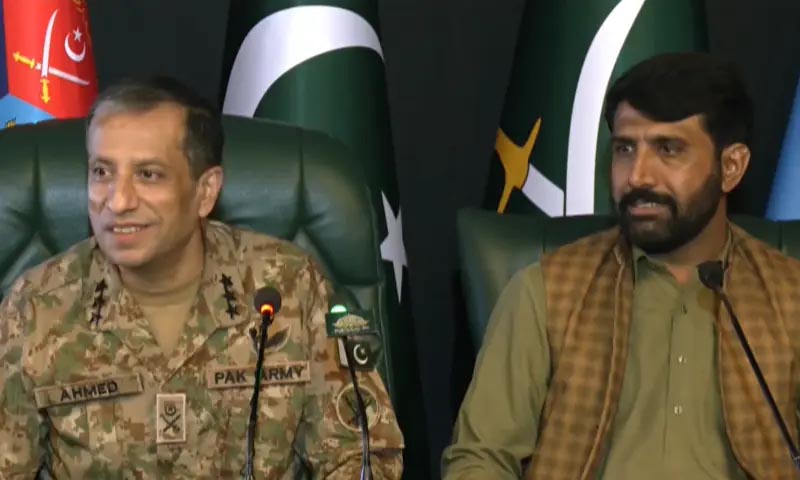
The latest press conference of Director General Inter-Services Public Relations (DG ISPR), Lieutenant General Ahmed Sharif Chaudhry, on October 1, 2026, has once again brought into focus the dangerous relationship between Pakistan and India. The central issue discussed was an Indian military claim regarding the alleged killing of a Pakistani national in Indian Illegally Occupied Jammu and Kashmir (IIOJK), followed by extensive reporting in Indian media linking the individual to terrorism and the Pakistan Army.
The significance of the episode goes far beyond the identity of one individual. At its heart lies a much more serious question: Can two nuclear-armed neighbours afford a media and political environment in which unverified allegations can rapidly become the basis for military confrontation?
Major Points of the DG ISPR Press Conference
According to Pakistani military authorities and reports of the press conference, the sequence began on September 29 when the Indian Army’s Chinar Corps announced a joint operation involving the Indian Army, Jammu and Kashmir Police and the Central Reserve Police Force in the Korag-Yousmarg area. Indian authorities initially stated that one alleged militant had been killed during an exchange of fire.
The following day, Indian military and media reports identified the alleged militant as Muhammad Asif alias Hashim Moosa, and subsequently associated him with the banned Lashkar-e-Taiba and the Pakistan Army. Indian media reports also claimed that he had previously served in Pakistan’s Special Services Group.
The DG ISPR challenged this narrative by presenting Muhammad Asif, a retired Pakistan Army havildar, alive before the media. Asif stated that he was at his home when reports appeared on social media claiming that he had been killed in Kashmir. He also said that he received calls from Indian numbers seeking personal information about him. He stated that he had joined the Pakistan Army in 2000, served in the SSG from 2005 and retired in 2023.
The DG ISPR argued that the changing sequence of identification and the subsequent circulation of the allegation demonstrated what he described as an Indian “false-flag” operation. This characterization is the Pakistani military’s allegation; India’s own official account and the underlying events should continue to be examined independently through verifiable evidence.
The episode also highlights the role of media. Reports by several Indian outlets repeated the alleged identity and background of the individual, while official Indian institutions were also reported to have repeated elements of the claim.
The Background of “False Operations” and Information Warfare
Relations between Pakistan and India have repeatedly been affected by allegations of terrorism, cross-border militancy and military involvement. The problem becomes particularly dangerous when an unverified allegation moves rapidly from social media to television channels, newspapers, government statements and eventually the political or military arena.
The May 2025 crisis provided a stark reminder of this danger. Following the Pahalgam attack, India and Pakistan entered their most serious military confrontation in years, with strikes occurring across the international border and Line of Control. Analysts have subsequently highlighted the escalation risks inherent in future crises between the two nuclear-armed states.
The lesson is clear: information can become a weapon in a crisis. A photograph, an anonymous intelligence source, an unverified identity or an emotionally charged television headline can create public pressure for retaliation before facts have been independently established.
This is why responsible journalism is particularly important in South Asia.
Recommendations to the Indian Government
India and Pakistan have serious and longstanding disputes. These cannot be solved overnight. But both countries have an overriding common interest: preventing another war.
First, no military or political action should be based solely on preliminary intelligence or media reports. Allegations involving terrorism should be subjected to transparent verification before official conclusions are announced.
Second, India should strengthen established military-to-military communication channels with Pakistan. Direct communication during a crisis can prevent misunderstandings and reduce the possibility that a tactical incident develops into a strategic confrontation.
Third, both countries should revive discussions on nuclear risk-reduction and confidence-building measures. Experts have specifically recommended renewed dialogue on nuclear confidence-building measures, including emergency communications and notification mechanisms.
Fourth, India should avoid allowing domestic political pressures to dictate foreign and security policy. Strong governments are not necessarily those that respond most quickly; sometimes strength is demonstrated through restraint, verification and responsible decision-making.
Finally, New Delhi should recognise that Pakistan is a nuclear-armed neighbour, not a problem that can be solved through military pressure alone. Dialogue, diplomacy and crisis-management mechanisms are essential.
Recommendations to the Indian Media
The Indian media also has an important responsibility.
Television channels should verify claims before broadcasting them as established facts. Anonymous “security sources” should not automatically become the basis of sensational headlines.
Second, media organisations should distinguish clearly between allegation, intelligence assessment and established fact.
Third, photographs and personal information of individuals should not be circulated without verification. In the present case, the appearance of Muhammad Asif before the media demonstrates the potential consequences of premature identification.
Fourth, Indian journalists should resist language that portrays every Pakistan-related security story as an opportunity for confrontation. Similarly, Pakistani media must exercise the same responsibility.
The media should compete for accuracy rather than sensationalism.
A Message for Both Nuclear Neighbours
Pakistan and India have fought several wars and experienced numerous military crises. They have also demonstrated, at different times, that dialogue and communication can prevent escalation.
Research on South Asian nuclear crises has warned about an “escalation cascade”, in which political, psychological, military and informational pressures reinforce one another.
The greatest danger today is therefore not merely a deliberate decision to start a war. It is the possibility that a chain of misinformation, misunderstanding, retaliation and counter-retaliation could push two nuclear powers towards a conflict neither actually intended.
The people of Pakistan and India deserve peace. They deserve development, employment, education, healthcare and prosperity—not another generation living under the shadow of war.
The latest DG ISPR press conference should therefore be viewed not simply through the prism of Pakistan-India propaganda battles. It should serve as a reminder to policymakers, military establishments and media organisations on both sides that truth must come before retaliation, verification before accusation, and dialogue before confrontation.
India and Pakistan may disagree on Kashmir, terrorism and numerous other issues. But there is one principle on which there should be no disagreement: another war between two nuclear neighbours would serve neither nation.
The wiser course is therefore to establish facts, control rhetoric, strengthen communication channels and keep the door to dialogue open.
In South Asia, restraint is not weakness. It is responsibility. And responsible leadership today means ensuring that the next crisis does not become the next war.