










http//: www.thenewslark.com
Dr. Syed Mehboob
Senior Research Editor
The News Lark, political and economic analyst
Indonesia is the largest Muslim country with a population of 290.125 million. Islam is a religion of peace, tolerance, and love, teaching the best way of life and covering all aspects of human life. Islamic economics is free of interest (Riba), free of economic injustice and oppression. It is the best solution to most of the modern economic problems.
The Indonesia Sharia Economic Festival (ISEF) is Indonesia’s largest annual Sharia economic forum and exhibition, organized by Bank Indonesia in collaboration with national institutions like KNESK since 2014. To develop and promote the national and global sharia economy, halal industry, Islamic MSMEs, Social Finance (ZISWAF), and financial literacy are its objectives.
It holds and organizes high-level international conferences, policy dialogues, trade exhibitions, modest fashion shows, halal culinary events, and sharia innovation competitions.
The Indonesia Sharia Economic Festival (ISEF) 2026 was organized on October 14 to 18th at the Jakarta International Convention Center (JICC) Senayan, Jakarta.
The sharia economy has emerged as a new source of economic growth, thereby unlocking blessings, equity and prosperity for all. In Eastern Indonesia (KTI), ongoing efforts to drive the sharia economy are being implemented in synergy with local communities, pesantren (Islamic boarding schools) as well as micro, small, and medium enterprises (MSMEs). The Sharia Economic Festival (FESyar) in Eastern Indonesia, spanning five days from 14th to 18thOctober2026, is providing momentum and synergy to all elements supporting the sharia economy in terms of strengthening stability and economic transformation in the region.
In his remarks presented at the closing ceremony by Regional Assistant 3, Alfian, the Deputy Governor of West Kalimantan, Krisantus Kurniawan, said: “This comprehensive initiative provides strategic momentum for grounding the values of the sharia economy, while unlocking various opportunities for local communities to become acquainted with and understand sharia economic development in more depth.” With diverse cultures co-existing in harmony, including the Dayak, Melayu, and Tionghoa peoples, alongside various other tribes, West Kalimantan offers a variety of authentic halal products. Starting with traditional cuisine based on halal principles, to Muslim-friendly tourism and fabrics that can be integrated into modest fashion. “This provides strong capital to establish West Kalimantan as a new hub of halal industry growth in Indonesia,” added Deputy Governor of West Kalimantan, Krisantus Kurniawan.
Head of the Sharia Economy and Finance Department of Bank Indonesia, Imam Hartono, reiterated that “The sharia economy not only offers an alternative but is also an integral part of the national development strategy.” The Sharia Economic Festivals (FESyar) are expected to reinforce this position. The series of activities showcased at FESyar KTI recorded a tangible contribution by generating sales transactions for halal products from 22 provinces in the KTI region. In fact, business matching MSMEs with sharia financial institutions led to Rp15.8 billion in financing. This flagship event also featured 16 Safe and Healthy Halal Culinary Zones (Zona KHAS) and facilitated halal certification for MSMEs throughout Eastern Indonesia.
West Kalimantan, specifically, has massive potential to develop halal products, including key commodities such as palm oil, rubber, coffee, aloe vera, and fish products, which can be processed further into value-added halal products. Access to international trade through the Entikong and Aruk border crossings unlocks compelling trade opportunities for halal product exports to Malaysia, Brunei and the ASEAN region, supported by Muslim-friendly tourism (MFT) showcasing the Islam-Melayu culture and featuring the iconic Kapuas River and Equator Monument.
More than 44,000 visitors attended the series of activities, including the Sharia Fair, Sharia Forum, and various competitions. The ‘Green Space x Plastic Pay’ collaboration was also presented at FESyar KTI 2025, which is an innovative concept of sustainability, recycling more than 4,200 plastic bottles and successfully reducing the carbon footprint by up to 450kg of carbon. In addition, FESyar KTI 2026 also hosted a Training of Trainers (ToT) event for 456 journalists covering the sharia economy to boost public literacy, coupled with the launch of the West Kalimantan Waqf Movement (Gerakan Kalbar Berwakaf), which aims to strengthen waqf as an instrument of socio-economic development.
In synergy with the National Islamic Economy and Finance Committee (KNEKS) and all strategic partners, Bank Indonesia will continue cross-sector collaboration to strengthen the halal value chain (HVC), nurture inclusive and adaptive Islamic finance, as well as increase sharia economic literacy and inclusion rooted in Islamic values to strengthen Indonesia’s position as a global hub of the sharia economy by 2029.
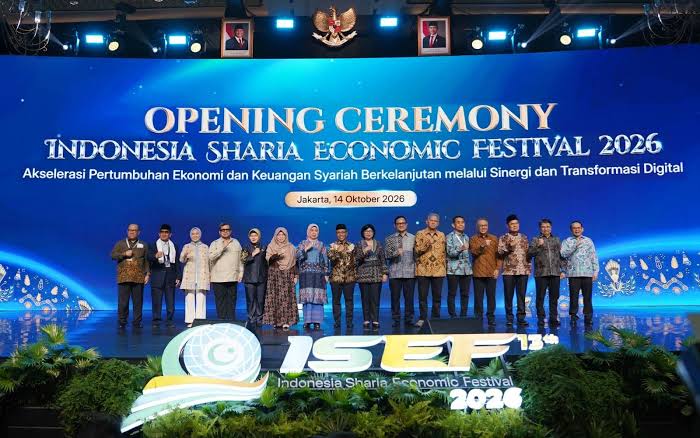
The 13th Indonesia Sharia Economic Festival (ISEF) 2026 officially opened on October 14 at the Jakarta International Convention Center (JICC). Running until October 18, the festival represents an important platform for Indonesia to strengthen its position in the global Islamic economy and finance landscape.
Yet beyond the scale and excitement of the event lies a more fundamental question: how far can this festival translate the potential of the Islamic economy into business opportunities, jobs, and improved public welfare?
ISEF 2026 carries the theme “Accelerating Sustainable Economic and Financial Growth through Synergy and Digital Transformation.” According to Bank Indonesia’s press release, this year’s event brings together more than 1,000 halal industry players and features over 100 activities. Business leaders, financial institutions, government agencies, academics, and international partners gather to explore opportunities across an increasingly interconnected ecosystem.
This scale reflects a broader reality: the Islamic economy is no longer confined to banking services or religious activities. It encompasses halal food, modest fashion, Muslim-friendly tourism, financing, zakat, waqf, and the digital economy. Together, these sectors offer opportunities to generate economic value, expand employment, and strengthen Indonesia’s competitiveness.
The potential is more than theoretical. According to the State of the Global Islamic Economy Report 2025/2026, Indonesia ranks fourth globally in the overall Islamic economy, holds the top position in modest fashion, and ranks third in halal food. These achievements provide a valuable foundation for Indonesia to expand its role in international markets.
Nevertheless, significant potential does not automatically translate into widespread prosperity. Having products that appeal to international consumers is one thing; consistently supplying those markets, meeting quality standards, maintaining competitive prices, and managing a sustainable business are entirely different challenges. This is where the real work begins.
ISEF can help bridge that gap. Through exhibitions, business-matching sessions, industry forums, and financing discussions, businesses have opportunities to meet prospective buyers, identify partners, and access funding. Its collaboration with Trade Expo Indonesia 2026 also creates opportunities to connect Islamic economy promotion with broader trade activities.
Consider a small business producing halal food. A product previously sold only within its local community may gain access to buyers in other regions or even international markets. Yet meeting a prospective buyer is only the first step. The business still needs mentoring, appropriate certification, production standards, financing access, and the capacity to fulfill orders reliably.
For this reason, ISEF’s success should not be measured solely by visitor numbers or the value of transactions announced during the event. More meaningful indicators include whether business agreements are fulfilled, whether financing increases productive capacity, and whether participating enterprises continue to grow after the festival ends.( Continued )