

















Dr. Syed Mehboob
Political and Economic Analyst
http//:www.thenewslark.com
drmehboob.thenewslark@gmail.com
China’s now famous investment in infrastructure — it currently has the world’s largest expressway network, in addition to the largest high-speed rail network — reduced logistical costs and facilitated domestic and international trade. The expansion of telecommunications infrastructure supported the burgeoning digital economy and enhanced overall connectivity within the country: China now boasts more than 4.25 million 5G base stations, compared to less than 150,000 in the United States.
Reforming state-owned enterprises was another critical component of China’s economic strategy. Gradual restructuring and partial privatization of SOEs, including the deliberate creation of competitors in key sectors like petroleum and telecoms, aimed to improve efficiency and competitiveness, allowing for a more dynamic industrial sector. Major Chinese SOEs even tapped into leading capital markets in the U.S., improving their corporate governance, becoming more transparent, and streamlining their operations to appeal to overseas investors. On balance, this whole process was managed well, resolving the tension between the benefits of market mechanisms and the need to maintain social stability.
Despite the continuing importance of the state sector, by the mid-1990s — even before China acceded to the WTO in 2001 — job growth was coming primarily from the private sector. For three decades, urbanization brought large-scale migration from rural areas to China’s cities, providing a steady tailwind of relatively inexpensive labour. At the same time, a substantial middle class fueled domestic consumption, creating a significant internal market for goods and services. This was especially true after 1998. In that year, the implementation of housing reform policies initiated by then-Premier Zhu Rongji made the purchase of state-owned housing by residents at steeply discounted prices not only possible but ubiquitous. A commercial housing market came into being almost overnight and became the source of considerable urban wealth.
China’s integration into the global economy was facilitated by geopolitical shifts following the Cold War and broader trends in globalization. A long period of interstate peace in the region, now exceeding 40 years, the creation of both bilateral and multilateral free trade agreements, and China’s push to join the WTO in 2001 significantly boosted China’s trade and investment flows, further embedding it into global supply chains.
Though difficult to quantify, it’s hard to ignore cultural factors: a strong work ethic and the influence of Confucian values emphasizing education and social harmony have contributed to China’s economic success.
When it came to education, Beijing put its money where its cultural predilections already were. China’s massive investments in human capital development proved instrumental in sustaining its growth. Significant investments in post-secondary education and vocational training created a more skilled and versatile workforce.
China’s rapid adoption of digital technologies positioned it at the forefront of the digital economy early on. Beginning in 1997, with the internet still in its infancy in China, a wave of tech entrepreneurs, including many returnees from the U.S., founded companies that, within just a decade, would become some of the world’s biggest tech companies, broadening the information horizons of ordinary Chinese people, transforming the retail landscape, and driving further innovation. The widespread use of mobile payments and the rise of e-commerce giants like Alibaba catapulted China to the forefront of digital commerce.
In parallel to the private sector-led growth of the consumer internet, the Chinese state recognized the transformative potential of technology and pushed enterprises to embrace tech.
Through campaigns for“ information “beginning in the early 2000s and for “Internet Plus” a decade later, Beijing incentivized businesses to embrace technologies. By the mid-2010s, foreign visitors to Chinese cities began remarking frequently on the hypermodern feel of the consumer experience in China.Meanwhile, through subsidies and the unambiguous telegraphing of its priorities to scientists, researchers, local officials, and entrepreneurs alike, the Chinese state signaled which specific technologies it identified as key: AI, advanced robotics, new equipment, advanced semiconductors, next-generation telecommunications standards, electric vehicles, photovoltaics, and wind energy, to name a few.The Chinese leadership under Xi Jinping has as its current focus the development of “ New Quality Productive Forces (NQPF). What this means is that innovation will, it is hoped, become the main driver of growth, with an emphasis on quality growth over quantity or rapid expansion. This translates more concretely into a renewed emphasis on basic science, “hard” tech like new materials and semiconductors, artificial intelligence, supply chain efficiency and rationalization, and green and sustainable development.
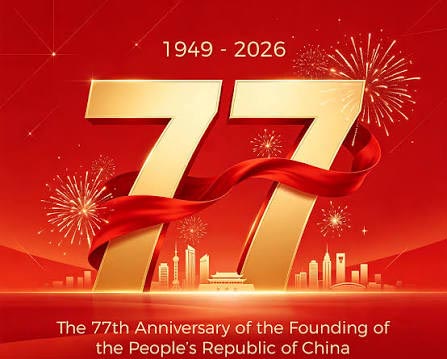
Xi Jinping would like to see physicists doing physics, not designing sophisticated financial products or social media advertising algorithms. Whether these strategies will succeed in navigating China through its next phase of development remains an open question, but if China’s record is any indication, one might reconsider betting against it.Other developing countries might look to China’s experience for lessons, but the unique combination of historical context, cultural factors, and policy decisions that shaped China’s rise may not be easily replicable. When its own rhetoric speaks so often of “Chinese characteristics,” it may be less likely that China will seek to push its own developmental model, though doubtless some of its features will prove attractive. China has transformed over 77 years from a poverty-stricken nation into the world’s second-largest economy and a global leader in modern development, innovation, and poverty reduction.
Established in 1949 under Mao Zedong, ending a century of foreign aggression, civil strife, and extreme economic hardship. Basic caloric intake, literacy rates, gross industrial output, and average life expectancy saw substantial early improvements. Deng Xiaoping’s Vision, iInitiated historic economic reforms and opening-up policies starting in 1978, shifting toward a socialist market economy.
China is the role model for developing countries. Today, China stands at the forefront in terms of economic development, poverty alleviation, stability, science and technology, quality education, human development, artificial intelligence, and global connectivity. However, seventy-six years ago, it was a poverty-ridden country. It was a journey from absolute poverty, marked by hardship, fighting against foreign aggression, addressing internal problems, learning from the outside world, and embracing commitment, hard work, dedication, concentration, and sincerity in leadership and meritocracy. This transformation turned China from a poverty-ridden nation to a developed, dignified nation and a world power.The study of any country’s economic system cannot be separated from its history, origin, culture, values, philosophy, and ideology. What China achieved in forty years, from 1980 to 2020, is astonishing, as a similar achievement was made by Europe in four centuries. The West had done it by discovering two continents, massacring two hundred million aboriginals and natives, and colonizing large regions in the world. The Chinese did it without wars, loot, bloodshed, invasion, and plunder, without the discovery of vast oil and gas resources, with IMF policy advice or World Bank assistance.
In the year of revolution, 1949, China was the largest underdeveloped nation in the world. Its first three decades, from 1949 to 1979, were under strict Marxist-Leninist centralized planned economic management, and it achieved a great degree of social sector development. Before the two opium Wars, China accounted for thirty-four percent of global GDP. These opium wars were launched jointly by the British and French forces from 1840 to 1860 to force China to import opium and open up its coastal cities for trade to address a burgeoning trade deficit. China was subjected to a coalition of eight nations in 1901, resulting in pillage, loot, and plunder of the capital city of Beijing. (Continue)