













Sarang Munir Soomro
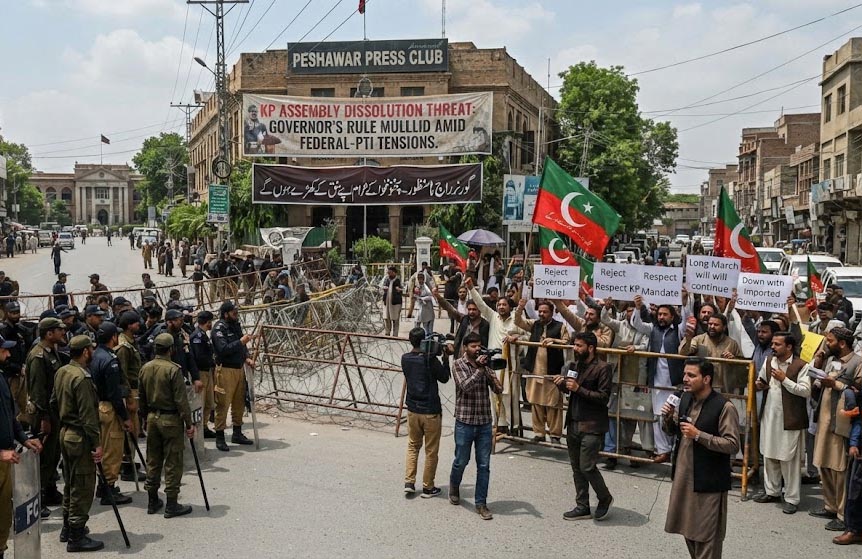
Over the past few days, tensions between the federal government and the PTI have intensified further. After the federal government sealed off Islamabad because the PTI refused to completely abandon its plan for a long march, another unusual prescription has now emerged: the federal government may impose Governor’s Rule or an emergency in Khyber Pakhtunkhwa.
Earlier, there had been discussions about disqualifying the Chief Minister of Khyber Pakhtunkhwa. However, moving away from that option, the federal government is now considering the imposition of an emergency or Governor’s Rule in the province, and serious consultations are reportedly underway.
A few days ago, two federal ministers said that the government was seriously considering imposing Governor’s Rule or an emergency in Khyber Pakhtunkhwa. Now, the matter appears to be receiving even greater attention.
According to sources, Prime Minister Shehbaz Sharif is expected to meet the President today regarding the Khyber Pakhtunkhwa situation. The meeting is expected to consider, in light of Articles 233 and 234 of the Constitution, whether Governor’s Rule or an emergency should be imposed in the province.
Media reports have also emerged regarding an important meeting between Prime Minister Shehbaz Sharif and Interior Minister Mohsin Naqvi. According to sources, following the Prime Minister’s return to the country, Mohsin Naqvi briefed him in detail on the current situation in Khyber Pakhtunkhwa and also informed him about the constitutional and legal issues relating to the province. Various legal and constitutional options for controlling the situation were reportedly discussed.
According to sources, Prime Minister Shehbaz Sharif has decided to take the government’s coalition partners into confidence before making any decision regarding Khyber Pakhtunkhwa. It has also been decided to take President Asif Ali Zardari into confidence on the matter.
A well-known YouTuber had also claimed the previous day that an important meeting had taken place between Mohsin Naqvi and President Zardari, during which Naqvi had failed to bring the President on board. The YouTuber further claimed in his vlog that President Zardari had clearly refused to support the imposition of an emergency or Governor’s Rule in Khyber Pakhtunkhwa.
Here, it is also important to remember that one possible reason for President Zardari’s reported refusal is that the Pakistan Peoples Party does not want to become part of a course of action that could create an undesirable political path with the PTI. At present, the PPP’s relationship with the Pakistan Muslim League-Nawaz is also passing through a somewhat sensitive phase.
In such circumstances, the PPP may also believe that if it supports an emergency in Khyber Pakhtunkhwa, the process could move further and the issue of Sindh could eventually emerge as well—something that would be extremely difficult for the PPP to tolerate.
Nevertheless, if the federal government wants to proceed, many things may be possible. Even so, taking the PPP into confidence is important because confronting the PTI while simultaneously failing to maintain a stable political relationship with the PPP could create difficulties for the government in the future. This is why the PPP remains important in this equation, and its position may be acceptable to the federal government to some extent. Otherwise, the political importance of the PPP itself could be affected.
Where political tolerance has become increasingly difficult to find and where the question of patience hardly arises, such stages repeatedly emerge in which little is achieved beyond political retaliation.
The point to consider is that where political differences exist, sitting together and resolving those differences through negotiations and dialogue is the beauty of politics. It must also be understood that resolving disagreements through dialogue is the essence of democracy. If so, then how can pushing all these matters forward through force be called democracy?
If we look at the past, the PTI has also been part of such an era and mindset. During its time in power, it too violated and distorted several democratic and ethical principles under the influence of power. Now, there appears to be a repetition of that same era.
However, viewed overall, the repeated return of such practices during a democratic period only strengthens a form of politics in which no politician’s democratic and moral credibility can remain intact.
The federal government could have been described as genuinely democratic if it had kept Islamabad open for dialogue and political engagement instead of blocking it with containers. The federal government would have demonstrated a commitment to democracy if, instead of threats of emergency and Governor’s Rule, it had sent the PTI a message of dialogue.
In such a situation, the PTI should also act with restraint and wisdom. It should respond to every dispute and controversial statement with political reconciliation and prudence. Such political wisdom is what can still save and improve the country.
The country is currently standing at a critical point, where any display of political recklessness could prove dangerous. Pakistan is already surrounded by the burden of debt, while peace and security across the country remain a matter of concern. Alongside this, a serious administrative and governance crisis has become a longstanding problem.
The deteriorating situation in Balochistan, rising terrorism in Khyber Pakhtunkhwa, the lack of trust between the federation and the provinces, and the mutual blaming for failures are all contributing to a situation in which tension between state institutions and elected governments, rather than coordination, is creating another serious risk for the country.
In such circumstances, this rare prescription of running the train of democracy on the tracks of Governor’s Rule and emergency, in my view, could ultimately prove to be a disastrous prescription—one that no politically wise doctor may be able to cure.
Political faces may continue waiting for the return of a democratic era, gradually losing their strength in the process. Democracy, after all, is supposed to provide a means for resolving political problems. Yet, unfortunately, we have repeatedly failed to find the courage to use democracy itself as the solution.