





















By Brig Syed Karrar Hussain Retired
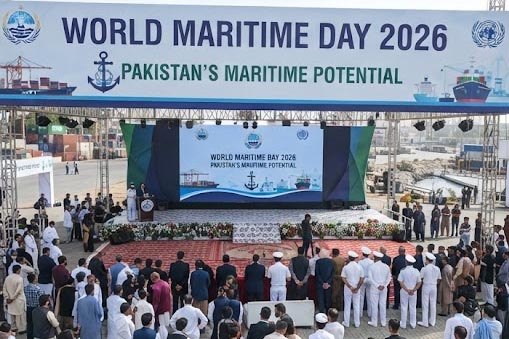
Every year, the maritime community observes World Maritime Day on the final Thursday of September. This year, the day falls on 24 September 2026, with the theme “From Policy to Practice: Powering Maritime Excellence.” The theme carries particular significance for developing maritime nations such as Pakistan, where geography, ports, shipping, coastal resources and maritime trade can play a much greater role in national economic development.
World Maritime Day is an official United Nations observance associated with the International Maritime Organization (IMO). The day provides an opportunity to highlight the importance of shipping, maritime safety and security, protection of the marine environment, seafarers’ welfare and the contribution of maritime transport to international trade. The IMO was established through a convention adopted in Geneva in 1948, which entered into force in 1958. World Maritime Day itself was conceived in 1978 to create greater awareness of the IMO’s work and the importance of the maritime sector.
The importance of shipping to the world economy cannot be overstated. According to the United Nations and IMO, at least 80 percent of international trade moves by sea. Food, fuel, machinery, industrial raw materials, automobiles, fertilizers, energy products and countless other commodities depend upon maritime transport. Any disruption to major shipping routes can therefore affect not only ports and shipping companies but also industries, consumers and national economies.
From Policy to Practice
The 2026 World Maritime Day theme is particularly relevant because international maritime regulations can achieve their objectives only when they are effectively implemented at the national and operational levels. IMO has emphasized that international standards must be translated into national legislation, effective enforcement, professional training, modern infrastructure and safe day-to-day maritime operations.
For Pakistan, this message should be understood as an opportunity rather than merely an annual observance. Pakistan possesses a strategically important coastline along the Arabian Sea and sits close to some of the world’s busiest maritime trade routes. Its geographical location gives it the potential to serve not only its own economy but also regional markets, including Central Asia, Afghanistan and western China.
Pakistan’s Maritime Gateway
Pakistan’s principal commercial ports are Karachi Port, Port Qasim and Gwadar Port.
Karachi Port is Pakistan’s historic maritime gateway and remains central to the country’s commercial activity. Its location within Karachi provides access to the country’s largest commercial and industrial centre. However, the rapid expansion of Karachi city has also created challenges involving road congestion, urban development, environmental pressures and the movement of cargo between the port and inland markets.
Port Qasim, located near Karachi, has developed into a major multipurpose port and an important industrial and energy gateway. It handles a broad range of commodities, including coal, petroleum products, edible oil, grain, cement, fertilizers, containers and LNG. The Ministry of Maritime Affairs describes Port Qasim as an important energy and industrial hub, with direct connections to national road and railway networks.
Gwadar Port represents Pakistan’s longer-term strategic maritime opportunity. Located on the Arabian Sea in Balochistan, Gwadar is positioned close to the approaches to the Persian Gulf and important international shipping routes. The Gwadar Port Authority describes the port as a potential gateway for Pakistan and the wider region, with opportunities in transit trade, transshipment and connectivity with Central Asia, Afghanistan and western China.
These three ports should not be viewed merely as separate cargo-handling facilities. They should be developed as components of an integrated national maritime and logistics network.
Why Maritime Development Matters to Pakistan
Pakistan’s maritime sector has implications far beyond the ports themselves. Efficient maritime transport directly affects the cost of imports and exports. A competitive port system can reduce logistics costs, improve the competitiveness of Pakistani products and make the country more attractive to international investors.
Pakistan’s textile, rice, sports goods, surgical instruments, leather, agricultural and manufactured-product exports ultimately depend upon reliable international transportation. Similarly, Pakistan imports petroleum, machinery, industrial raw materials, chemicals, energy products and other essential commodities through maritime routes.
A stronger maritime sector can therefore contribute to export growth, industrial development, employment generation, foreign-exchange earnings and regional connectivity.
The Ministry of Maritime Affairs itself has articulated a vision of positioning Pakistan as a leading maritime nation and regional transshipment hub through modern ports, efficient logistics, improved hinterland connectivity, transit trade, transshipment, sustainable development and protection of marine ecosystems.
The Missing Link: A Stronger National Shipping Industry
One of Pakistan’s major challenges is that developing ports alone is not sufficient. Pakistan also needs a stronger national merchant shipping capability.
A vibrant national shipping industry can retain a greater share of freight expenditure within the country, create employment for Pakistani seafarers, develop maritime expertise and strengthen national economic resilience. Pakistan National Shipping Corporation and private-sector shipping companies can play a greater role if supported by predictable policies, competitive financing and an investment-friendly regulatory environment.
The government should therefore encourage investment in modern merchant vessels, container shipping, bulk carriers, tankers and specialized vessels. Long-term financing mechanisms, reasonable taxation and simplified regulatory procedures can encourage both domestic and foreign investors.
Digitalisation and Modern Ports
The future of maritime trade is increasingly digital. Pakistan’s ports should move towards integrated digital platforms connecting customs, port authorities, shipping lines, terminal operators, freight forwarders, banks and other stakeholders.
Paperless documentation, electronic cargo clearance, automated gate systems, vessel traffic management, artificial intelligence, data analytics and cybersecurity can significantly reduce delays and improve transparency.
The objective should be simple: a ship should spend the minimum possible time waiting at anchorage or in port.
Developing Human Resources
No maritime strategy can succeed without skilled people. Pakistan should invest substantially in maritime education and professional training. The Pakistan Marine Academy and other maritime institutions should be strengthened, while universities and technical institutions should develop programmes in naval architecture, marine engineering, logistics, port management, maritime law, cybersecurity and environmental sciences.
Pakistani seafarers have the potential to become an important source of employment and foreign exchange. Their international certification, training and welfare should remain a national priority.
Recommendations for Pakistan and International Shipping Companies
Pakistan should adopt a long-term National Maritime Development Strategy with measurable targets for ports, shipping, shipbuilding, ship recycling, logistics, maritime education, fisheries, coastal tourism and the Blue Economy.
First, port infrastructure should be modernized and port-hinterland connectivity through roads and railways substantially improved.
Second, Pakistan should create a genuinely competitive environment for domestic and international shipping companies through transparent regulations, predictable taxation and faster administrative procedures.
Third, Gwadar should be developed in parallel with Karachi and Port Qasim rather than in competition with them. Each port can specialize according to its geographical and commercial advantages.
Fourth, Pakistan should promote transshipment and transit trade by offering efficient services to Central Asian states, Afghanistan and western China.
Fifth, maritime security and cybersecurity must remain priorities. International shipping companies need confidence that their vessels, cargoes and crews can operate safely.
Sixth, environmental standards should be implemented in line with IMO requirements. Cleaner fuels, renewable energy, waste management, pollution control and environmentally responsible port operations should become integral components of maritime development.
Finally, international shipping companies should be encouraged to treat Pakistan not merely as a cargo destination but as a long-term maritime partner. Greater investment in terminals, logistics, training, ship services and technology can create mutual economic benefits.
Conclusion
World Maritime Day 2026 provides Pakistan with an important opportunity to look towards the sea with a new economic vision. The country’s coastline is not simply a geographical boundary; it is a potential gateway to international commerce.
The theme “From Policy to Practice: Powering Maritime Excellence” should inspire Pakistan to transform maritime policies into measurable results—faster ports, efficient shipping, skilled seafarers, stronger maritime security, cleaner seas and better connectivity.
Pakistan has the geography, ports and strategic location required to become an important maritime nation. What is required now is sustained implementation, institutional coordination, private-sector participation and long-term national commitment.
The future of Pakistan’s maritime economy should not be measured only by the number of ships entering its ports. It should be measured by how effectively those ships connect Pakistani industry with the world, how many jobs and opportunities they create, how much foreign exchange they generate, and how successfully Pakistan converts its geographical advantage into sustainable economic strength.
On World Maritime Day 2026, the message for Pakistan is therefore clear: the time has come to move from maritime potential to maritime performance—from policy to practice.