


















Dr.Syed Mehboob
Political and Economic Analyst
http//: www.thenewslark.com
email: drmehboob.thenewslark@gmail.com
Peace is the desire of many countries, but maintaining peace is very difficult. This we have seen in Gaza, where more than 70,000 Palestinians were killed by Israel, and among these 50,000 are children. All international institutions failed to put pressure on Israel to stop the genocide. So every nation has to make necessary arrangements to defend against an aggressor. Turkiye is self-sufficient in defence, and it achieved an important milestone in its journey from a client/purchaser of defence technology to exporter.
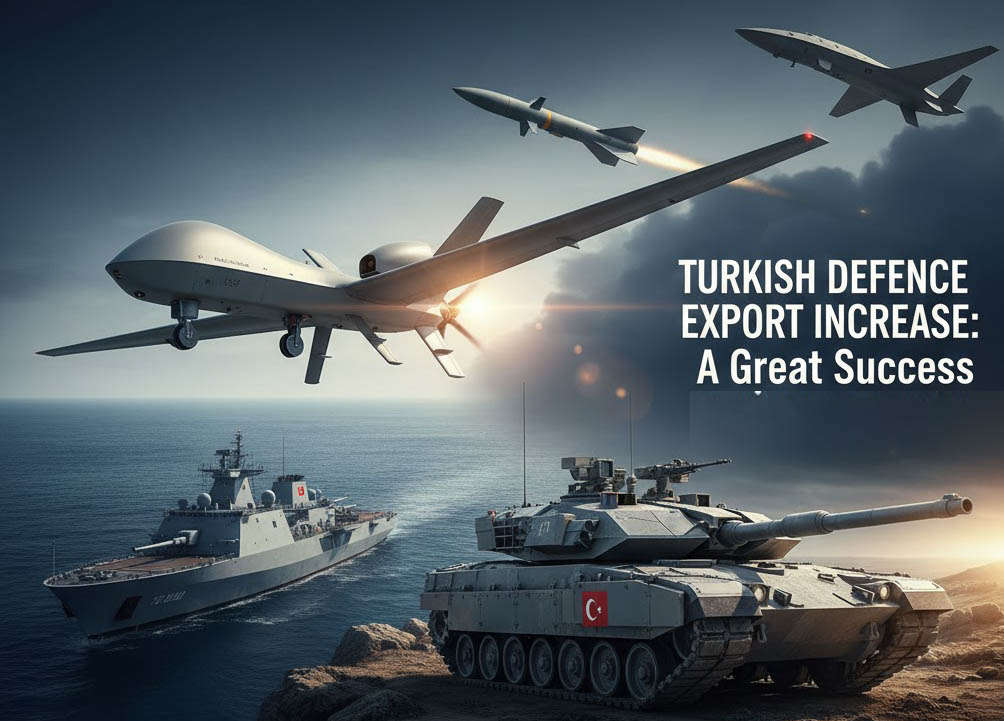
Year 2025 was a very successful one for the Turkish defence industry as Turkiye’s defence and aerospace exports reached a record high of over US$ 10 billion in 2025, marking a 48% increase from the previous year, driven by high demand for drones, armed vehicles, and, increasingly, naval platforms. Key export markets include the US, Europe, and Asia Pacific, with major contracts for KAAN jets and HURJET trainers contributing to this growth.
| Year | Defence exports US$ billion |
| 2024 | 7.1 |
| 2025 | 10.56 |
The surge is driven by high-value-added products, including Baykar’s UAVs, which generated US$1.8 billion in 2024, alongside bombs, missiles, and marine vessels. A significant portion of 2025 exports, about US$5.6 billion, went to the EU, NATO countries, and the US, including significant deals with Spain and Romania. US$ 10.56 billion is the biggest amount ever recorded by the defence sector. President Erdogan said the latest figures confirmed that Türkiye has transformed into a globally competitive defence supplier. Referring to recent developments, he highlighted the HÜRJET procurement agreement signed with Spain as a concrete example of Türkiye’s growing footprint in advanced aviation programmes.
Turkish defence exports were only US$ 248 million in 2002, which surged to US$10.56 billion in 2025, an increase of 4,161 %. This shows that brother country Turkiye entered a new phase in defence exports, and it is now among the countries capable of sustaining double-digit billion-dollar defence exports. In 2025, it further received orders of US$ 17.8 billion worth of new sales. In 2025, its defence exports increased 49%, while it is expected it will further increase 80% on 2026. It is interesting to note that in 2025, 56 percent of Turkiye’s defence and aerospace exports were delivered to the European Union, NATO countries, and the United States of America. Turkiye achieved the last ten years with the world’s highest export growth rates and achieved an average export turnover per capita of US$ 100,000. Turkiye’s Defence Industries Secretariat (SSB) organized 485 international activities in 2025, held 401 bilateral meetings with 94 countries, 17 defence industry meetings, attended 22 global events, carried out some 17 multinational activities, and held 21 industry days. They accompanied Turkish President Recep Tayyip Erdogan on seven overseas visits.
Turkish defence and aerospace exports accounted for 3.6% of its total exports, rising from 1.7% in 2022. Some 185 companies of Turkiye exporter over US$ 1 million. Some fifty five Turkish provinces made defence and aerospace exports last year.
Turkish AselsanElektronik shares have risen 264% in value over the year, while the benchmark of the Turkish market, the BIST 100 index, is up about 45%. In 2025, Aselsan became the first Turkish company whose market capitalization surpassed the one trillion Turkish Lira, about US$ 30 billion mark.
Global military expenditure surpassed US$ 2,800 billion. In the defence sector, fifteen leading countries, including Turkey, in terms of military power and capability, are caught between coordinating, transitioning, and adapting to conventional army structures, conventional weapons, ammunition, and platforms; new-generation irregular warfare techniques; new-generation warfare technologies and strategies; and artificial intelligence-focused new-generation weapons, ammunition, and platforms. They are struggling to train sufficient high-quality personnel and manage costs effectively. The United States’ defence spending, which has reached $1 trillion, is now straining the federal budget.
In the last five years, the concept of warfare has changed radically. With drones, land, sea, and submarine platforms are no longer just reconnaissance or surveillance tools, but have become strategic elements with direct attack capabilities. The Russia-Ukraine War has proven on the ground how low-cost but deadly unmanned systems can upset the balance on the front lines. The 2020 Azerbaijan–Armenia Karabakh War demonstrated that UAVs could alter the course of ground warfare without the need for air superiority, opening the door to a new doctrine. This change in warfare techniques on the battlefield heralds an era described internationally as ‘lethal transparency.’ New-generation electronic warfare systems, artificial intelligence-supported swarm algorithms, and layered air defence networks have now become integral components of the new generation battlefield.
Baykar’s TB2 and Akıncı models have successfully served in Syria, Libya, and Karabakh, and have become symbols against the Russian army in Ukraine. The TB3’s ability to take off and land from the TCG Anadolu has propelled Turkey into the drone carrier concept and placed it at the forefront of sea-air integration. Unmanned combat aircraft projects such as Kızılelma and ANKA-3 also enable manned and unmanned air assets to converge under the same doctrine.In addition, the process of building short, medium and long-range air defense layers with domestic capabilities under the HİSAR and SİPER programs and the Steel Dome project is being followed with admiration by many of Turkey’s allies and is also facilitating the signing of successive long-term defense technology and security cooperation agreements between Turkey and these allies. The GÖKDENİZ close-range air defence system, TF-2000 air defense frigates and the naval drones under development also reinforce the ‘system of systems’ vision in terms of Turkey’s new generation warfare doctrine and strategy.
In a context where the emerging E7 economies are accelerating strategic cooperation and wide-ranging joint project steps to deepen their economic, commercial, political and military cooperation with Turkey without exception, the President’s fair, strong and determined stance, which reinforces the perception of a ‘Strong Turkey’, is causing the messages he has delivered and will deliver at all international meetings to be followed with great interest by the international public.
Therefore, under the visionary leadership of the Turkish President, the giant strides taken over the past 20 years in the fields of defense, security, energy and digital technologies, along with capabilities and capacities that have elevated the Turkish Armed Forces to among the world’s strongest armies, enable a strong Turkey to stand up for its own geography and the oppressed, to hold those responsible to account, and to manage a strong diplomatic process both on the ground and at the negotiating table. Under President Erdogan’s strong, determined and visionary leadership, Turkey has assumed the role of a ‘game changer’ that is reshaping the destiny of Eurasia. A strong Turkey also forms the essence of the Vision for the Turkish Century.