














Dr.Syed Mehboob
Senior Research Editor
The News Lark, political and economic analyst
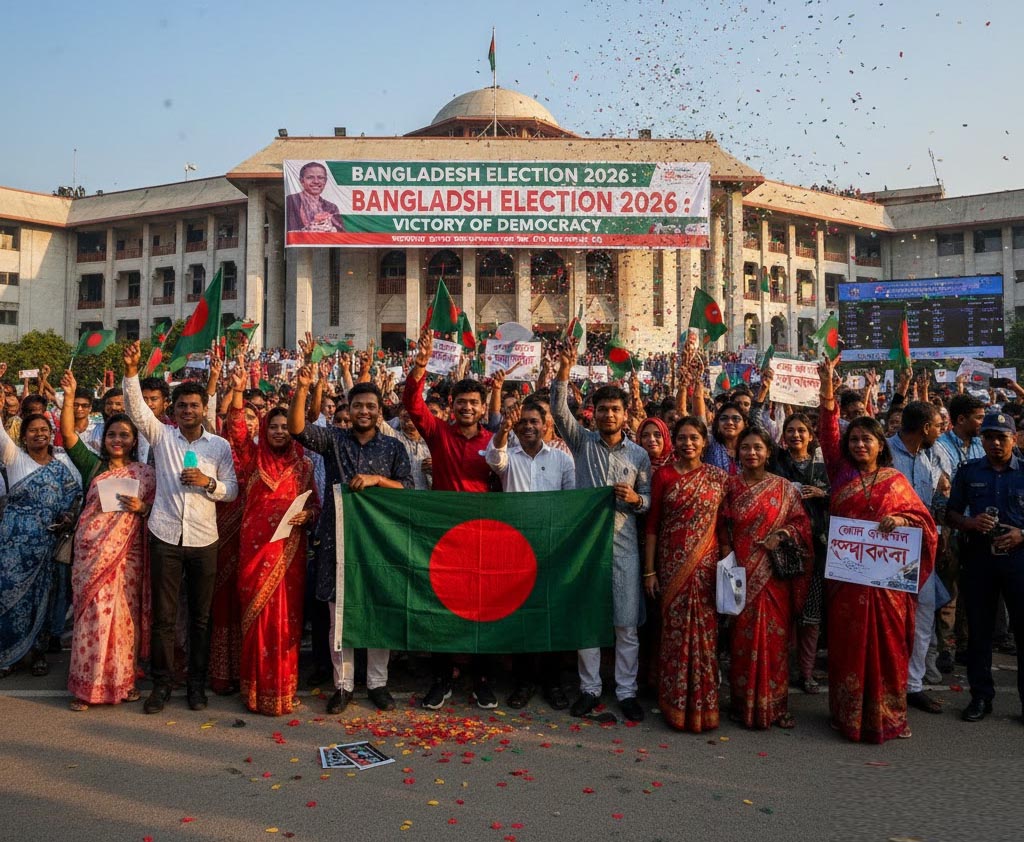
12th February 2026 was an important and historical day when the people of Bangladesh exhibited their right to choose their future representatives. It was a victory of democracy, democratic norms, and values. Elections were held in a peaceful atmosphere, and no major incidence of violence was reported. It was the first election after the July Revolution that ended the 15-year-long rule of Sheikh Hasina. The election was the most transparent and widely accepted by people, the national and international media, and both the number one and number two parties. The Bangladesh Nationalist Party (BNP), led by Tarique Rehman, won a landslide victory in the election, securing two-thirds of the seats. Bangladesh Jamaat-e-Islami secured the second most seats. A constitutional reform referendum on the July Charter was also held alongside the election.
About one hundred and twenty-seven registered voters were eligible to cast their votes in favor of their favorite candidates. About 2,028 candidates contested for two hundred and ninety-nine seats in the election. The election was considered as the world’s first “ Gen-Z inspired election.
It is interesting to note that Election 2024 was won by the Awami League, which major opposition parties boycotted, and the turnout was a record low, while Election 2026 had the highest ever turnout of 60%. On 17th November 2025, the International Crimes Tribunal ruled that Hasina and her co-defendants were guilty of war crimes and sentenced her, along with former home minister Asaduzzaman Khan Kamal, to death. Begum Khalida Zia, former Bangladesh Prime Minister, a popular leader, died on 30 December 2025.
| Total registered votes | Male | Female |
| 127.69 million | 64.841 million | 62.897 million |
Party |
% vote |
BNP |
49.63 |
Jamaat e Islami |
31.97 |
National Citizen Party |
3.07 |
Bangladesh Nationalist Party claims that it wanted to build a tolerant, humane, peaceful, people-welfare-oriented, social and economic-driven democratic and prosperous society, ensuring the participatory role of people belonging to all faiths and ethnic nationalities. BNP has complied with Vision 20230 to achieve the objectives of making Bangladesh a happy, prosperous, modern, and self-respecting nation through uprooting the obstacles that thwart people’s genius, effort, enthusiasm, and initiative. BNP also claims to bring an end to political and social divisions in the country by uniting the spirit of Bangladesh Nationalism. It further claims to ensure democracy, good governance and economic transparency.
BNP also promised that the armed forces shall be modernized, trained, and organizationally reinforced and equipped with cutting-edge technology, advanced armaments, and imbued with the supreme spirit of patriotism. Civil and military relations will be so designed to be compatible with democratic dispensation. The Armed Forces shall be appropriately developed and expanded. Participation of the defense in the national developmental activities and international peacekeeping will be encouraged.
Regarding foreign policy, BNP claims to be firmly committed to upholding the independence, sovereignty, and dignity of Bangladesh. BNP promised not to interfere in the internal affairs of any other country, nor to create any security threat to any other country. BNP also committed that strong resistance will be made if any other country interferes into internal affairs of Bangladesh and poses any threat to the state security of Bangladesh. BNP believes that across the border, Bangladesh has friends and no master.
Regarding economic policy, BNP wants to transform Bangladesh by 2030 into a modern and democratic high-middle-income country and, within this period, plans to increase per capita income to US$ 5,000.
Mr. Tarique Rehamn has taken oath as the new Bangladeshi Prime Minister. Mr. Tarique was born in November 1965 in Lahore. After completing his initial studies at Dhaka’s BAF Shaheen College, he enrolled in the Department of International Relations of the University of Dhaka in the 1980s. In the University, he read the political thoughts of Socrates, Plato, Aristotle, Hobbes, Locke, Rousseau, Voltaire, Karl Marx, and other exceptional thinkers.
Before the 2001 election, Mr. Rahman established an office in Dhaka to do studies on local-level problems and good governance. He also held discussions with intellectuals and civil society members there. Thanks to his efforts, the BNP won a landslide victory in the 2001 elections. Despite being the chairperson’s son and receiving widespread support from the grassroots, he did not assume any public office by nepotism and concentrated on empowering the party’s grassroots by bridging the gap between their representatives and the people. As a recognition of his efforts to build the party, he was appointed as the Senior Joint Secretary of BNP by the Standing Committee in 2002.
In 2005, Mr. Rahman convened a countrywide grassroots forum that included every upazila or sub-district in Bangladesh. He visited every sub-district, addressed grassroots leaders and activists, held one-on-one conversations with locals, offered his opinions and listened to supporters’ feedback, and preached the BNP’s vision to the people. He informed people about government subsidies for farmers, allowances for the elderly, the anti-plastic bag movement to maintain ecological balance, and the distribution of stipends for female students, which greatly raised the gender ratio in schools. He personally signed at least 18,000 response letters to conference registrants. These response letters addressed regional issues and proposed possible solutions.
He was elected Senior Vice-Chairman of the BNP in 2009 and gradually became involved in the BNP’s reorganization. In 2018, when his mother, the former three-time Prime Minister, Begum Khaleda Zia, was imprisoned under false charges, he was nominated as the Acting Chairman of the party. He has been leading the pro-democracy movement against autocratic Sheikh Hasina since then.
After a painful 17 years in exile, the historic return to Bangladesh of Mr. Tarique Rahman, Acting Chairman of the Bangladesh Nationalist Party (BNP). Following the passing of Honorable Chairperson Deshnetri Begum Khaleda Zia, and in accordance with the Constitution of Bangladesh Nationalist Party-BNP, the Party’s Acting Chairman, Mr. Tarique Rahman, assumed the duties of Party Chairman.
In 1994, Tarique Rahman married Dr Zubaida Rahman, the daughter of the former Bangladesh Navy chief and a two-time minister in subsequent governments, Late Rear Admiral Mahbub Ali Khan. Zubaida Rahman is a qualified cardiologist by training and studied at Dhaka Medical College. They have a daughter named Zaima Zarnaz Rahman.
Bangladesh Jamaat e Islami, led by Shafiq ur Rehman, emerged as the second-largest party in Bangladesh. Mr. Shafiq ur Rehman was born on 31st October 1958. He has been leading Jamaat since 2019. Shafiq ur Rehman got involved in politics in student life by affiliating with the JaSaD Chhatra League in 1973, followed by the Bangladesh Islami Chhatra Shibir in 1977. After graduation, he joined the Sylhet District unit of the Jamaat-e-Islami party in 1984. Following ATM Azharul Islam’s detention in 2011, he became the acting secretary-general of the party. In 2019, he was elected as the ameer of the party.
Shafiq ur Rahman is known for his moderate position as a leader of an Islamic party.Rahman passed SSC from Baramachal High School in 1974, and then he passed HSC from Murari Chand College in Sylhet in 1976. He got an MBBS degree from Sylhet MAG Osmani Medical College in 1983.Political career.
People of Pakistan wish the best of luck to Bangladesh and its people. I, as the Senior Research Editor of the News Lark, Mr. Jawed Ahmed Malik, CEO and Chief Editor of the News Lark, congratulate the people and leadership of Bangladesh for this milestone and their adherence to the principles of democracy and pledge our commitment to continue our support and to contribute for the promotion of Bangladesh-Pakistan Friendship.