





















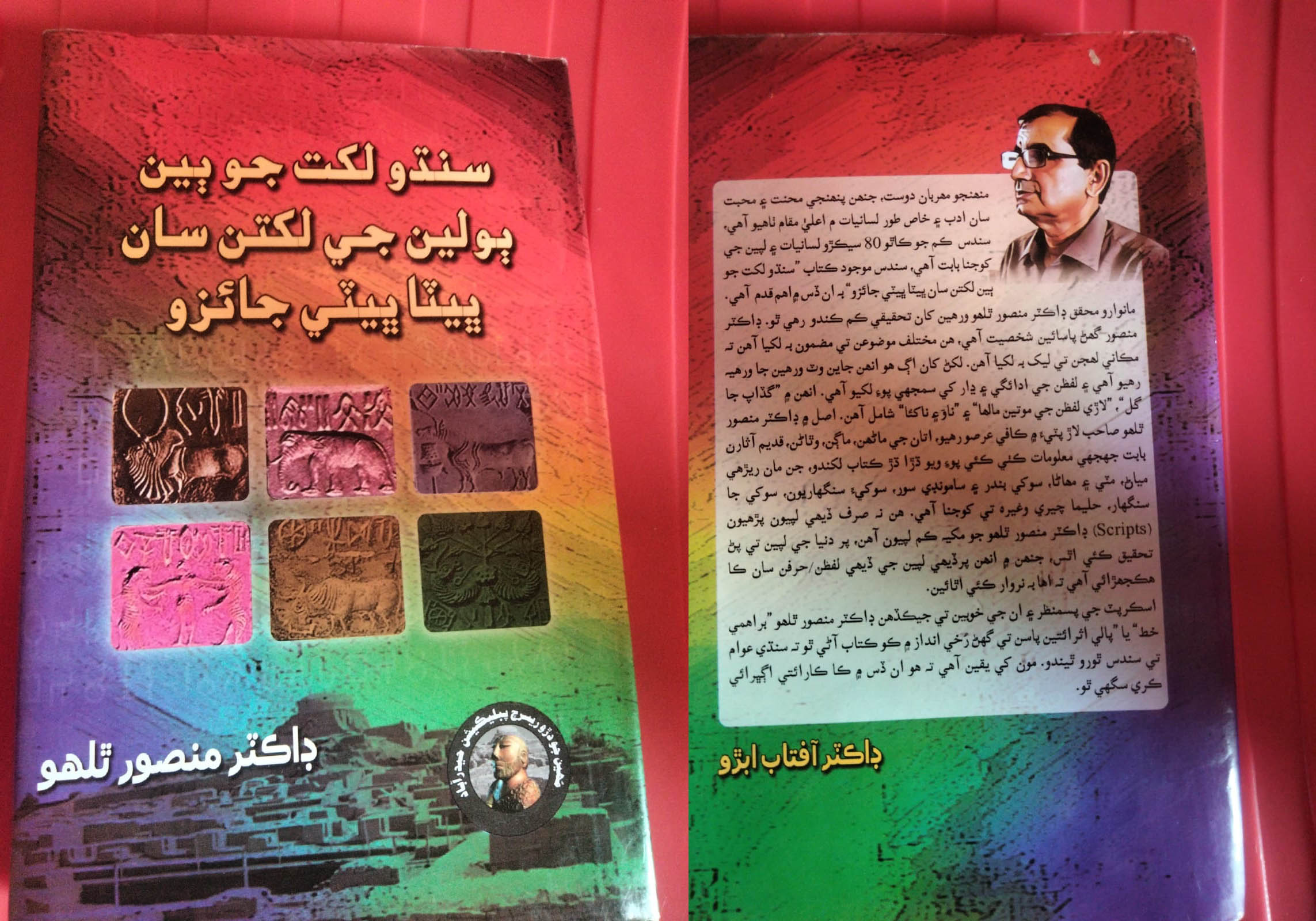

Review by: Ghulam Mustafa Khuhawar
Author: Dr. Mansoor Thalho
In the book’s foreword, renowned writer Shahzad Fatah Muhammad Thebo raises an important question: Despite so many advancements in research, why does the Indus script remain an unsolved mystery to this day? Perhaps one reason is that scholars around the world are still reluctant to recognise modern Sindhi as the language spoken in the era of Mohenjo-daro.
In this book, Dr. Mansoor Thalho has presented an impressive comparative study of the Indus script alongside the scripts of other ancient languages of the world.
In his introductory remarks, Dr. Mansoor Thalho writes that ancient written symbols were used in letters and numerical figures, and this practice continues even today. According to the author, symbols of the Indus script, with their remarkable antiquity, can also be found in several other languages.
In his review, Muhammad Khan Jarwar observes that Dr. Mansoor Thalho has demonstrated comparisons between the Indus script and the scripts of various languages around the world.
## Chapter One: Seals of Mohenjo-daro and the Brahmi Script
The author provides details of seals discovered at various sites in the Indus Valley, covering eleven archaeological locations. According to the account, two seals were discovered at each of these sites.
He also discusses seals associated with Sindh that were discovered outside the Indian subcontinent, stating that a total of 3,048 seals have been found.
The chapter includes a chart comparing Brahmi and Sindhi symbols. The author also presents charts of the symbols found at Mohenjo-daro and the letters of the Brahmi script.
Dr. Mansoor Thalho further writes that the traders of Sukkur and Shikarpur developed scripts associated with the names of their respective ports.
## Chapter Two: Symbols of Mohenjo-daro and African Languages
The author writes that trade and travel between Sindh and Africa continued for hundreds of years through ports and islands. He suggests that this historical interaction may help explain why the written forms of many African characters resemble symbols of the Indus script and certain ancient Latin forms.
Dr. Mansoor Thalho discusses symbols engraved on stones, arguing that they point to ancient connections between the people of the Indus Valley Civilisation and African civilisations.
The chapter includes a chart of writing tablets and discusses the word lak (mountain pass), incorporating verses from the poetry of Shah Abdul Latif Bhittai.
Among the verses cited are:
Pasi dongar dah, jim halan mein heeniyun vehin;
Lanchi lak, Latif chaye, pathi Kechiyan kah.
Puchhi puraj, Sassui! Balochani basa;
Un waraite war ji, aasra had na la.
Jo akhiyun od ah, so preen par aanhun ma chayo.
These verses reflect the themes of perseverance, hardship, and the journey in Shah Latif’s poetry.
### Symbols of Mohenjo-daro and African Writing Systems
The author further explains that certain symbols engraved on stones resemble the Indus script and the signs discovered at Mohenjo-daro, while others appear similar to letters in the Sindhi script. He believes these similarities may indicate ancient connections between the people and cultures of the Indus Valley and Africa.
Photographs of the stones are included in this chapter. According to the author, 24 symbols were identified, appearing in combined forms, of which ten were associated with phonetic symbols.
The chapter also includes charts comparing Tifinagh and other Amazigh writing forms with seals from Mohenjo-daro.
### The Indus Script and the Berber Writing System of Africa
The book presents charts showing the sounds and written forms of four writing systems: Libyco-Berber, Tifinagh Tuareg, Neo-Tifinagh, and Neo-Tifinagh Ahaggar.
The author also includes charts of several historical Sindhi scripts, including:
– Larai script
– Sehwan Baapra script
– Rajai script
– Shikarpuri script
– Sukkur script
These charts provide a comparative perspective on the diversity of historical writing traditions associated with Sindhi.
## Chapter Three: Opinions on the Antiquity of the Sindhi Language
The author argues that the written history of Sindhi extends back thousands of years and that the language has an identifiable connection with the inscriptions of Mohenjo-daro.
He describes Sindhi as a language belonging to a non-Aryan linguistic tradition, with roots deeply embedded in the civilisation of Mohenjo-daro.
According to the author, Sindhi has been spoken across different regions of Sindh for centuries, and several scripts have been used to write it. He suggests that if a single standard Sindhi script had been developed on the basis of these historical writing systems, the antiquity of the language could have been better preserved and recognised.
### Ancient Inscriptions, Numbers, and Letters of Languages
The researcher writes that the Dravidians came to settlements in the Indus Valley after hearing accounts of Sindh’s prosperity. He further argues that the Sindhi language existed before the arrival of the Aryans and Dravidians.
The chapter includes a chart containing 38 letters of the Southern Landa script associated with Sindhi.
The author also presents verses from Shah Abdul Latif Bhittai’s Sur Yaman Kalyan as supporting evidence and includes a chart of the Memoni script.
## Chapter Four: The Journey of Sindhi Writing Alongside Traders
The researcher states that traders from Sindh, referred to in the book as Pani, used the Indus script. He discusses the sounds associated with these written symbols and compares them with inscriptions found in other civilisations.
A chart illustrates Semitic inscriptions dating from the thirteenth and sixteenth centuries. The author also presents verses from Shah Abdul Latif Bhittai’s Sur Sarirag as evidence and includes tablets bearing two symbols.
The chapter further contains a chart of the Southern Semitic script, alongside another chart depicting inscriptions from eastern Palestine.
## Chapter Five: Symbols and Signs
In this chapter, the author compares the North Italic script with the Indus script and provides a chart of North Italic characters. He also presents tablets bearing four symbols.
Dr. Mansoor Thalho writes that the Himyaritic script was used in tribal areas of Yemen and that the written forms of its characters resemble certain symbols of the Indus script.
The chapter also includes a chart of the Old Negev Hebrew script and a chart of Latin notes.
## Chapter Six: Ancient Stone Inscriptions from Sweden, Their Images, and the Indus Script
The researcher writes that numerous inscriptions engraved on Stone No. 19 at a site in Sweden resemble symbols of the Indus script. He further suggests that some of these symbols bear similarities to the shapes of letters in historical Sindhi writing.
### Viking Runes and the Indus Script
According to the researcher, the Viking runic script contains 24 characters. He argues that the shapes of these characters bear considerable resemblance to inscriptions engraved on tablets and other objects discovered at Mohenjo-daro.
Some of these characters, he suggests, also resemble the written forms of letters in the Sindhi language.
## Chapter Seven: A Brief Review of Canaanite Inscriptions
The researcher writes that several characters in Canaanite inscriptions, including Moabite, Phoenician, and other related writing traditions, appear similar in form to symbols of the Indus script and characters of ancient Sindhi scripts.
The chapter also includes a chart of the Sehwan Baapra script of Sindhi.
### Eastern Palestinian Inscriptions and the Indus Script
The researcher states that traders in Sindh used symbols of the Indus script for accounting and commercial records. He suggests that the written forms of certain characters in historical Sindhi scripts resemble inscriptions found in eastern Palestine.
A chart of eastern Palestinian inscriptions is included.
The author also discusses the Rajai script, stating that it was used for commercial purposes in different areas of Thatta. A chart of this script is provided, along with a chart of the Khwajki script of Sindhi.
### Finger-Shaped Cylinders and the Indus Script
The researcher explains that archaeological excavations are continuing at ancient sites around the world. Just as excavations in Sindh have uncovered earthenware vessels bearing engraved words, discoveries have also been made at other ancient sites.
Finger-shaped cylindrical objects have been found at a site between the Euphrates rivers, while similar objects have also been discovered in northern Syria.
According to the author, one symbol engraved on a finger-shaped cylinder resembles the numeral three. He further suggests that its form bears similarities to written characters of the Sindhi language.
The researcher also argues that the inscriptions on clay cylinders resemble symbols found on tablets discovered at Mohenjo-daro, suggesting possible similarities between these ancient writing traditions.
## Chapter Eight: Written Forms of Characters in Sindhi and Latin Scripts
In this chapter, the researcher presents a chart of ancient writing systems. He argues that certain characters in ancient Latin inscriptions resemble those found at Mohenjo-daro and the letters of historical Sindhi scripts.
The author also writes that some characters of the Southern Picene script resemble symbols discovered at Mohenjo-daro.
Similarly, the researcher compares the Oscan script and argues that several of its written forms resemble symbols of Mohenjo-daro and characters of ancient Sindhi writing.
The chapter also examines the Umbrian script, which contains 21 characters. According to the author, some of these characters resemble the symbols found at Mohenjo-daro.
## Conclusion
Dr. Mansoor Thalho’s research presents a comparative examination of the Indus script and the writing systems of several ancient civilisations. By studying inscriptions, seals, stone carvings, tablets, and historical scripts from different regions, the author attempts to identify similarities between the Indus script and other writing traditions.
His work raises important questions about the antiquity of the Sindhi language, the origins of its historical scripts, and the cultural and commercial connections that may have existed between ancient Sindh and other civilisations.
The author’s research opens new avenues for further investigation into the Indus script. It may also encourage younger generations to explore the historical significance, antiquity, and cultural value of the Sindhi language and its writing traditions.
However, similarities in written symbols alone do not establish a direct historical relationship between scripts. Such claims require further linguistic, archaeological, and historical evidence. This makes continued scholarly research essential to understanding the still-undeciphered Indus script and its possible connections with other ancient writing systems.