





















Mian Muhammad Shaheryar
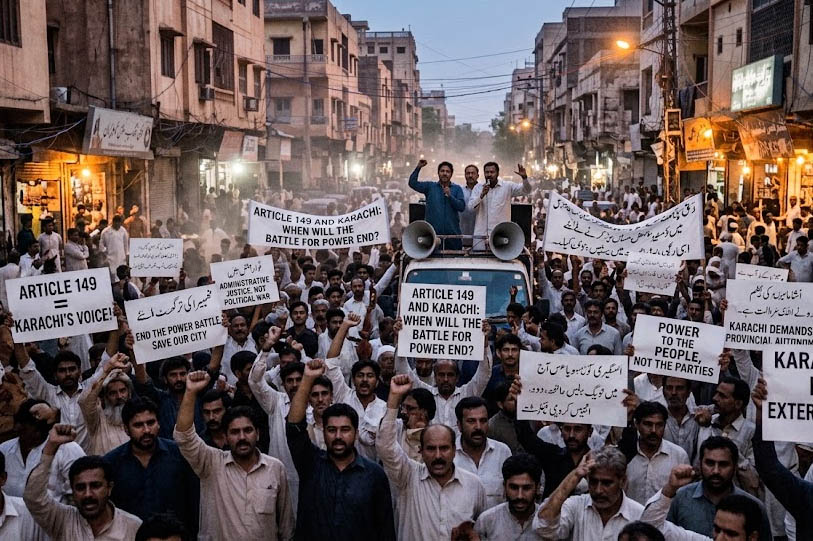
Karachi is Pakistan’s economic lifeline, the capital of Sindh, and one of the country’s most important centres of commerce and industry. The challenges facing this city go far beyond municipal administration. They concern the national economy, the federal structure, provincial autonomy, and the fundamental rights of millions of citizens. This is why any proposal to place Karachi under federal control, or any debate surrounding Article 149 of the Constitution, carries significance far beyond ordinary political discussion.
The fundamental question, however, remains: Can Karachi’s problems be solved by transferring administrative powers, or does the real solution lie in effective governance, transparent accountability, and a stronger local government system within the constitutional framework?
Article 149 of Pakistan’s Constitution empowers the federal government to issue directions to provincial governments under specific circumstances. However, it would be legally incorrect to interpret this provision as an unrestricted authority to take over the entire administration of a city. Federal directions, the transfer of administrative powers, and changes to provincial boundaries are distinct constitutional matters, each subject to its own legal requirements and procedures.
At the same time, provincial autonomy must not become a shield against questions concerning administrative performance. If Karachi continues to face problems involving water supply, drainage, public transport, waste management, roads, and urban planning, citizens have every right to demand answers from the relevant governments and institutions. Constitutional authority must go hand in hand with responsibility and accountability.
The Pakistan Peoples Party’s opposition to proposals for placing Karachi under federal control must be understood in the context of provincial autonomy. Similarly, those advocating a greater federal role argue that administrative reforms are necessary to address the city’s persistent problems. However, neither position becomes an established constitutional or legal fact merely because it is expressed through a political statement. Both must be examined against the constitutional text, legal arguments, and their practical consequences.
The proposal to separate Karachi from Sindh raises a separate constitutional question. Under Article 239(4) of the Constitution, a constitutional amendment altering the boundaries of a province requires approval by at least two-thirds of the total membership of the provincial assembly concerned. Therefore, invoking Article 149 as a means of unilaterally changing provincial boundaries or Karachi’s constitutional status would not accurately reflect the applicable constitutional framework.
The most important consideration in this debate is the welfare of Karachi’s residents. People want clean drinking water, safe roads, reliable public transport, effective drainage, a clean environment, and a functioning local government. They need practical results, not an endless exchange of accusations between the federal and provincial governments.
The federal government must fulfil its responsibilities within its constitutional jurisdiction. The Sindh government must improve its performance in provincial and urban administration. Local government institutions, meanwhile, must receive appropriate powers and resources under the law, alongside a transparent system of accountability.
Karachi’s future cannot be secured by sacrificing the Constitution to political expediency, nor can provincial autonomy be used as a shield against administrative failure.
The need of the hour is for the federal and provincial governments to move beyond political confrontation and prioritise constitutional dialogue, institutional cooperation, and the delivery of essential public services. If circumstances arise in which Article 149 is considered applicable, the legal basis and limits of its use must be clearly established. If the existing administrative system is inadequate, reforms must be pursued transparently and through the proper constitutional process.
Karachi does not belong to any single political party or government institution. It belongs to its people. Its future must be shaped by the Constitution, the rule of law, public interest, and accountable governance.
The conclusion is clear: Karachi needs better governance, not a battle for power; constitutional supremacy, not political slogans; and tangible results, not empty promises.