












http//: www.thenewslark.com
Dr. Syed Mehboob
Senior Research Editor
The News Lark, political and economic analyst
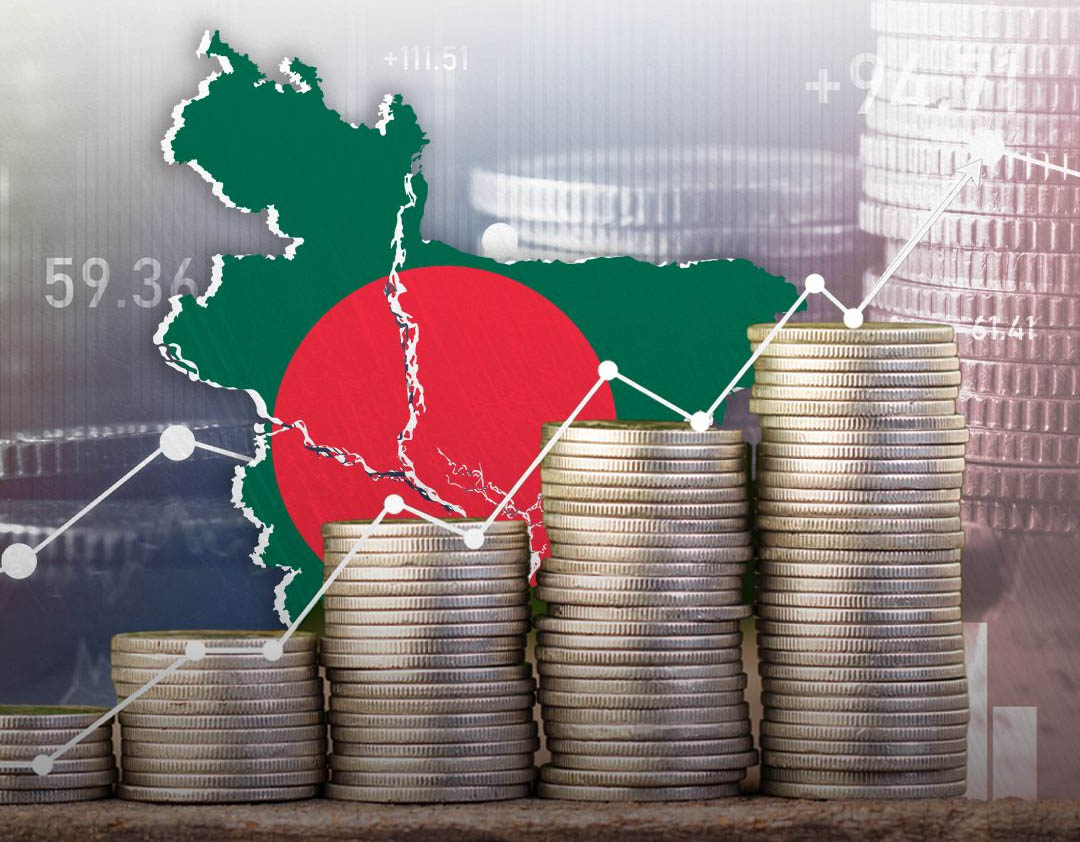
Bangladeshi people are hardworking, intelligent, patriotic, and consistent in achieving their goals. Despite political upheavals and disturbances, Bangladesh continued its journey towards economic development, and it achieved a great milestone by crossing a GDP of US$ 500 billion, a half-trillion economy, which is a great success.
According to the preliminary estimates from the Bangladesh Bureau of Statistics (BBS) for the fiscal year 2026, the total nominal GDP size reached US$ 501 billion, with per capita income rising to US$ 3,202.
Bangladesh gained in the agriculture and services sectors have helped its economy rebound from sluggish growth of 3.4% in the outgoing fiscal year. The government recently announced a US$ 77 billion national budget targeting a 6.5% economic growth rate. Bangladesh is scheduled to officially graduate from Least Developed Country (LDC) status, which will eventually phase out current trade preferences and force the country to rely on direct trade agreements. However, it is a matter of great satisfaction and pride for the Bangladeshi nation that it has entered the half-trillion-dollar economy club. Government’s recent measures. Including a large Central Bank stimulus package aimed at reviving business and supporting agriculture is pinned great hope on to bolster economic activity. The economy grew by 4.1 percent in the current fiscal year, up from 3.49% in the previous year. With the expansion, the Gross Domestic Product (GDP), a measure of the final value of goods and services produced over a certain period, stood at US$ 501 billion this year, up from US$ 456 billion a year ago, an increase of US$ 45 billion, a 9.8 % increase. During 2025-26, the agriculture sector expanded 2.78 % from 2.42 % last year. The services sector grew 4.59% in fiscal year 2026-26 from 4.35% a year earlier. However, manufacturing sector production slowed to 2.86% in the current year from 3.71% in the previous year as exports fell and domestic demand slowed amid persistent inflation. Economists and analysts have the opinion that latest figures indicate that the economy is gradually regaining momentum despite lingering structural weaknesses.
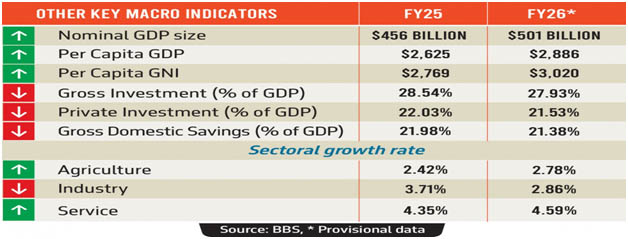
Investment and savings indicators weakened during the year. The investment-to-GDP ratio declined to 27.93% from 28.54% a year earlier. Domestic savings fell to 21.38% of GDP, while national savings dropped to 26.93%.
An increase in the size of GDP and per capita income is certainly a positive development. It indicates that the economy is gradually recovering. However, Bangladesh should not focus solely on the size of growth; It must also examine how widely the benefits of that growth are being distributed. Political and economic stability play a crucial role in attracting investment, as investors generally seek environments that offer stability and predictability. Analysts described Bangladesh’s entry into the half-trillion-dollar GDP club as a significant milestone achieved after decades of steady economic progress.
Economy of Bangladesh
Population: 173.56 million ( 2026)
GDP Nominal US$ billion: 501 ( 2026)
GDP PPP US$ billion: 1,900 billion ( 2026)
GDP rank: 36th Nominal ( 2026)
GDP rank: 26th PPP ( 2026)
GDP Growth
| Year | % growth |
| 2024 | 4.2 |
| 2025 | 3.5 |
| 2026 | 4.7 |
GDP by Sector
| Sector | % of GDP |
| Agriculture | 11.2 |
| Industry | 37.65 |
| Service | 51.24 |
Exports : US$ 48.28 billion ( 2025)
Export Items: Textile and garments, Fish and seafood, leather and leather goods, Pharmaceuticals, Processed food, Plastic, bicycle
Main Export Partners
| Country | % of Exports |
| USA | 18 |
| Germany | 10.96 |
| UK | 9.57 |
| Spain | 7.36 |
| France | 5 |
Imports US$ billion: 61 billion
Import Items: Liquefied natural gas, crude oil and petroleum, machinery and equipment, chemicals, cotton, foodstuffs
Main Import Partners
| Country | % of Imports |
| China | 26.4 |
| India | 14. 3 |
| Indonesia | 5.6 |
| Brazil | 4.2 |
| Malaysia | 4.1 |
Foreign Reserves: US$ 34.32 billion
Bangladesh is a mixed economy. It is the second-largest economy of South Asia after India. It is the 36th economy in GDP (nominal) and 26th in Purchasing Power Parity ( PPP). Bangladesh is seen by various financial institutions as one of the Next Eleven. It has been transitioning from being a frontier market into an emerging market. Bangladesh is set to graduate from the group of Least Developed Countries (LDC) to join the group of Developing Countries in November 2026. By the 1990s . Bangladesh has a booming ready made garments industry. As of 16 March 2024, Bangladesh has the highest number of Green Garment Factories (GGF) in the world. Bangladesh has a growing pharmaceutical industry with a twelve percent average growth rate. ( Continued)