





















By Prof. Khalid Hussain Channa
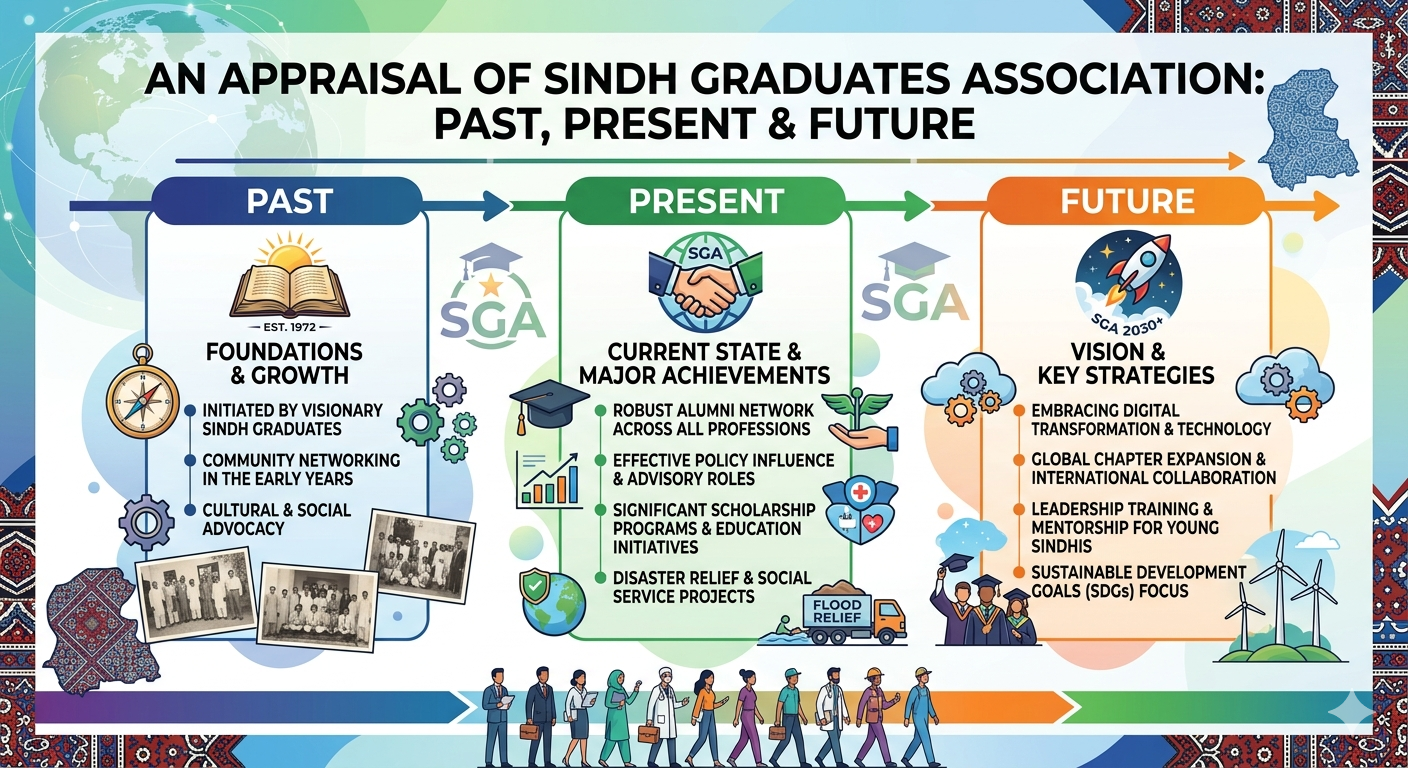
The Sindh Graduates Association (SGA) stands as one of the most vibrant and credible civil society organisations in Pakistan, with a legacy rooted in selfless service, intellectual leadership, and community development. It is both a privilege and an honour for me to reflect on its journey—past, present, and future—especially in the company of dedicated volunteers who continue to uphold its noble mission.
At the outset, I extend heartfelt congratulations to the organisers of the recent residential workshop on transformational leadership and institutional building. Such initiatives are not only timely but essential. As the saying goes, “People do not plan to fail; they fail to plan.” SGA’s success, in fact, is a testament to careful planning, collective wisdom, and sustained commitment.
A Vision Born from Concern
The origins of SGA are deeply inspiring. Its foundation lies in a simple yet powerful realization—the need to improve the quality of education and social conditions in Sindh. In 1967, when Dr. Muhammad Suleman Shaikh visited his primary school in Hala, he was disheartened by its poor condition: dilapidated buildings, lack of clean water, inadequate facilities, and absence of basic infrastructure. Rather than accepting the situation, he chose to act.
Along with like-minded friends such as Naseer Abro and Abdul Ghaffar Abro, he initiated efforts that led to the formation of the Hala Graduates Association, which established and improved primary schools in the area. This marked the beginning of a movement driven by personal responsibility and social awareness.
The idea matured further in Karachi, where, after the dissolution of One Unit, many educated Sindhis faced social and professional challenges. Regular intellectual gatherings—particularly at Café New York—led to the conceptualization of a non-political, non-religious, and non-profit organisation. Thus, on June 4, 1972, SGA was formally established under the chairmanship of Advocate Muhammad Bakhsh Shahani and later registered under the Societies Act.
A Journey of Dedication and Integrity
From its humble beginnings—with just 56 members and limited financial resources—SGA has evolved into a vast network of over 11,000 members and 129 branches across Sindh and beyond. Its journey reflects not only growth in numbers but also depth in impact.
The financial integrity of early volunteers is particularly noteworthy. The first annual income stood at merely Rs. 1,302, with expenditures carefully recorded down to the smallest detail. Today, SGA manages projects and institutions with budgets running into billions of rupees—yet the spirit of honesty and transparency remains its defining strength.
Expanding Horizons: Education, Health, and Social Service
Education has always been at the heart of SGA’s mission. From a single Roshan Tara School, the organisation now manages 23 schools and other educational institutions, including initiatives in Islamabad such as hostels, libraries, and community centres.
In the health sector, SGA has rendered remarkable services. Since 1977, it has organised hundreds of free eye camps across Sindh, benefiting hundreds of thousands of patients. In addition, skin camps, general medical camps, and institutions like Al-Shams Charitable Hospital have extended healthcare services to millions, particularly in underprivileged regions.
SGA has also played a vital role in recognising excellence. Through gold medals, lifetime achievement awards, and numerous other honours, it has celebrated the contributions of distinguished individuals from various fields—thereby promoting a culture of appreciation often thought to be lacking in our society.
Documentation and Institutional Strength
Another hallmark of SGA is its strong tradition of documentation and transparency. With dozens of books, reports, magazines, and annual publications, the organisation has maintained a detailed record of its activities. Regular audits—both internal and external—ensure accountability, while annual conventions and council meetings provide platforms for collective decision-making.
The Road Ahead: Challenges and Opportunities
Despite its impressive achievements, SGA faces several challenges that must be addressed to sustain and enhance its impact.
First, unity among members is crucial. The strength of any organisation lies in its cohesion. The spirit of “SGA ja sathi, ghar ja bhaati” (SGA members are like family) must be upheld in letter and spirit.
Second, there is an urgent need to engage the youth. With nearly 60% of Pakistan’s population under the age of 30, their inclusion is not optional—it is essential. Similarly, greater participation of women—who constitute nearly half of the population—must be ensured.
Third, SGA must adapt to the demands of the modern world. Skill-based education, digital platforms, online learning (including virtual Roshan Tara Schools), and career counselling centres can empower the younger generation and expand SGA’s reach globally.
Fourth, the organisation should leverage its vast human resource pool—comprising professionals from diverse fields—by placing the right individuals in appropriate roles. Institutional efficiency depends on merit-based utilisation of talent.
Finally, periodic review of the constitution, adoption of modern communication tools (such as online media channels), and regular SWOT analyses can help SGA remain dynamic and forward-looking.
Conclusion
The story of Sindh Graduates Association is a story of vision, sacrifice, and collective action. It began with empty hands but a determined heart; today, it stands as a beacon of hope and service.
As we move forward, the guiding principle must remain unchanged: sincere service to humanity, guided by integrity, unity, and foresight. If SGA continues to evolve while staying true to its core values, its future will be even more impactful than its glorious past.
khalidchanno@yahoo.com