
















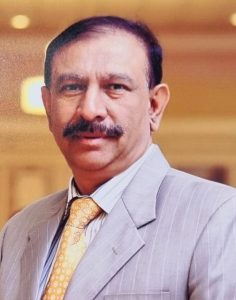
By Brig Syed Karrar Hussain Abidi (Retired)
As I entered the central office of Anjuman Taraqqi-e-Urdu Pakistan as the chief guest, a wave of serene joy swept over me. From the very doorway, the air itself seemed infused with the fragrance of literature and learning. Passing by the lush green lawn, my eyes caught sight of neatly arranged chairs, the faint scent of books in the air, walls adorned with timeless quotes from Urdu poets, and posters rich with information about libraries. For a moment, it felt as if I had stepped into a living treasure of our scholarly heritage. Gazing toward the library, I could almost hear centuries of wisdom whispering softly: “You took your time, dear friend, but you have come at last.”
The host of the seminar, Rabia Ali Fareedi, moved gracefully across the venue, greeting each guest with warmth and poise. Her eyes sparkled with an unmistakable love for Urdu literature and an inner joy that comes only from a sincere bond with knowledge. Nearby, I noticed the other organizers — Nadeem Zafar, Sameem Kardar, Jawahar Aleem, and their devoted colleagues from the Anjuman — tirelessly giving the final touches to every detail with evident passion.

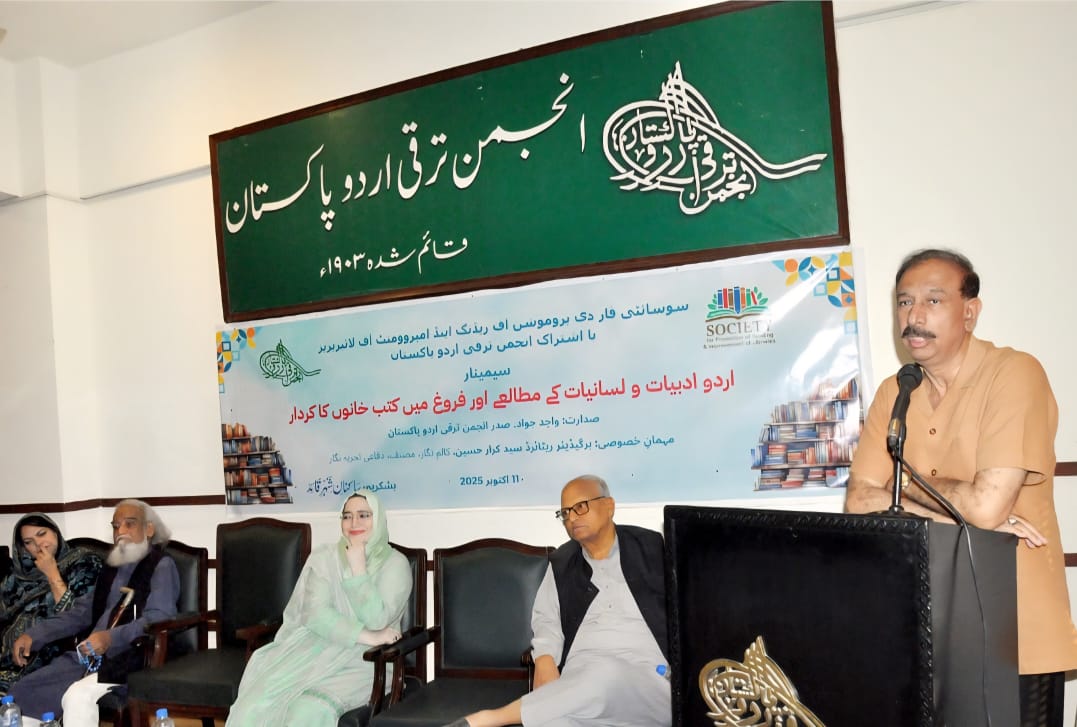
The seminar, held under the joint auspices of the Society for the Promotion of Reading and Improvement of Libraries (SPRIL) and Anjuman Taraqqi-e-Urdu Pakistan, took place on 11 October 2025, in the heart of Karachi. The theme for the event was both thought-provoking and timely:
“The Role of Libraries in the Study and Promotion of Urdu Literature and Linguistics.”
The intellectual gathering was presided over by Wajid Jawwad, President of the Anjuman, while I had the honor of attending as the Chief Guest.
As I took my seat, I looked around and found the hall brimming with professors, researchers, librarians, students, and literary figures from across the city. Every face reflected a shared love for knowledge. The session began with welcoming remarks by Sameem Kardar, who eloquently outlined the objectives of the program.
The event opened with a recitation from the Holy Qur’an by Nadeem Zafar, followed by a soul-enriching na’at, filling the atmosphere with spiritual grace.
Then began a series of remarkable presentations by distinguished scholars and literary figures — among them Dr. Yasmeen Farooqi, Mahmood Khan, Prof. Shadab Ahsani, Javed Saba, Dr. Riffat Parveen Siddiqui, Syed Abid Rizvi, and myself.
Dr. Yasmeen Farooqi spoke first, shedding light on the timeless importance of books and libraries. Her words carried both simplicity and depth. She reminded the audience that the very first revelation to the Muslims was “Iqra” — Read! — a command that forever established the centrality of knowledge in human destiny. “Sadly,” she said with a sigh, “we have drifted away from both the book and the quest for knowledge. The developed nations take pride in their languages, while we hesitate to speak our own.” Her sincerity moved the audience to deep reflection.

Next came Mahmood Khan, well-known for organizing major literary gatherings in Karachi and for his social work. He passionately emphasized the need to revive reading habits among the youth. “A book,” he said, “is a lamp that illuminates the mind. If we can help our youth rediscover the joy of reading, our nation will naturally find its right direction.”
Prof. Shadab Ahsani, former Head of the Urdu Department at Karachi University, then gave a captivating talk on the history of the Urdu language. He called Urdu the language of love, tolerance, and culture. “When the British removed Urdu from the education system,” he explained, “their aim was to enslave minds. Until we make our national language the medium of instruction, we cannot hope for intellectual freedom.” His words resonated deeply across the hall.
Renowned poet and broadcaster Javed Saba then took the stage. He spoke about the paradox of modern life: “Today, man is drowning in a flood of information,” he observed, “but drifting farther away from true knowledge.” His voice softened as he added, “Libraries are the last sanctuaries where reflection and wisdom still breathe.”
After him, Dr. Riffat Parveen Siddiqui, Head of the Department of Library and Information Science at Karachi University, delivered an intellectually rich address on the evolution of languages and the importance of the national tongue. “Today,” she said, “we think in one language, write in another, and publish in a third — and the meaning gets lost in translation.” Her remark left the audience in thoughtful silence.
Syed Abid Rizvi, Financial Advisor to the Anjuman, shared that the organization actively supports the establishment of new libraries and is willing to provide books free of cost to any individual or institution eager to set one up. The announcement was met with delighted applause.
Meanwhile, Ikram-ul-Haq, President of SPRIL, joined the gathering via a video message from Saudi Arabia. His sincere words highlighted the society’s ongoing efforts to promote reading culture and enhance libraries across Pakistan.
In a generous gesture, Dr. Amna Khatoon from the Library Promotion Bureau presented participants with publications from the Bureau as gifts — a thoughtful symbol of her dedication to the cause of knowledge.
Throughout the session, Rabia Ali Fareedi conducted the proceedings with remarkable grace. Her diction, fluency, and rhythm of speech captivated everyone in the hall. She introduced each speaker with elegance and maintained the audience’s engagement from start to finish.
The concluding remarks were given by Jawahar Aleem, who paid glowing tribute to the collaborative spirit between SPRIL and the Anjuman.
Finally, I was invited to share my reflections. Standing before that attentive audience, I said:
> “The Urdu language is a living truth. Attempts to erase it will always fail. Both Urdu and the written word are alive — and will continue to enlighten future generations.”
I added,
> “Libraries are not mere buildings; they are fortresses of knowledge, culture, and thought. If we fail to protect them, the foundations of our intellectual life will weaken.”
The hall echoed with applause — not for me, but for the enduring truth those words carried. I expressed my heartfelt gratitude to the organizers, speakers, and participants for keeping the torch of learning alive.
By the end, there was a collective understanding among all present: that libraries are not just repositories of books, but nurseries of intellect and guardians of national identity. They must be nurtured and strengthened with devotion.
As the ceremony concluded, floral bouquets and certificates of appreciation were presented to all speakers and guests of honor. The evening ended over a delightful cup of tea, as faces beamed with intellectual joy and contentment.
Stepping out of the building, I turned back for one last look at the Anjuman Taraqqi-e-Urdu headquarters. The golden rays of the setting sun bathed its façade in light. To me, it was more than a structure — it was a radiant beacon, silently pledging to spread the light of knowledge and literature to generations yet to come.