














By Brig Syed Karrar Shah retired
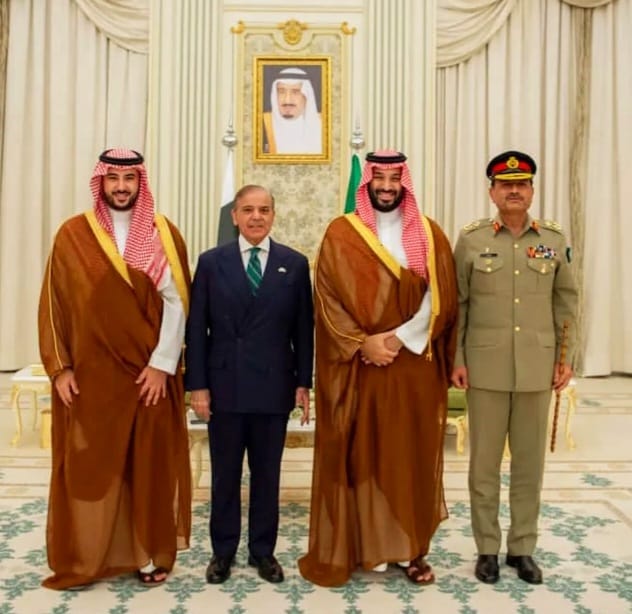
The signing of the Pakistan–Saudi Arabia Mutual Defence Treaty has emerged as one of the most defining developments of the contemporary Muslim world. It is not just an agreement between two states—it represents the revival of an age-old brotherhood, anchored in shared faith, culture, and common threats. The treaty carries profound implications for Pakistan’s foreign policy, its military posture, its economy, and above all, the confidence of its people.
The Nature of Relations Between Pakistan and Saudi Arabia
Pakistan and Saudi Arabia have always maintained relations deeper than mere diplomacy. The connection between the two countries is rooted in the Islamic faith, shared values, and mutual respect. Saudi Arabia is home to the Two Holy Mosques, making it the spiritual heart of the Muslim world. For Pakistan, whose identity is strongly tied to Islam, the bond with the Kingdom transcends political convenience.
Over the decades, this relationship has taken the shape of strategic dependence: Pakistan views Saudi Arabia as a trusted partner in the Gulf, while Saudi Arabia looks to Pakistan for military expertise and manpower. This mutual trust has ensured that the relationship goes beyond trade or occasional cooperation—it is built on reliability during times of need.
History of Pakistan’s Defence Forces in Saudi Arabia
The history of Pakistan’s armed forces serving in Saudi Arabia is as old as Pakistan itself. As early as the 1960s, Pakistan deployed military advisors and trainers to Saudi Arabia to help develop the Kingdom’s armed forces. Pakistani pilots flew Saudi fighter jets, Pakistani engineers helped in setting up bases, and Pakistani officers trained Saudi soldiers.
The 1980s saw a greater expansion of cooperation. Thousands of Pakistani troops were stationed in the Kingdom, tasked with defending its borders and securing critical infrastructure. During the Iran–Iraq war, Pakistan quietly supported Saudi Arabia’s security framework. The collaboration was not one-sided: Saudi Arabia extended generous oil and financial support to Pakistan during its economic crises.
Even in the 21st century, this cooperation continued. Pakistani contingents were deployed for the defence of the holy sites, for counter-terrorism training, and to assist in building advanced military capabilities. This long-standing partnership laid the foundation for the mutual defence treaty signed today.
Pakistan’s Regional Position After Marka-e-Haq (10th May 2025)
The May 2025 victory, known as Marka-e-Haq, redefined Pakistan’s position in South Asia and the broader region. By giving a decisive response to aggression, Pakistan proved not only its military strength but also its resilience as a nation. The war changed perceptions: Pakistan was no longer seen merely as a defensive power, but as a country capable of shaping the strategic environment of the region.
For Muslim countries, particularly those in the Gulf, Marka-e-Haq carried symbolic weight. It showed that a Muslim state with limited resources, but with unity and resolve, could deter a much larger adversary. This elevated Pakistan’s image from being a regional player to a potential protector of Muslim interests, thereby making it a natural partner for defence treaties in the Islamic world.
After Israel’s Attack on Qatar: Why Arab States Look Towards Pakistan
The Israeli strike on Qatar served as a wake-up call for the Arab world. For decades, Gulf states had relied heavily on American security guarantees. However, the events surrounding Qatar highlighted a harsh reality: U.S. priorities had shifted. Washington’s hesitance to directly confront Israel, combined with its pivot towards Asia and internal divisions, eroded Arab confidence in American protection.
At this critical juncture, Arab states turned towards Pakistan. There are several reasons for this shift:
1. Credibility of Action – Pakistan has repeatedly shown that it acts decisively in the face of threats. Its response during Marka-e-Haq was the most recent and powerful example.
2. Shared Islamic Identity – Arab states trust Pakistan because of its ideological commitment to defending Muslim lands, especially the sanctity of the Haramain.
3. Nuclear and Conventional Strength – Pakistan remains the only Muslim-majority nuclear power with a battle-hardened conventional army. This makes it uniquely capable of providing both deterrence and real military assistance.
4. Absence of Hidden Agendas – Unlike Western powers, Pakistan does not seek permanent bases, regime change, or political manipulation in the Gulf. Its only motive is the security of the Muslim world.
Thus, the Israeli aggression against Qatar accelerated the Arab world’s shift towards Pakistan as a reliable defence partner.
Effects of the Pakistan–Saudi Defence Pact
The signing of this defence pact is a turning point with far-reaching effects.
1. On Pakistan’s Foreign Policy
Pakistan’s foreign policy has traditionally balanced between the West, China, and the Muslim world. The defence pact with Saudi Arabia will tilt Pakistan further towards the Islamic bloc. It will strengthen Pakistan’s position in the Organization of Islamic Cooperation (OIC) and provide it leverage in negotiations with both Washington and Beijing.
At the same time, Pakistan will face challenges in managing its ties with Iran, which may view the pact with suspicion. Diplomacy will be needed to ensure that Pakistan’s role is seen as protective rather than provocative.
2. On the Armed Forces of Pakistan
For the armed forces, the pact opens opportunities and responsibilities. More troops, advisors, and units may be deployed in Saudi Arabia. Joint exercises, intelligence sharing, and defence production collaboration will enhance Pakistan’s military readiness.
The exposure to modern Gulf technology, combined with Saudi financial support, can help Pakistan in upgrading its defence industries. On the flip side, it will also demand careful planning to avoid overstretching the army while maintaining readiness on the eastern border.
3. On Pakistan’s Economy
The economic impact may be highly positive. Saudi Arabia’s investments in Pakistan’s defence industries, infrastructure, and energy sector are expected to grow. The pact could lead to long-term oil supply arrangements on concessional terms, reducing Pakistan’s import bill. Additionally, remittances from millions of Pakistani workers in the Kingdom may rise as defence cooperation deepens.
However, there will also be critics who argue that Pakistan could become too dependent on Saudi financial assistance, which may limit its economic sovereignty. The government will need to strike a balance by diversifying its partnerships.
4. On the Common Man of Pakistan
For the ordinary Pakistani, the pact brings both hope and responsibility. Hope, because stronger ties with Saudi Arabia could mean more job opportunities, better remittance inflows, and relief in energy costs. Responsibility, because Pakistan’s soldiers may be called upon to defend not just their own homeland but also the broader Muslim world.
Public sentiment is largely in favour of the treaty. Pakistanis see defending the Haramain Sharifain as a sacred duty. Yet, the common man will also expect that the economic benefits of this pact trickle down to everyday life in the form of reduced inflation, job creation, and national pride.
Conclusion
The Pakistan–Saudi Arabia Mutual Defence Treaty is more than an agreement—it is the formal recognition of a bond that has existed for decades. It brings together military might, spiritual responsibility, and economic opportunity. For Pakistan, it represents both a challenge and an opportunity: a challenge to maintain balanced foreign relations while assuming greater responsibility in the Muslim world, and an opportunity to strengthen its global standing, economy, and military capability.
In a world where old alliances are weakening and new ones are emerging, Pakistan has positioned itself as the shield of the Muslim world. The success of this treaty will depend on sincerity, strategic planning, and the ability to ensure that its benefits reach not only the corridors of power but also the homes of ordinary Pakistanis.