












Dr.Syed Mehboob
Senior Research Editor The News Lark
Political and Economic Analyst
http://www.thenewslark.com
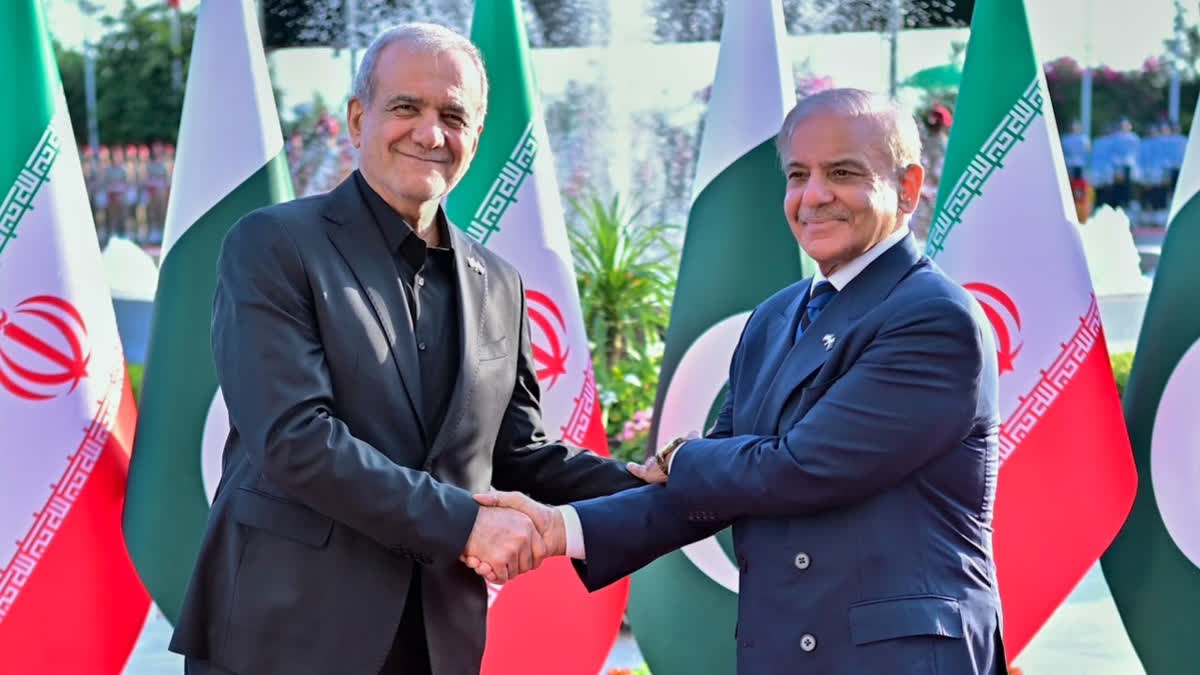
23rd June 2026 was a historical and highly important day when a very important person from our brother and neighboring country, Iran’s president, His Excellency Masoud Pezeshkian, visited Pakistan. This visit is a significant one as it underscores a deepening bilateral partnership following Pakistan’s successful mediation in the historic US-Iran peace talks. A very warm and historical welcome was given to him. Prime Minister Shehbaz Sharif, President Asif Ali Zardari, and important cabinet members were there to receive President Pezeshkian. The landmark trip focuses on thanking Pakistan for brokering the recent peace agreement, expanding economic cooperation, and fostering regional security.
The visit serves as a massive diplomatic triumph for Pakistan. President Pezeshkian traveled to Islamabad largely to express gratitude to Prime Minister Shehbaz Sharif for mediating the landmark Islamabad Memorandum of Understanding (MoU) with the United States. This agreement initiated a 60-day roadmap toward a final deal, easing international sanctions and unfreezing billions in Iranian assets.
Pakistan and Iran are actively expanding their economic footprint, aiming to elevate bilateral trade. Following past border tensions, the visit marks a united front against regional instability. Top officials, including Pakistan’s Army Chief Field Marshal Asim Munir, are engaging with President Pezeshkian to establish a coordinated approach toward the Western borders. This includes frameworks for de-confliction, counter-terrorism, and broader regional peace. Prime Minister Shehbaz Sharif formally assured the Iranian delegation that Pakistan will remain a steadfast partner in achieving everlasting peace. The meetings aim to build a new security structure for countries in the region, fortifying historical, cultural, and religious ties. Advancing discussions on energy security, including the long-discussed Iran-Pakistan gas pipeline and electricity imports to resolve Pakistan’s energy shortfalls. Establishing robust trade corridors that provide Pakistani farmers, traders, and industrialists access to the Iranian market.
During his day-long visit, Pezeshkian, who is accompanied by a high-level delegation that includes ministers and senior officials, held talks with Prime Minister Shehbaz Sharif, and also met with Field Marshal Hafiz Syed Asim Munir, President Asif Ali Zardari.
Pezeshkian arrived aboard a special aircraft named Minab 168, a tribute to the one hundred sixty people who were killed in an attack on an Iranian girls’ school by US and Israeli forces in the Iranian city of Minab on the first day of the war in February.Iranian Foreign Minister Abbas Araghchi, who had arrived separately earlier in the day from Oman, was also part of the delegation.
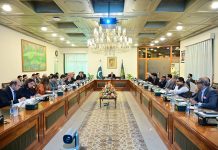
The Iranians held bilateral talks with PremierShehbaz Sharif, followed by a delegation-level meeting between the two sides. Senate Chairman Yousaf Raza Gilani, National Assembly Speaker Ayaz Sadiq, Deputy PM and Foreign Minister Ishaq Dar were also present on the occasion. During the visit, the two sides reviewed the full spectrum of bilateral relations and explored new avenues to further deepen cooperation across diverse sectors, including trade, energy, border security, people-to-people exchanges, and regional connectivity. Pezeshkian’s visit follows the crucial first round of talks between the United States and Iran, mediated by Pakistan and Qatar, in the Swiss city of Bürgenstock, to end the war in Iran.As part of the agreement, the US will release $12bn in frozen Iranian funds. The US has also announced a temporary easing of international sanctions on Iran, allowing it to sell its oil and petrochemicals until August 21. The talks concluded with a 60-day roadmap towards a final deal.Iran’s President Masoud Pezeshkian, on 23rd June, called for a “united front” of Muslim nations, extending “hands of friendship” for a new regional security structure.
President Pezeshkian appreciated Pakistan’s peace efforts and highlighted the historical, time-tested, deep, and strong relations between the two countries. Prime Minister Shahbaz Sharif clarified that Iran’s ballistic missiles programme is not part of the MoU with the US.
Addressing a joint press conference later with the prime minister, Pezeshkian said he held “constructive meetings and discussions” with PM Shehbaz, President Asif Ali Zardari and Chief of Defence Forces (CDF) and Chief of Army Staff Field Marshal Asim Munir.
“In these discussions, we had many good points talks and discussed regarding the latest developments in the region and in the world, and also regarding bilateral relations,” he elaborated.Pezeshkian observed that the two neighbours were “adamant to use the positive existing atmosphere to usher in a new era and open a new chapter in the bilateral relations between the two countries and draw new horizons and new opportunities of cooperation based on shared interests”.
He said Iran believed that “peace, stability, sustainable security, development and the welfare of nations in the strategic region of West Asia and the Persian Gulf can only be ensured through straightforward and honest discussions, intra-regional cooperation, interactions and cooperation based on mutual respect for the countries in the region”.
“Based on this fact, we stretch our hands of friendship to establish a common understanding and build a new security structure for the countries in the region,” Pezeshkian further said.
He noted that PM Shehbaz’s mention of Qatar, Saudi Arabia, Türkiye and Egypt in his remarks alongside him was a “very well-placed mentioning of the roles that these authorities and these leaders actually played in the discussions that led to the peace” between the United States and Iran.
“I believe Muslims should form a united front against their enemies,” the Iranian president said.He went on to say that the “tremendous potentials” of Pakistan and Iran, along with the political will of the leaders and support of their nations, can “elevate the relations between Iran and Pakistan to a level that is befitting the two countries’ position in the Islamic world and can produce a successful model of cooperation in solidarity and brotherhood”.
Pezeshkian declared that the two countries “share a strong resolve to promote and enhance interactions and relations, especially in the area of economy and trade”.He observed that both countries’ ministers, within the framework of the MoUs and the agreements that have been made during last year’s visit, have “tried to remove any technical existing hurdles and operationalize the decisions that have been made”.
President Pezeshkian began his address by reciting verses by the renowned poet Allama Iqbal, which he said continued to inspire unity among Muslim nations.
He said the two nations “do not merely live next to each other, but they share a common destiny in the majority of their aspirations, concerns and hopes”.
“Pakistan for us is not merely a neighboring country; it’s a brotherly and friendly country and has been an amicable companion and has had deep historical, cultural, religious, and popular bonds between the two nations, and these bonds have brought our nations closer,” he highlighted.
It is worth mentioning that the relations between Pakistan and its brotherly country, Iran, have always been consolidated based on mutual respect, goodwill, and historical trust. Pezeshkian said the “recent developments have once again showcased the consolidation of this valuable asset”.
The president stated: “In a critical historical juncture that the region is facing a multitude of challenges, the responsible and visionary role played by Pakistan in supporting the discussions and negotiations in de-escalating and strengthening the regional stability is a manifestation of a brotherly and futuristic attitude and viewpoint by this country towards the developments in the region.”( Continued)