









Dr. Syed Mehboob
Political and Economic Analyst
http//:www.thenewslark.com
drmehboob.thenewslark@gmail.com
The Berlin Wall was a great symbol of the divide between East and West Germany, which tried to divide the souls, hearts, and minds of people. This wall was a concrete barrier that encircled West Berlin from 1961 to 1989 for twenty-seven years and separated it from East Berlin and the German Democratic Republic ( East Germany). It was the keen desire of the people on both sides to rejoin, unite, and to demolish this wall, as well as to end differences and shake hands with one another. Construction of the Berlin Wall was commenced by the government of East Germany on 13 August 1961. Before the Wall’s erection, about three and a half million East Germans, about 20% of the population, circumvented Eastern Bloc Emigration restrictions and defected from the GDR, many by crossing over the border from East Berlin into West Berlin; from there they could then travel to West Germany and to other Western European countries.
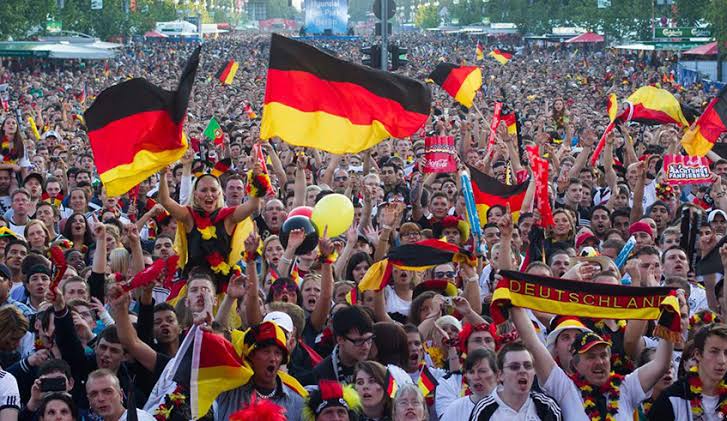
November 9, 1989, a crowd flooded the checkpoints, which resulted in the fall of the wall and reunification on October 3, 1990. Since then, the German Government and people have celebrated this unification as their national day every year on 3rd October. This day is symbolizes as the freedom and democracy for the people of Germany. Reunification reshaped Europe’s political landscape, serving as a cornerstone for modern European cooperation and stability. German people celebrate October 3 with great zeal and enthusiasm. Almost every city hosts events, open houses, and smaller celebrations. In addition, each year on 3 October one of the federal states organizes a larger, official festival, typically in its state capital. The responsibility for hosting that falls to whichever state is currently chair of the Bundesrat, Germany’s upper house of Parliament.
The celebrations’ atmosphere is festive, welcoming, and safe. Each year a different city hosts the national celebrations. Many mosques in Germany are open to the general public on October 3. This is an initiative to stimulate contact between Muslims and non-Muslims and to emphasize the role that Muslims played in forming modern Germany. German Unity Day is the only national holiday in Germany, as all other holidays are administered by the individual states.
German Unity Day is a public holiday in Germany, so post offices, banks and many businesses are closed. Nearly all stores are closed, although a few may be open in some city areas. Bakeries, petrol stations and stores at railway stations, airports and near highways are often open. Public transport services may run as usual, at a reduced service or no service depending on where one lives or intends to travel. There may be some disruption to traffic around large celebrations.
Germany is a country in Western and Central Europe. It lies between the Baltic Sea and the North Sea to the north, with the Alps to the south. Its sixteen constitutional states have a population of 84.96 million, making it the most populous member of the European Union. Germany borders Denmark to the north; Poland and the Czech Republic to the east; Austria and Switzerland to the south; and France, Luxembourg, Belgium, and the Netherlands to the west. The nation’s capital and most populous city is Berlin, and its main financial center is Frankfurt; the largest urban area is the Ruhr.
Germany is a developed country with a strong economy, the largest in Europe by nominal GDP. As a major force in several industrial, scientific and technological sectors, Germany is both the world’s third largest exporter and third-largest importer. It is widely considered a great power; Germany is part of multiple international organizations and forums. It has the third highest number of UNESCO World Heritage Sites, fifty of which fifty-two are cultural.
Germany has a social market economy with a highly skilled labour force, a low level of corruption, and a high level of innovation. It is the largest economy in Europe by nominal GDP, as well as the world’s third largest by nominal GDP. It is also the sixth largest economy by Purchasing Power Parity (PPP). Its PPP-adjusted GDP per capita amounted to 115 % of the European Union ( EU).
Economy of Germany at a glance
Population : 84.96 million ( 2025)
GDP
Nominal US$ billion : 5,450 ( 2026)
PPP US$ billion : 6,408 (2026)
GDP Growth : 0.8% ( 2026)
GDP per Capita
Nominal : US$ 65,303 ( 2026)
PPP : US$ 76,747 (2026)
GDP By Sector %
Agriculture : 0.7
Industry : 26.1
Services : 62.6
Exports US$ billion : 1,774 billion
Imports US$ billion : 1,545 billion
Export Partners %
EU 55.8
USA 9.4
China 5.2
Uk 5.1
Import Partners %
EU 51.5
China 12.5
USA 6.9
UK 2.8
Trade with Pakistan
| Year | Exports US$ bn | Imports US$ bn | Total trade US$ bn | BOT US$ billion | Total Pak Exports US$ bn | % of Pakistan’s Exports | Total Pak import US$bn | % of Pak Import |
| 2020 | 2.124 | 1.209 | 3.333 | 0.914 | 22.246 | 9.5 | 45.84 | 2.6 |
| 2021 | 2.56 | 1.57 | 4.13 | 0.99 | 28.88 | 8.9 | 73.11 | 2.2 |
| 2022 | 3.05 | 1.27 | 4.33 | 1.78 | 31.17 | 9.8 | 71.10 | 1.8 |
| 2023 | 2.52 | 1.05 | 3.57 | 1.47 | 28.95 | 8.7 | 50.36 | 2.1 |
| 2024 | 2.73 | 0.915 | 3.64 | 1.81 | 32.46 | 8.4 | 56.52 | 1.6 |
| 2025 | 3.24 | 0.94 | 4.18 | 2.28 | 30.8 | 10.6 | 65.10 | 1.5 |
Pakistan’s national poet, philosopher, great thinker, and politician Allama Muhammad Iqbal spent a transformative academic period in Germany between 1907 and 1908, where he mastered the German language and earned his doctorate in Metaphysics from the Ludwig Maximilian University of Munich. He lived in Heidelberg for about six months in 1907 at a boarding house called Pension Scherer ( later Neunheimer Landstrasse) near the Neckar River. He quickly learned the German language with the help of his private tutor, Emma Wegnast. Inspired by the scenery of the river, he wrote the famous poem, “ Aik Sham” ( An Evening), by the banks of the Neckar River. He moved to Munich and completed his Ph.D. dissertation titled “The Development of Metaphysics in Persia” in 1908. His time in Germany exposed him to deep Western philosophies, heavily shaping his worldview through thinkers like Goethe, Nietzsche, and Kant. ( Continued)