















Child Marriage Is Not Tradition — It Is a Human Rights Issue
Written by: Abeer Zeb, Peshawar
A girl is born with dreams. Like every human being, she carries hopes, ambitions, and the desire to build a meaningful life. She may dream of becoming a doctor who saves lives, a teacher who inspires generations, a lawyer who fights for justice, a researcher who discovers new possibilities, or simply a person who has the freedom to make her own choices.
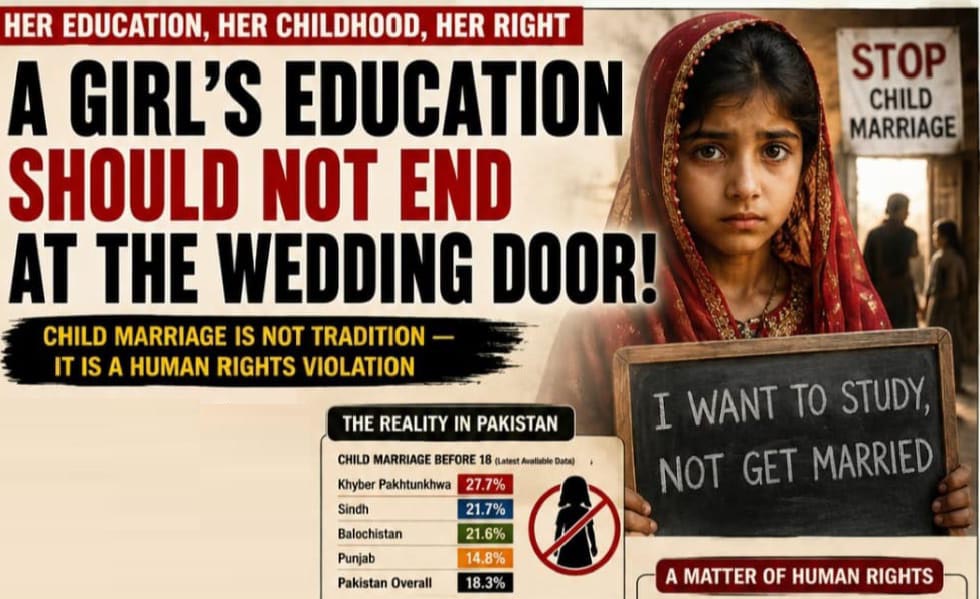
But for millions of girls around the world, including many in Pakistan, these dreams are often interrupted before they have the chance to become reality. The reason is child marriage — a practice that takes away a girl’s childhood, limits her opportunities, and places restrictions on her future.
Child marriage is not merely an early wedding. It is the denial of fundamental rights. It can take away a girl’s right to education, personal development, decision-making, and the opportunity to reach her full potential. When a child is pushed into marriage before she is emotionally, physically, and mentally prepared, society does not protect her. Instead, it takes away choices that every human being deserves.
According to UNICEF, Pakistan has millions of women and girls who were married before reaching the age of 18. The issue is strongly connected with education. Girls who remain in school are less likely to experience child marriage because education gives them knowledge, confidence, and greater control over their own lives.
Education is not a privilege reserved for some girls. It is a basic human right.
When a girl is forced to leave school because her family or society believes marriage is more important than education, the loss is not limited to one individual. A future doctor, teacher, journalist, scientist, entrepreneur, or community leader may never get the opportunity to contribute her talents to society.
There are many reasons behind child marriage, including poverty, lack of awareness, social pressure, gender inequality, and limited educational opportunities. In some cases, families believe they are making the right decision for their daughters. However, protecting a girl does not mean ending her education or limiting her dreams. Real protection means providing her with education, safety, dignity, and the freedom to develop her potential.
Human rights are based on a simple but powerful principle: every person deserves equal respect, dignity, and opportunity. A girl should never be considered less valuable because of her gender. Her dreams, abilities, and ambitions matter just as much as anyone else’s.
Our society must seriously reflect on one important question: What kind of future are we creating if we encourage our daughters to dream but do not give them the opportunity to achieve those dreams?
The answer begins with education.
Every girl who remains in school represents hope for a stronger and more developed Pakistan. Every girl protected from child marriage represents a future strengthened. Every family that chooses education over early marriage contributes to building a society where daughters are valued not only as wives or family members, but as individuals with rights, abilities, and dreams.
A girl’s childhood belongs to her. Her education belongs to her. Her future belongs to her.
We must not close the door of education and open the door of marriage too early. A girl deserves the time to grow, learn, understand the world, and discover her own potential.
Let our daughters study first, dream first, and build their futures first — and let marriage come when they are ready, with dignity, maturity, and choice.