
















By: Maryam Wahab
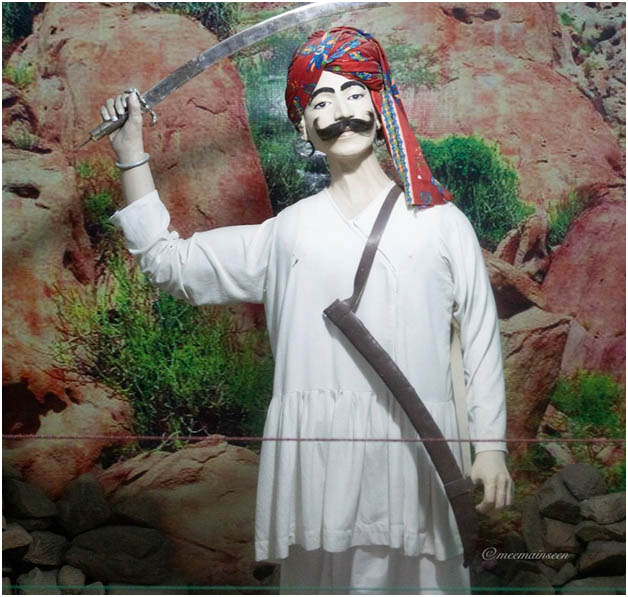
In 1843, Sir Charles Napier successfully annexed the Emirate of Sindh into the British Empire, infamously telegraphing back the Latin pun “Peccavi” (“I have sinned”). While the British East India Company assumed they had crushed all regional defiance, the rugged Parkar region of Tharparkar remained an active hotbed of rebellion. As detailed in VeerjiKolhi’s comprehensive historical account, Amar RooploKolhi, a local warrior named RooploKolhi (born Rupaji Gohil in 1818 in Konobhari village) stood at the heart of this resistance. He proved that the local thirst for sovereignty could not be broken by colonial forces.
While mainland India’s War of Independence was suppressed by 1858, Tharparkar rose in a coordinated rebellion the following year. On April 15, 1859, local forces led by RooploKolhi, alongside regional leader Rana Karan Singh of Nagarparkar and Soda Kalji, launched an armed insurgency. As documented in the colonial records of the Gazetteer of the Province of Sind, an army of 8,000 Kolhi fighters descended from the granite peaks of the Karoonjhar Mountains armed primarily with traditional weapons like swords and bhalas (spears). They ambushed colonial outposts, seized the Nagarparkar treasury, and disrupted British revenue channels. The tactical shock of this guerrilla offensive caused severe casualties among the British forces, compelling the British Commander, Colonel Tyrwhitt, to make a chaotic retreat on camelback toward Mirpurkhas. This stunning victory temporarily stripped the British Raj of its administrative control over the desert expanse.
Determined to re-establish control, Colonel Tyrwhitt returned with heavily armed military reinforcements mobilized from Karachi, Hyderabad, and Ahmedabad. The colonial forces struggled against the Kolhi fighters, who used the natural cave networks of the Karoonjhar terrain to launch swift guerrilla strikes.
The tide turned tragically against the resistance due to internal espionage. A local informant named Hasispuri spied on the movements of the rebels, revealing their positions to the British army. During a fierce confrontation at the Pag Wool water well, where the Kolhi fighters had gathered to fetch water, the British surrounded and captured RooploKolhi.
Colonel Tyrwhitt recognized Rooplo’s influence and attempted to break the rebellion through diplomacy and terror. He offered Rooplo a conditional amnesty, vast wealth, and land if he would apologize, accept British vassalage, and reveal the secret hideouts of Rana Karan Singh. Rooplo flatly refused.
In an attempt to terrorize the local public, British soldiers subjected Rooplo to brutal torture in front of his fellow villagers: they plucked out his fingernails, wrapped his fingers in oil-soaked cotton, and set them ablaze. Throughout the ordeal, Rooplo stood completely unyielding.His resilience was deeply anchored by his wife, Menawaati Kolhi, who actively supported the freedom fighters. When pressured by the community to yield to save his life, Menawaati famously urged her husband:
“Do not surrender, Rooplo. Let our blood stain these mountains, but do not let our generations say a Kolhi bowed his head to foreign masters.”
After a kangaroo military trial, RooploKolhi was sentenced to death. On August 22, 1859, at the age of 41, he was hanged from a tree on the banks of the Gordharo stream at the base of the Karoonjhar Mountains. Alongside him, the British executed hundreds of his comrades to suppress further mutiny.
Today, RooploKolhi’s sacrifice is deeply etched into the heritage of Sindh. To honor his indomitable spirit, the Sindh Tourism Development Corporation, established the RooploKolhi Resort in Nagarparkar. Under the provincial government’s vision to promote cultural tourism, this facility serves as a vital visual anchor for travelers, reminding them that the grand granite peaks of Karoonjhar once echoed with the battle cries of a legendary freedom fighter.
However, brick-and-mortar hospitality must only be a gateway to a deeper historical reclamation. While the resort stands as a commendable tribute, a much more rigorous, concerted effort is required from the Government of Sindh to fully explore, document, and broadcast the glorious history of this 1857 rebellion. This political will must not only honor the past but also empower its living legacy, epitomized by leaders like Krishna Kumari Kohli, the first Hindu Dalit woman elected to the Senate of Pakistan, who directly hails from Nagarparkar and embodies the resilient spirit of the region. True promotion demands replicating the provincial government’s remarkable developmental efforts seen in the higher education sector—such as establishing the state-of-the-art NED University Campus, the Thar Institute of Engineering, Sciences and Technology (TIEST)—and channeling that same commitment into building dedicated historical museums, preserving battlegrounds like the Shaheed RooploKolhi Memorial, and ensuring that the indigenous resistance of the Thari people is permanently etched into the national consciousness.
In fact, the bleeding soil of Tharparkar still cradles the memory of Rooplo Kohi, a son who proved to the world that the mountains don’t bow. Though his voice was choked by a colonial noose, his ultimate sacrifice remains an eternal heartbeat of freedom that will never be forgotten. His sacrifice echoes forever through the Karoonjhar peaks, urging today’s students to remember that true education means standing firm for truth, protecting your heritage, and never compromising your integrity under pressure.
========== X ========== X ==========