















Dr. Syed Mehboob
Economic and Political Analyst
http//: www.thenewslark.com
Khana e Kaaba and Masjid e Nabvi, which jointly are called” Harmain Shareefain,” are the most revered, sacred, and highly respectable places for the Muslims of 1.9 billion around the world. Every muslim dreams and desires to have Ziarah of these holy places. It is a matter of great pride for the whole Pakistani nation that Pakistani Forces are acting as the “Defenders of Harmain Shareefain” ( Alhamdulillah).
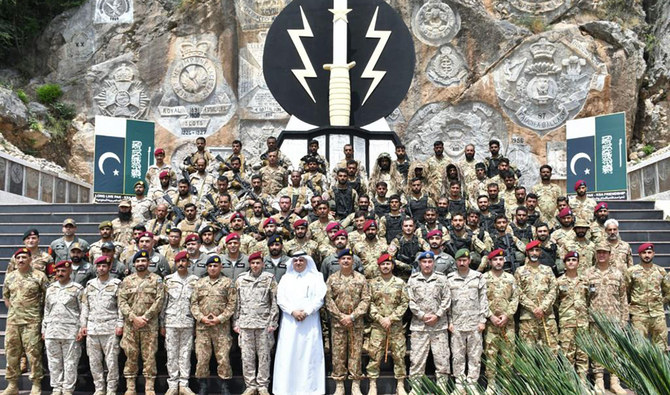
Pakistan has deployed a military contingent, including fighter jets and supporting personnel, to Saudi Arabia’s King Abdulaziz Air Base. This deployment follows a Strategic Defense Agreement (SMDA) signed in 2025, committing to collective security where an attack on one country is deemed an attack on both. This is Pakistan’s first visible military move under a mutual defense pact. A mix of fighter and supportive jets landed at King Abdul Aziz Air Base in Saudi Arabia.
After May 2025, when Pakistan defeated Indian forces, which is six times larger than that of Pakistan, and has a defense budget nine times bigger than that of Pakistan. This victory raised the importance of Pakistan enormously, and the Saudi Arabia-Pakistan Defense Agreement was the outcome of that victory. Pakistan also emerged as “ the Global Peace Promoter” as it brought both Iran and the US to the table to negotiate, which was the first highest-level table talks between Iran and the US after the 1979 Iranian revolution, a gap of about 47 years.
Iran wanted an assurance that we would not use Saudi soil to attack Iran, and Pakistan has provided such assurance to Iran; now, there is no justification for attacking Saudi Arabia. Pakistan is the sixth-largest military power by active troops, and in terms of training, toughness, and professionalism, it has the best forces in the world.
Saudi Arabia has historically remained Pakistan’s closest defense partner in the Middle East, with both countries sharing extensive military and intelligence cooperation. Military relations between the two were expanded in 1967. Former Saudi intelligence chief Prince Turki bin Sultan described the level of cooperation as “probably one of the closest relationships in the world between any two countries”, while Pakistan’s ambassador to Saudi Arabia, Naeem Khan, stated that Pakistan considered Saudi Arabia’s security as a “personal matter. The Pakistan Air Force has been in contact with the Royal Saudi Air Force (RSAF) since the early 1960s. Following grievances over British military cooperation in the 1960s, King Faisal Shaheed turned to Pakistan’s assistance for air force training and maintenance. In the 1960s, Pakistan helped the Royal Saudi Air Force (RSAF)
A protocol was signed between Pakistan and Saudi Arabia on 14 December 1982 following the latter’s request for military manpower assistance. Throughout the 1970s and 1980s, up to 15,000 Pakistani troops were stationed in Saudi Arabia to provide defense to the country. Some of them were part of a brigade combat force positioned near the Israeli Jordanian-Saudi border. As of the Gulf War in 1991, up to 13,000 troops and 6,000 advisers from Pakistan were posted in Saudi Arabia.Under the 1982 protocol, cooperation was widened to include military training, defense production and sharing, and joint exercises. Contingents of the Pakistan Armed Forces have frequently participated in joint military exercises inside Saudi Arabia in conjunction with the Saudi Armed Forces. Pakistani military presence in the kingdom continues presently, providing Saudi Arabia with support against internal and external regional threats.
The Pakistan Navy and the Royal Saudi Navy also share wide-ranging maritime cooperation, having conducted a series of joint naval exercises. Officers of the Royal Saudi Navy were provided training by the Pakistan Navy during the RSN’s formative years.
The Pakistani force consists of fighter and support aircraft belonging to the Pakistani Air Force, to enhance joint military coordination, raising the level of operational readiness between the armed forces of the two countries.
The Pakistani deployment was aimed at reassuring Riyadh that Islamabad would help defend the kingdom from any threat.
Pakistan and Saudi Arabia have long shared a multifaceted relationship rooted in strategic military cooperation, mutual economic interests, and shared Islamic heritage. These ties have encompassed economic assistance and energy supplies, with Saudi Arabia being a significant source of financial aid and oil for Islamabad.
Reports indicate that between 10 and 18 Pakistani aircraft arrived in Saudi Arabia, possibly including JF-17 Block III fighters alongside airborne support platforms designed for surveillance, command, and logistical sustainment.
Saudi officials also referred to a broader contingent of approximately 13,000 Pakistani personnel under the wider strategic defence agreement, indicating that the deployment extends beyond aviation into force protection, logistics, and command integration.
The decision to position those assets specifically inside Saudi Arabia’s Eastern Province indicates that Riyadh and Islamabad are prioritizing protection of oil terminals, petrochemical complexes, and Gulf maritime corridors over symbolic political signaling.
Security of the Energy Corridor includes infrastructure whose disruption would immediately affect global oil prices, maritime insurance costs, and commercial shipping through the Gulf, creating consequences extending far beyond Saudi Arabia.
Such a scenario would activate the September 2025 defence pact and could transform an Iranian strike against Saudi infrastructure into a confrontation involving nuclear-armed Pakistan. (continued)