


















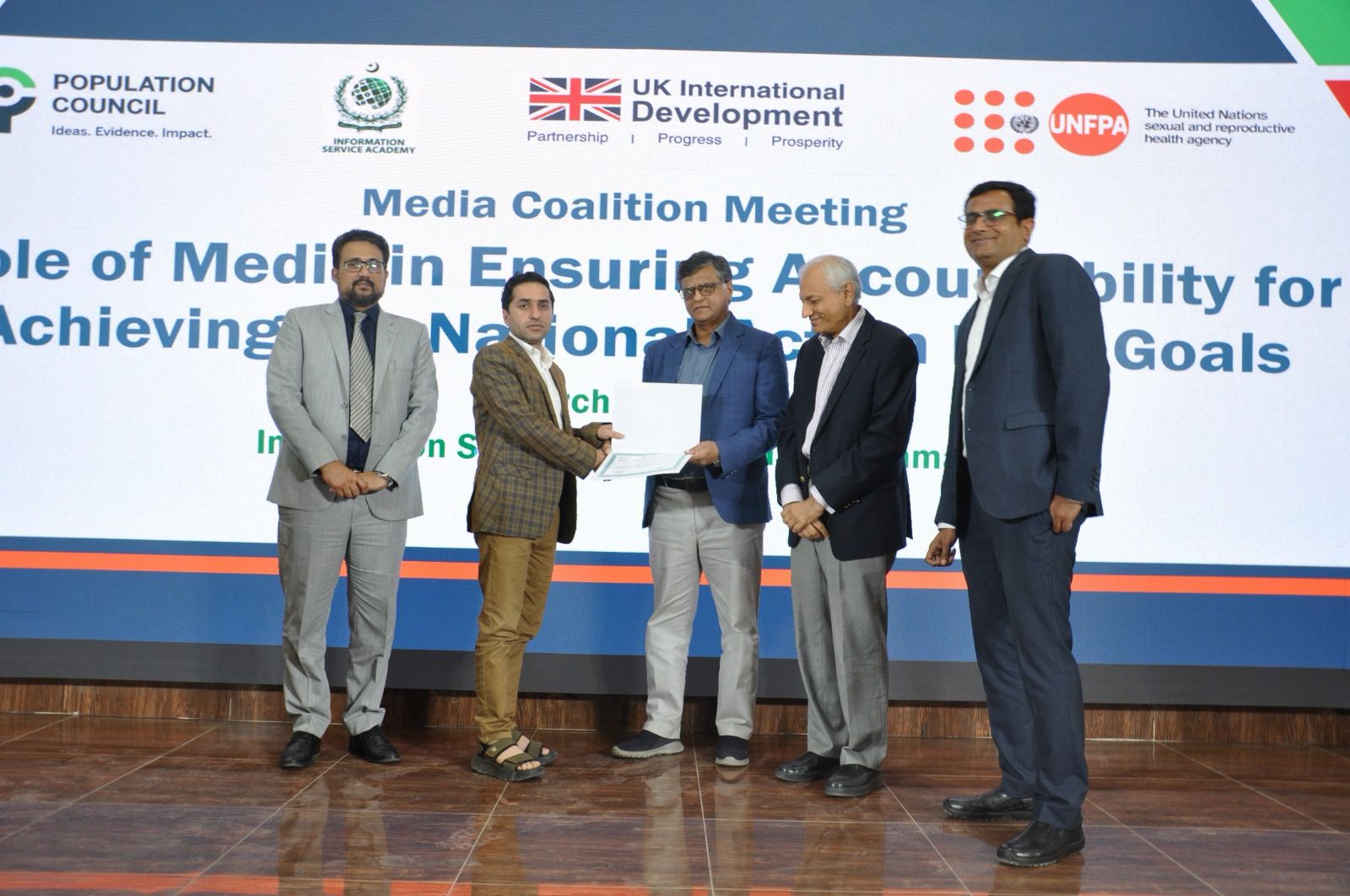
Islamabad: The Population Council, in collaboration with the Information Service Academy (ISA) and the United Nations Population Fund (UNFPA), convened a Media Coalition Meeting in Islamabad to strengthen the media’s role in advancing Pakistan’s National Action Plan on population under the Council of Common Interests (CCI). The meeting brought together senior journalists, communication experts, and public sector representatives to discuss how evidencebased reporting can improve accountability and public understanding of demographic challenges.

In line with CCI recommendations, the Population Council, in collaboration with UNFPA, established the Media Coalition in 2018, beginning with 31 journalists and gradually expanding into a diverse network of more than 60 members representing print, TV, radio, digital, and locallanguage outlets across Pakistan. With strong provincial and district-level representation, the coalition has produced over 2,000 stories on population, family planning, health, and the crosssectoral impact of rapid population growth and development issues, serving as a platform that connects journalists with data, research, and policymakers to strengthen evidence-based reporting.
Speaking at the opening session of the Media Coalition Meeting, Dr. Ali Mir, Senior Director, Population Council, highlighted the critical role of responsible journalism in shaping national discourse. “When journalists elevate facts over assumptions, they become a force for better governance and better outcomes,” he said, emphasizing that sustainable progress depends on media highlighting policy gaps, service barriers, and community realities.
Mr. Adnan Akram Bajwa, Director of the Information Service Academy, reaffirmed ISA’s commitment to supporting journalists through credible information and professional capacity building. He noted that public trust in institutions grows when reporting is grounded in accuracy and clarity. “Media is not just a messenger—it shapes how families understand their options and how institutions respond to their needs,” he said.
In his remarks, Ikram ul Ahad, Manager Communication, Population Council, underscored the human impact of Pakistan’s reproductive health challenges. He noted that maternal mortality remains disproportionately high among poor rural women who face persistent barriers to family planning services. Each year, Pakistan witnesses an estimated six million unintended pregnancies, of which 3.8 million end in abortions, many under unsafe conditions. “These numbers reflect a crisis of access,” he said. “When women cannot obtain contraception, they lose control over their health, safety, and future.”
Members of the Media Coalition, Zafar Sultan (PTV) and Daniyal Umar (Samaa TV), presented a consolidated stocktaking exercise conducted collectively by all coalition members on provincial progress in implementing the CCIendorsed National Action Plan on Population across Punjab, Sindh, KP, Balochistan, and Islamabad. Their presentation summarized insights from all members working in the field, highlighting consistent patterns across regions, including urban–rural disparities in health services, shortages of female health workers, recurring contraceptive supply disruptions, uneven policy implementation, and limited outreach of services in district areas. They emphasized that sustained media reporting is vital for exposing systemic gaps and ensuring that provincial commitments translate into measurable improvements for communities.
Participants stressed the need for deeper media coverage of population-related issues—particularly rural health inequities, highrisk pregnancies, and limited access to reproductive health services—to strengthen public awareness and policy accountability. Journalists agreed that evidencedriven reporting can amplify community voices, illuminate service delivery failures, and ensure demographic issues remain central to national policy dialogues.
Concluding the meeting, Dr. Jamil Ahmad Chaudhry, Program Specialist, UNFPA, emphasized the importance of collective action in safeguarding the health and rights of women and girls. “Every preventable maternal or newborn death is a reminder that urgent action is not optional—it is our obligation,” he said. The meeting closed with a shared commitment among media professionals, government institutions, and development partners to strengthen collaboration and accelerate progress toward Pakistan’s reproductive health and population goals.