
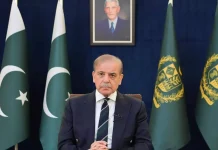













ISLAMABAD:Prime Minister Muhammad Shehbaz Sharif Monday, announced a detailed energy saving and austerity plan to cut government expenditure and reduce the use of fuel in the public and private sector to stave off effects of high oil prices on the general public.
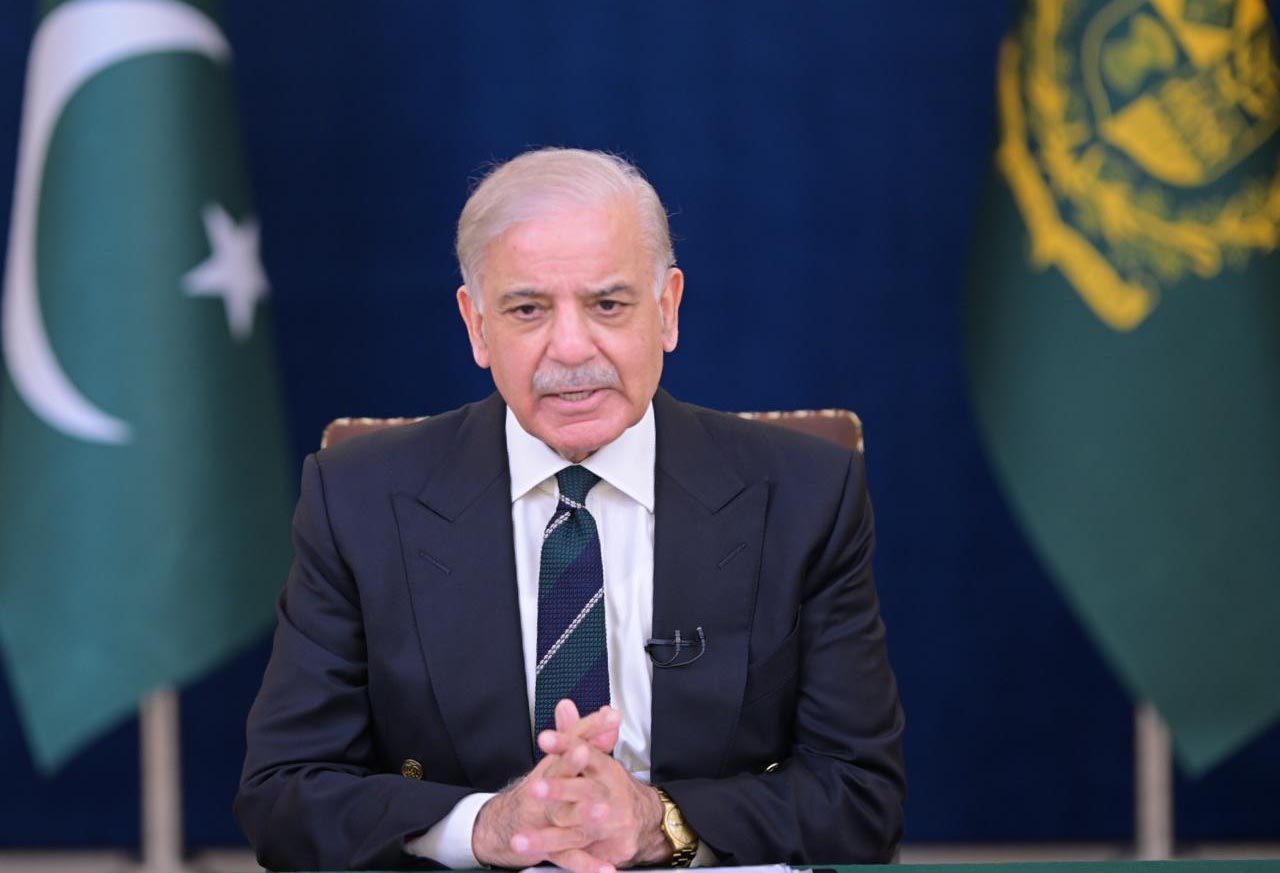
After finalizing the plan in a meeting of federal and provincial governments meant to cut government expenditure and provide relief to the public, the Prime Minister announced the measures in a televised speech.
The Prime Minister informed that for the next two months, 50 percent reduction would be made in the fuel received by government department vehicles. It does not include ambulances and public buses.
“All 60 percent of vehicles of government departments are being grounded to save fuel. For the next two months, ministers, advisors, and special assistants will not draw salaries. The salaries will be spent on public relief. The salaries of members of Parliament will be cut by 25 percent,” he continued.
He said two-day salaries of officers in grade 20 and above – whose salaries are more than 300,000 rupees – will be deducted for use of public relief.
The expenses incurred by all government departments, except for the salaries, are being reduced by 20 percent.
He said that a complete ban has been imposed on the purchase of furniture, air conditioners, and other items in government departments. A complete ban has also been imposed on foreign visits by federal and provincial ministers, advisors, special assistants, and government officers, except for those visits that are essential for the national interest.
This ban will also apply to the Prime Minister, Chief Ministers, and Governors.
Teleconferencing and online meetings will be given priority so that maximum fuel saving is possible. Government dinners and Iftar parties are completely banned, he added while revealing details.
He said to cut expenditure, seminars and conferences will not be held in hotels but at government premises and a special committee will give approval for this purpose.
The Prime Minister said decisions have also been made regarding the government and private sector for energy conservation.
In the government and private sector, except for essential services, 50 percent of the staff will work from home. Offices will be open for only four days a week, he added.
An additional holiday is being given per week to conserve oil. This will not apply to banks. The decision to work from home and an additional weekly holiday will not apply to the sectors of industry and agriculture.
Further, all schools are being given two weeks of vacation and online classes are being started immediately in all higher education institutions, he added.
While giving reasons for the recent increase in fuel prices by the government, he said a very serious and dangerous situation was facing the region.
“Unfortunately, the entire region, Iran and the Middle East, is currently in the throes of a dangerous war. The loss of innocent human lives, the suffering of the displaced and the impact on peace are a cause of deep concern for all of us,” he remarked.
He said Pakistan was trying its best in this tense situation to resolve the issues through deliberation and diplomacy.
“On the other hand, we are also facing terrorism on our western borders. In response to the infiltration and attacks by the facilitators of the terrorists in Afghanistan, the brave forces, under the leadership of our determined and brave General Syed Asim Munir, are performing their sacred duty of protecting the security and sovereignty of the beloved homeland and protecting the lives and property of the citizens with utmost dedication.”
He said the government and people of Pakistan expressed deep sorrow over the martyrdom of Ayatollah Seyyed Ali Khamenei, his family and innocent Iranian brothers and sisters as a result of the Israeli abhorrent attacks on Iran. “We strongly condemn these attacks.”
He said, “Pakistan also strongly condemns the attacks on its brotherly Muslim countries; Saudi Arabia, the United Arab Emirates, Qatar, Kuwait, Bahrain, Jordan, Lebanon, Oman, Turkiye and Azerbaijan, and expresses regret over the loss of life.”
“These attacks pose serious threats to the peace and stability of the entire region,” he asserted, adding, “We have had detailed discussions with the leaders of these brotherly countries, and on your behalf, I have conveyed a message to the people and leadership of these countries that Pakistan stands shoulder to shoulder with them in this hour of trial.”
“We consider the security and stability of these brotherly countries as part of our own security and stability,” he added.
He drew attention to the fact that “in today’s world, a crisis that arises in one country spreads to other countries in a few days”.
He mentioned that the price of crude oil in the global market, which was about $60 per barrel a few days ago, had suddenly increased to more than $100.
He warned that if the situation continued to deteriorate in this way, these prices could get out of control.
He noted that Pakistan’s economy, agriculture, transportation and much of daily life were reliant on the supply of oil and gas from the Gulf.
“Keeping this fact in mind, the government has taken extremely difficult decisions to stabilize the economy. Such administrative and economic decisions were not easy at all,” he stressed, adding, “We have introduced financial discipline and reforms in the energy sector so that the energy deficit facing Pakistan can be reduced.”
Shehbaz Sharif said the difficult situation at the global level was having an adverse effect on everybody.
However, he assured that the government was making every effort to keep Pakistan’s economy stable despite these most difficult global conditions. He said that due to the recent increase in petrol prices, the government had to undoubtedly take a very difficult and heartbreaking decision.
“My heart and mind went through a struggle while approving the oil price hike. My mind said there was no other way but to increase the prices, but my heart said that the poor should not be burdened.”
“I was suggested to increase the prices of petrol and diesel much more than the current increase. We tried to find a middle way out of this severe difficulty so that people should not be burdened,” he added.
He pointed to the difficult economic conditions that Pakistan had faced in the past years.
He recalled that there was a time when Pakistan was facing the threat of bankruptcy in the most difficult situation.
“We put aside political interest and took care of the interests of the state and the economy.”
He thanked people for fully supporting the government in difficult decisions and for showing patience and courage.
He said, “There has been a significant reduction in the inflation rate. The policy rate has almost halved. The value of the rupee is stable, and electricity prices have also been reduced with great effort.”
“This success is not the result of any single individual, but is the fruit of the prayers and joint struggle of the entire nation. Out of a sense of responsibility, I assure you once again that we will make every effort to minimize the burden on people.”
He empathised by saying that he was well aware of the fact that it was a burden on a father, mother and son when little money was left for the medicine of the elderly or when they worry about the educational expenses of their children.
He forewarned that oil prices will increase again inevitably, but he will make every effort to prevent shifting of the burden on the common man.
“Consultations and efforts are ongoing day and night to ensure that the burden does not fall on people. I will, God willing, not disappoint you.”
He urged the well-to-do people to step forward in the present precarious situation and help the vulnerable sections of society.
“Our history is a witness to the fact that our poor, hardworking workers and all those people who earn their livelihood by sweating day and night have always stepped forward and made sacrifices for the country. The time has come for the elite to step forward and play its role,” he added.
He cautioned the vested interests, hoarders and illegal profiteers of petrol and diesel not to try to gain illegal benefits; otherwise iron hand of law will come into force and strong action will be taken against such elements without discrimination. He said he had issued instructions to all provincial governments to protect consumers.
He said the world was facing a new challenge, the balance of power was changing and new alliances were being formed.
“At this delicate juncture, Pakistan once again needs brotherhood, solidarity and a sense of responsibility as much as it has ever needed before.”
“The blessed month of Ramazan teaches patience, selflessness, sacrifice and collective responsibility and reminds us that a strong and dignified nation moves forward in times of difficulty with prudence, patience, wisdom and mutual cooperation,” he concluded.
Earlier, a meeting was held to finalize austerity measures in a comprehensive review meeting chaired by the Prime Minister on the national economy in the context of the prevailing regional situation.
Deputy Prime Minister and Foreign Minister Ishaq Dar, Chief of Army Staff and Chief of Defence Forces Field Marshal Syed Asim Munir, federal ministers Khawaja Asif, Ahsan Iqbal, Jam Kamal, Azam Nazeer Tarar, Muhammad Aurangzeb, Ahad Khan Cheema, Musadik Malik, Attaullah Tarar, Sardar Awais Leghari, Shaza Fatima, and Ali Pervaiz Malik, Adviser to PM Rana Sanaullah, Minister of State Bilal Azhar Kayani, Chief Minister Punjab Maryam Nawaz, Chief Minister Sindh Syed Murad Ali Shah, Chief Minister Balochistan Sarfraz Bugti, Prime Minister Azad Jammu and Kashmir Faisal Mumtaz Rathore, Chief Minister Gilgit-Baltistan (Retd) Justice Yar Muhammad Nasir, Adviser to Chief Minister Khyber Pakhtunkhwa Mazhar Aslam, along with relevant senior government officials attended the meeting.
In the meeting, a detailed briefing was given on comprehensive measures for energy conservation across the country.
The participants held in-depth discussions on austerity and energy savings in light of the regional situation to ensure the stability of the national economy, leading to important decisions in this regard.