














By Brig Syed Karrar Hussain Retired
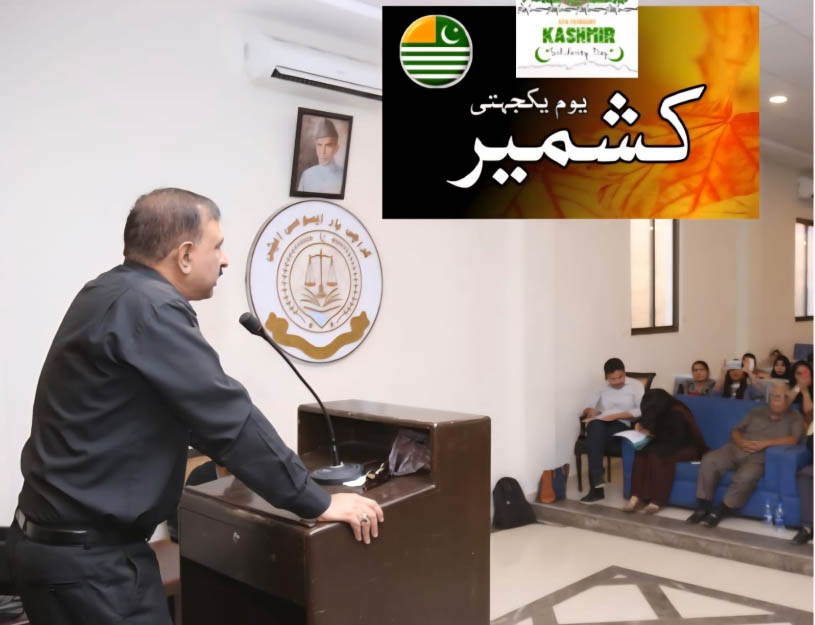
Every year on 5th February, Pakistan observes Kashmir Solidarity Day to reaffirm its unwavering moral, political, and diplomatic support for the people of Jammu and Kashmir. The day serves not only as an expression of solidarity but also as a reminder to the international community that the Kashmir dispute remains unresolved despite the passage of more than seven decades. It is a day to reflect upon the historical background of the conflict, the commitments made by the United Nations, the grave human rights violations in Indian-occupied Kashmir, Pakistan’s principled stance, and the collective responsibility of global powers to help resolve this long-standing dispute in accordance with international law and the wishes of the Kashmiri people.
Background of the Kashmir Dispute Between Pakistan and India
The Kashmir dispute originated at the time of the partition of British India in 1947, when the subcontinent was divided into two independent states: Pakistan and India. The princely state of Jammu and Kashmir, despite having an overwhelming Muslim majority and geographical contiguity with Pakistan, was ruled by a Hindu Maharaja, Hari Singh. Amid internal unrest and a popular uprising against his autocratic rule, the Maharaja controversially acceded to India in October 1947 under disputed circumstances.
This accession was immediately contested by Pakistan and, more importantly, rejected by the people of Kashmir themselves. The situation escalated into the first Indo-Pakistan war (1947–48), which ended with a ceasefire brokered by the United Nations. As a result, Kashmir was divided along what later became known as the Line of Control (LoC), separating Pakistan-administered Kashmir from Indian-occupied Kashmir.
Since then, Kashmir has remained a core dispute between the two nuclear-armed neighbors and a persistent source of regional instability. India’s consistent refusal to allow the Kashmiri people to exercise their right to self-determination has kept the region in a state of political uncertainty and conflict.
United Nations Resolutions on Kashmir
Recognizing the seriousness of the situation, the issue of Jammu and Kashmir was taken to the United Nations Security Council (UNSC) in 1948. After extensive deliberations, the UN passed a series of resolutions affirming that the final status of Jammu and Kashmir must be determined through a free and impartial plebiscite under UN supervision.
The most notable among these is UNSC Resolution 47 (1948), which called for:
A ceasefire between India and Pakistan
Withdrawal of forces
Holding of a plebiscite to ascertain the will of the Kashmiri people
Subsequent resolutions reaffirmed this commitment, clearly establishing Kashmir as an internationally recognized disputed territory, not an internal matter of India. Despite these binding resolutions, India has consistently failed to fulfill its obligations, refusing to hold the promised plebiscite while consolidating its military presence in the region.
The United Nations Military Observer Group in India and Pakistan (UNMOGIP) still exists, further underscoring the unresolved nature of the dispute. Unfortunately, the UN’s inability to enforce its own resolutions has deeply undermined its credibility in the eyes of the Kashmiri people.
Human Rights Violations in Indian-Occupied Kashmir
Indian-occupied Jammu and Kashmir is today considered one of the most militarized regions in the world, with hundreds of thousands of Indian troops deployed to suppress local resistance. Over the decades, numerous reports by international human rights organizations, including Amnesty International and Human Rights Watch, have documented widespread and systematic abuses.
These violations include:
Extrajudicial killings
Enforced disappearances
Arbitrary arrests and prolonged detentions
Torture and custodial abuse
Use of pellet guns causing permanent blindness
Restrictions on freedom of speech, movement, and assembly
The situation deteriorated sharply after 5 August 2019, when India unilaterally revoked Articles 370 and 35-A of its constitution, stripping Jammu and Kashmir of its special status. This illegal move was accompanied by a severe military lockdown, communications blackout, mass arrests of political leaders, and collective punishment of civilians.
Furthermore, India’s demographic engineering policies, including changes to domicile laws, aim to alter the Muslim majority character of the region—an act widely seen as a violation of international law and the Fourth Geneva Convention.
Despite mounting evidence, Indian authorities continue to deny or downplay these abuses, while independent journalists and observers are systematically barred from accessing the region.
Pakistan’s Stand on the Kashmir Issue
Pakistan’s position on Kashmir has remained clear, consistent, and principled since 1947. Pakistan regards Kashmir as an unfinished agenda of partition and firmly believes that the future of the region must be decided by its people in accordance with UN resolutions.
Pakistan has:
Extended unwavering diplomatic, political, and moral support to the Kashmiri people
Raised the issue at the United Nations, OIC, and other international forums
Highlighted Indian human rights violations through evidence-based advocacy
Offered dialogue with India based on justice, mutual respect, and international law
Pakistan has repeatedly emphasized that it seeks a peaceful resolution, not conflict, and considers lasting peace in South Asia impossible without a just settlement of the Kashmir dispute. Kashmir Solidarity Day is a reflection of Pakistan’s national consensus and moral obligation toward the oppressed people of Kashmir.
Responsibilities of the United Nations and World Powers
The continued suffering of the Kashmiri people raises serious questions about the role and effectiveness of the international community. The United Nations, having acknowledged the dispute and passed resolutions, bears a primary responsibility to ensure their implementation.
The UN must:
Actively pursue enforcement of its resolutions
Appoint special envoys or commissions to investigate human rights abuses
Ensure access for international observers and media
Similarly, global powers, particularly permanent members of the UN Security Council, cannot afford to remain silent spectators. Strategic interests, economic considerations, and geopolitical alliances should not override fundamental human rights and international justice.
World powers must:
Hold India accountable for violations of international law
Support meaningful dialogue between Pakistan and India
Press for demilitarization and protection of civilians
Stand firmly for the right of self-determination
Silence or selective concern only emboldens oppression and undermines the international rules-based order.
Conclusion
Kashmir Solidarity Day is not merely a symbolic observance; it is a reaffirmation of a moral and legal commitment to justice. The Kashmir dispute is not about territory alone—it is about human dignity, freedom, and the right of a people to decide their own future.
Until the Kashmiri people are allowed to exercise their democratic right through a free and fair plebiscite, peace in South Asia will remain elusive. The world must move beyond statements and adopt concrete measures to resolve this decades-old dispute.
History will ultimately judge the international community not by its declarations, but by its actions. Standing with Kashmir today is a stand for justice, international law, and the collective conscience of humanity.