


















Mukhtar Ahmed Butt
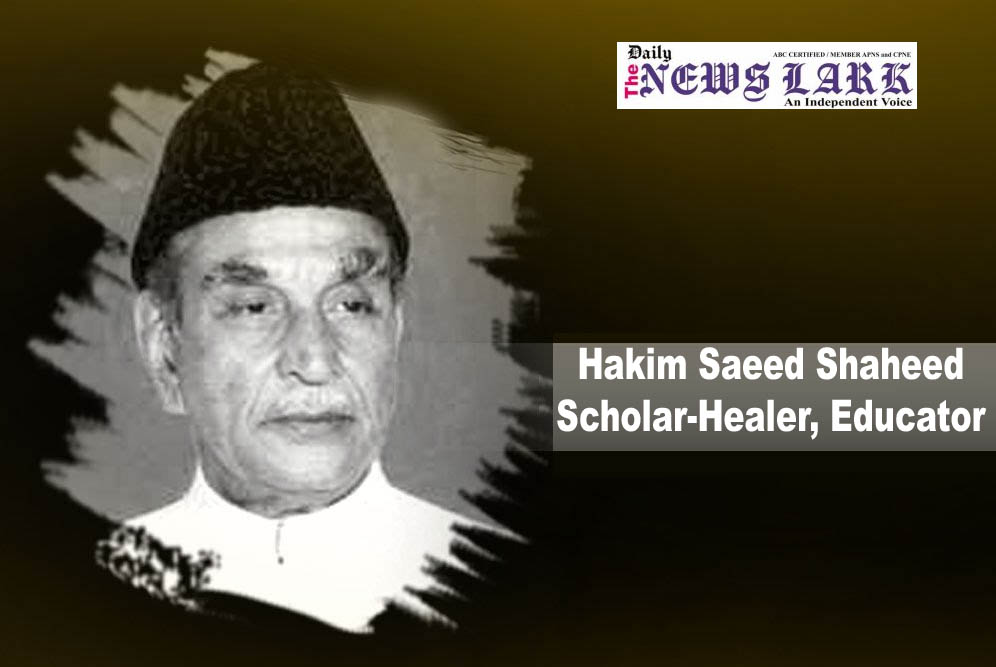
Hakim Muhammad Saeed was born in New Delhi on 9 Jan 1920 to an educated and religious Urdu-speaking family. His forefathers and family had been associated with the herbal medicine business, and had established the Hamdard Waqf Laboratories which today has emerged as one of the largest manufacturers of Unani medicines in the world what an achievement. Hakim Saeed entered school where he learned Arabic, Persian, Urdu, and English and studied the Quran. At the age of 18, he passed the university entrance test and went on to attend the University of Delhi in 1938. In 1942, Hakim Saeed obtained Pharmacy and BS in medicinal chemistry. Later on he joined Hamdard Waqf Laboratories as a junior researcher and participated in herbal quality control while formulating medicines. In 1945, Hakim Saeed obtained M.Pharm in Pharmacy from the same institution.After the independence of Pakistan in 1947, Hakim Muhammad Saeed left his hometown with his wife and daughter. They settled in Karachi. He established Hamdard Laboratories and served as its first director until his death in 1998. In 1952, he travelled to Turkey where he attended the Ankara University and was awarded a PhD in Pharmacy.Hakim Saeed began practicing medicine and continued to research Eastern medicines. Having established the Hamdard Laboratories in 1948, he was one of the driving forces in Pakistan for engaging the research in medical biology and medicines. In 1953, after his doctorate, he joined the Sindh University as the associate professor of Pharmacy and taught courses in organic chemistry.
In 1963, Hakim Saeed resigned due to differences with the Federal government. In 1964, he came into public limelight when hecriticized Lieutenant-General Wajid Ali Burkie, the Surgeon General of Army Medical Corps and high profile officer leading the Ministry of Health under the government of Field Marshal Ayub Khan. He criticized the General, saying, General Burkie used to say that Eastern medicine and homeopathy were quackery. Hakim Saeed fought bravely and succeeded in his mission. In1985, Hakim Muhammad Saeed established Hamdard University, where he served its first Vice-Chancellor. But, the best contribution of his life is the establishment of Madinat-al-Hikmah. It comprises Hamdard University with institutes as Hamdard College of Medicine and Dentistry, Hamdard Al-Majeed College of Eastern Medicine, Hafiz Muhammad Ilyas Institute of Herbal Sciences, Hamdard Institute of Education & Social Sciences, Hamdard Institute of Management Sciences, Hamdard Institute of Information Technology, Hamdard School of Law, Faculty of Engineering Science & Technology, Hamdard Public School and Hamdard Village School. Bait-al-Hikmah (the Library) is also a constituent part of Madinat-al-Hikmah. This is one of the biggest and best-stocked libraries of Pakistan.Look at the vision and foresight he displayed.
Hakim Saeed compiled over 200 books and journals in Urdu and English on Islam, Education, Pakistan, Science, Medicine and Health. Besides writing travelogues of countries he visited, he also wrote books especially for youth and children. He also edited some journals such as Hamdard Islamicus, Hamdard Medicus, Journal of Pakistan Historical Society ‘Historicus’, Hamdard Sehat and Hamdard Naunehal. Hakim Saeed participated in various international conferences on medicine, science, education and culture and travelled widely to many countries of the world. While in Pakistan he organised numerous international and national conferences seminars on topics of prime importance. He created two widely attended national forums, Hamdard Shura (for leaders of public opinion) and Naunehal Assembly (for children).He held offices and memberships in dozens of national and international organizations related to education and health care. He launched two journals, Hamdard Medicus and Hamdard Islamicus. Hamdard-e-Sehat was already being published under his editorship since 1940 and also appeared from Karachi in 1948. He launched a magazine for young readers, Hamdard Naunehal, and established a separate division, Naunehal Adab, for producing quality books for children.
He also served as 20th Governor of Sind. His tenure was from July 19,1993, to January 23,1994 for personal reasons. Hakim Saeed was an exponent of Eastern medicine who had treated patients from all over the world including Pakistan, Europe, Africa and the Middle East by the time of his death in October 1998. He helped get alternative medicine recognized by the World Health Organization (WHO). After a fifty-year career as a practitioner of Greco-Arab medicine, he was posthumously awarded the Nishan-e-Imtiaz by the Government of Pakistan in 2002 where as he deserved many awards during his life time.A great thinker son of Pakistan Hakim Muhammad Said Shaheed felt the need of establishing a think tank in Pakistan. It was in 1961 a beginning was made giving name of Sham-e-Hamdard.In this forum persons selected from different fields purely based on merit were picked up who would assemble once a month to discuss one major issue and give their input without any reservations. Recommendations framed after discussion were sent to government for considerations and drive benefit for the betterment of the country. The sphere of Sham-e-Hamdard was restricted to Karachi. Keeping in view popularity of this program close to year 1995 Hakim Muhammad Said Shaheed decided to change name of Sham-e-Hamdard to Shura Hamdard. To ensure merit and transparency Hakim Mohammad Said Shaheed invited members of Sham-e-Hamdard who have been participating regularly in meetings to become members of Shura Hamdard. While inviting he made following remarks.
“You are certainly the elite intellectuals of Pakistan and have as a whole edge over the Parliament and every assembly. Please come forward and help me in this national service. Let us work with utmost sincerity and good intentions and impartiality, and consider it a national duty to laud those in authority for their good deeds and take exception to their errors”
Responding to Hakim Said call large number of intellectuals from different fields who agreed with him became members of Shura Hamdard. First meeting of Shura Hamdard was held in 1995, now it is thirty years that meetings are held in different cities of Pakistan. Hakeem Said throughout his life has been emphasizing punctuality and attendance. Somehow or the other certain members ignore this criterion may be having genuine reasons must leave voluntarily if unable to participate. Shura Hamdard is well established and enjoys good reputation, Therefore, it must function in accordance with vision provided by Hakim Said.Hakim Muhammad Saeed left behind a daughter, Sadia Rashid, who is heading the Hamdard Foundation and the Hamdard Lab, and three granddaughters, Dr. Mahenaz Munir Ahmed, Amena Mian (who is married and settled in the United States with four children), and Fatima-Tus-Zahra Munir Ahmed, who has joined her mother at Hamdard.. Nation still waiting culprits to bring to justice, it was not loss of family but it was a national loss
HAZAROON SAAL NARGIS APNI BE NORI PEY ROOTI HAI
BARRY MUSHKAL SEY PAIDA HOTA HAI CHAMAN MEIN DEEDAWAR PAIDA
Thewriter is free lancer journalist and defence analyst