



















By Brig Syed Karrar Hussain Retired
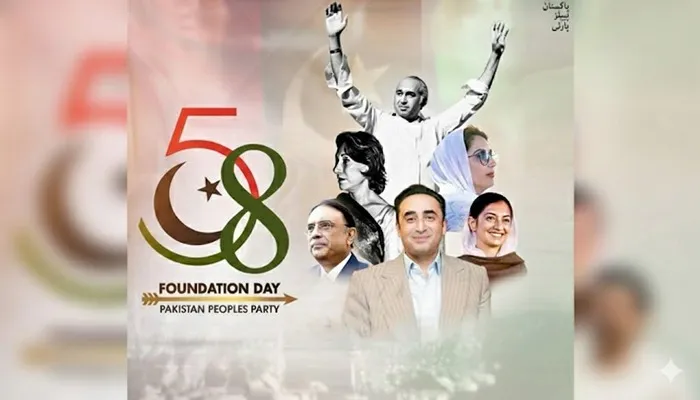
The Pakistan Peoples Party (PPP) occupies a unique position in the political history of Pakistan. It is one of the few political movements that emerged directly from the aspirations of the masses and later transformed into a national force advocating democracy, constitutional supremacy, and socio-economic justice. The Party’s Raising Day is not merely a commemoration of its inception on 30 November 1967; it is a tribute to a vision, a philosophy, and a struggle that shaped Pakistan’s political trajectory over five decades.
Founded in Lahore under the charismatic leadership of Shaheed Zulfikar Ali Bhutto, the PPP introduced a bold political philosophy rooted in empowerment of the underprivileged, equality of citizens, and people’s sovereignty. Over time, the party produced some of the most defining chapters in Pakistan’s political, constitutional, and democratic history. After the tragic martyrdom of Shaheed Mohtarma Benazir Bhutto, the leadership mantle shifted to Asif Ali Zardari, who steered the country through one of its most challenging periods with remarkable political wisdom and national unity.
Purpose of the Pakistan Peoples Party
The PPP was founded at a time when Pakistan faced political stagnation, military dominance, and deepening socio-economic inequalities. The founding purpose of the PPP was based on four major ideals:
1. People’s Sovereignty
The PPP firmly believed that power must rest with the people, not with a privileged few. Bhutto challenged the concentration of authority in the hands of elites and introduced a people-centric approach to statecraft.
2. Socio-Economic Justice
The unforgettable slogan “Roti, Kapra aur Makaan” captured the aspirations of millions. The objective was to eliminate economic disparities, introduce land reforms, and provide basic necessities to every citizen, regardless of class or background.
3. Democratic and Constitutional Struggle
The party pledged to fight for a democratic order where the constitution, parliament, and civil liberties would remain supreme. In an era of authoritarian rule, PPP’s formation marked the beginning of a powerful democratic resistance.
4. Empowerment of Marginalized Groups
The party mobilised labourers, peasants, students, women, minorities, and the working class—segments long ignored by traditional politics. It became a platform for the voiceless and downtrodden.
Through these guiding principles, the PPP evolved into the country’s most vibrant mass movement, redefining the contours of Pakistani politics.
Role and Services of Zulfikar Ali Bhutto
Zulfikar Ali Bhutto’s leadership remains one of the most influential periods in Pakistan’s national development. His accomplishments span constitutional reforms, foreign policy innovation, institutional development, and socio-economic uplift.
1. The 1973 Constitution — A Historical Achievement
Bhutto’s greatest legacy is the unanimous 1973 Constitution, which continues to serve as the backbone of Pakistan’s democracy. For the first time in national history, all political forces agreed on a federal parliamentary framework that ensured provincial autonomy, political rights, and institutional balance.
2. Laying the Foundation of the Nuclear Programme
In the aftermath of the 1971 war, Bhutto recognized the need for a strong national security policy. He initiated Pakistan’s nuclear programme, famously declaring, “We will eat grass, but we will make the bomb.” This strategic decision later secured Pakistan’s defence and regional stability.
3. Strengthening Pakistan’s Foreign Policy
Bhutto expanded Pakistan’s global footprint by building deeper relations within the Muslim world, China, and the developing nations. His successful hosting of the Islamic Summit Conference in Lahore in 1974 placed Pakistan at the centre of Muslim unity and international diplomacy.
4. Industrial, Labour, and Economic Reforms
Bhutto introduced far-reaching economic reforms:
Labour rights and unionization
Improved wages and job security
Nationalization of major industries
Establishment of key institutions like the Pakistan Steel Mills, Heavy Mechanical Complex, Port Qasim, and several industrial estates
These steps strengthened the industrial base and provided economic opportunities for the working class.
5. Birth of Popular Politics in Pakistan
Most importantly, Bhutto changed the political culture of Pakistan. He engaged directly with the people, listened to their grievances, and introduced a political consciousness that became the foundation of Pakistani democracy. His speeches, charisma, and empathy connected him with millions across the country.
Bhutto’s execution in 1979 was a major political tragedy, but his ideology survived, continued, and transformed through the leadership of his brave daughter, Shaheed Benazir Bhutto.
Role of Asif Ali Zardari After the Martyrdom of Shaheed Benazir Bhutto
The assassination of Shaheed Benazir Bhutto on 27 December 2007 was a national disaster. The country plunged into grief, political chaos, and uncertainty. It was in this critical moment that Asif Ali Zardari emerged as a stabilizing force and a guardian of national unity.
1. The Call of “Pakistan Khappay”
In the immediate aftermath of Benazir’s martyrdom, anger and unrest erupted across the country. Zardari’s historic words, “Pakistan Khappay” (Long live Pakistan), calmed the nation, controlled potential violence, and prevented the country from descending into civil strife. His call demonstrated statesmanship, restraint, and responsibility, placing national interest above personal tragedy.
2. Keeping the Party United During Its Hardest Hour
After the passing of its iconic leader, PPP was vulnerable to fragmentation. Zardari ensured unity by:
Bringing workers and leaders together
Maintaining organizational discipline
Respecting senior leadership
Preparing Bilawal Bhutto Zardari for future responsibilities
His leadership protected the party from internal divisions and preserved its political relevance.
3. The 18th Constitutional Amendment — A Game Changer
Under Zardari’s presidency, Pakistan witnessed one of its most important constitutional reforms: the 18th Amendment.
This amendment:
Restored parliamentary supremacy
Devolved major ministries to the provinces
Strengthened the Council of Common Interests
Enhanced provincial autonomy
Reformed the NFC Award for fair distribution of financial resources
It is widely recognized as a milestone in Pakistan’s democratic evolution.
4. Returning Presidential Powers to Parliament
Zardari voluntarily surrendered the President’s executive powers, including the authority to dissolve the National Assembly. This extraordinary step demonstrated a commitment to parliamentary democracy and constitutional rule—an unprecedented act in the country’s political history.
5. Building National Consensus Against Terrorism
The PPP government worked tirelessly to:
Strengthen national unity
Build consensus among political parties
Support security operations against militant groups
Introduce reforms in the Federally Administered Tribal Areas (FATA)
These steps helped stabilize the country during a dangerous period of extremism and terrorism.
Importance of Raising Day and the Road Ahead
The Raising Day of the Pakistan Peoples Party is a moment to reflect on its unmatched sacrifices, national services, and democratic vision. It reminds the nation of the guiding principles that shaped PPP’s foundation and continues to inspire its political journey.
Raising Day signifies:
Commitment to people’s empowerment
Struggle for democratic continuity
Dedication to constitutional supremacy
Defense of provincial autonomy
Support for labourers, farmers, students, and the working class
Continued resistance against dictatorship, extremism, and oppression
Today, under the leadership of Bilawal Bhutto Zardari, the party seeks to modernize its vision by addressing youth empowerment, economic revival, governance reforms, and inclusive development.
Conclusion
The Pakistan Peoples Party’s history is a saga of courage, sacrifice, democracy, and commitment to the people. From Zulfikar Ali Bhutto’s revolutionary politics to Benazir Bhutto’s fearless struggle, and from Asif Ali Zardari’s stabilizing leadership to Bilawal Bhutto’s emerging role—the PPP remains an essential pillar of Pakistan’s democratic system.
The Raising Day is a powerful reminder that Pakistan’s progress lies in democracy, tolerance, constitutional order, and socio-economic justice. The PPP, through its legacy and leadership, continues to carry the torch of these ideals and strives to build a more prosperous, peaceful, and inclusive Pakistan.