













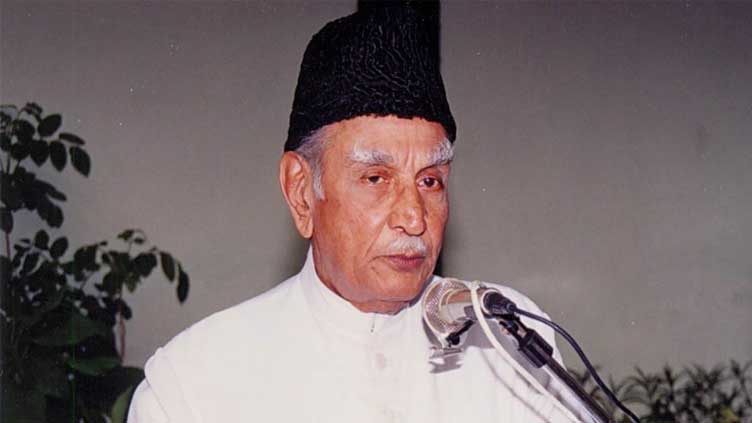

MUKHTAR AHMED BUTT
17 October 1998 is another darkest day in the history of Pakistan when Hakeem Muhammad Saeed was assassinated by a group of unknown assailants while he was on his way to attend a medical experiment at the Hamdard Laboratories in Karachi. His killing prompted Prime Minister of Pakistan, Nawaz Sharif to impose direct federal rule over the Sindh province but government failed to arrest the murderers
Hakeem Muhammad Said was born in Delhi, British India in 1920 to an educated and religious Urdu-speaking Muhajir family.He established the Hamdard Foundation in 1948, prior to his settlement in West Pakistan. In the next few years, the herbal medical products of the Hamdard Foundation became household names in Pakistan. Hakeem Muhammad Saeed authored and compiled approximately 200 books on medicine, philosophy, science, health, religion, natural medicine, literature, social issues, and travelogues. In 1981, Saeed became one of the founding member of the World Cultural Council, a nonprofit international organization, based in Mexico.He served as governor of Sindh Province from 19 July 1993 until 23 January 1994. Saeed was one of Pakistan’s most prominent medical researchers in the field of Eastern medicine.
His forefathers and family had been associated with the herbal medicine business and had established the Hamdard Waqf Laboratories in India before 1947, which today has emerged as one of the largest manufacturers of Unani medicines in the world.[1] Saeed attended the local school where he learned Arabic, Persian, Urdu, English and studied the Quran. At the age of 18, Hakeem went on to attend the University of Delhi in 1938. There, Saeed obtained a Pharmacy degree and a Bachelor of Science degree in medicinal chemistry in 1942.After his undergraduate education, Saeed joined Hamdard Waqf Laboratories as a junior researcher and participated in herbal quality control while formulating medicines.In 1945, Saeed attended the post-graduate course and obtained a master’s degree in pharmacy from the same institution. Before 1947, Hakeem Saeed was also involved in the Pakistan Movement activities.After the independence of Pakistan in 1947, Saeed left his hometown with his wife and only daughter. The family settled in Karachi, Sindh Province of West Pakistan. He established Hamdard Laboratories and served as its first director until his death in 1998. In 1952, Saeed travelled to Turkey where he attended the Ankara University and was awarded a PhD degree in pharmacy, then returned to Pakistan to devote his life to medicine research.
In 1985, Hakeem Mohammed Saeed founded Hamdard University, where he served as its first Vice-Chancellor and as a professor. Biggest achievement of his life is the establishment of Madinat-al-Hikmah campus in Karachi. It comprises Hamdard University with such institutes as Hamdard College of Medicine and Dentistry, Hamdard Al-Majeed College of Eastern Medicine, Hafiz Muhammad Ilyas Institute of Herbal Sciences, Hamdard Institute of Education & Social Sciences, Hamdard Institute of Management Sciences, Hamdard Institute of Information Technology, Hamdard School of Law, Faculty of Engineering Science & Technology, Hamdard Public School and Hamdard Village School.Where poor children are imparted free education including uniform free books and food. Some of the Bait-al-Hikmah (the Library) is also a constituent part of Madinat-al-Hikmah. This is one of the biggest and best-stocked libraries of Pakistan. Saeed participated in various international conferences on medicine, science, education and culture and travelled widely to many countries of the world. While in Pakistan, he organized numerous international and national conferences on topics of prime importance. Saeed created two widely attended national forums: Hamdard Shura (for leaders of public opinion) and Naunehal Assembly (for children). He held offices and memberships in dozens of national and international organizations related to education and healthcare. He launched two journals, Hamdard Medicus and Hamdard Islamicus. Hamdard-e-Sehat, which was already being published under his editorship since 1940, also appeared from Karachi in 1948. He launched a magazine for young readers, Hamdard Naunehal and established a separate division, Naunehal Adab, for producing quality books for children.After a fifty-year career as a practitioner of Greco-Arab medicine, he was posthumously awarded the Nishan-e-Imtiaz by the Government of Pakistan in 2002.He established Madinat al-Hikmah, a city of knowledge that houses Hamdard University, colleges, hospitals, and research centers. A great lover of children, Hakim Saeed believed that every child must go to school, and he worked tirelessly to promote education at all levels.Hakim Saeed also served as the Governor of Sindh, and founded the Hamdard Shura, a respected national think tank with branches in Karachi, Lahore, Rawalpindi, and Peshawar, where scholars and intellectuals debated national and international issues.
Hakim Muhammad Saeed Shaheed’s life remains an enduring example of devotion, integrity, and love for Pakistan. His institutions continue his mission of education, healing, and service to humanity.Her daughter Sadia Rashid is now holding the fort and carrying out his mission and ensures that unfinished agenda laid out by Hakim Muhammad Saeed Shaheed is fulfilled in true letter and spirit. May Allah grant her long life health and prosperity. Let us join all to pray Allah to grant highest place in Jannah and follow his slogans. “Love Pakistan, Built Pakistan” In the prevailing circumstances this slogan needs to be implemented in letter and spirit
The writer is freelance journalist and defence analyst