





















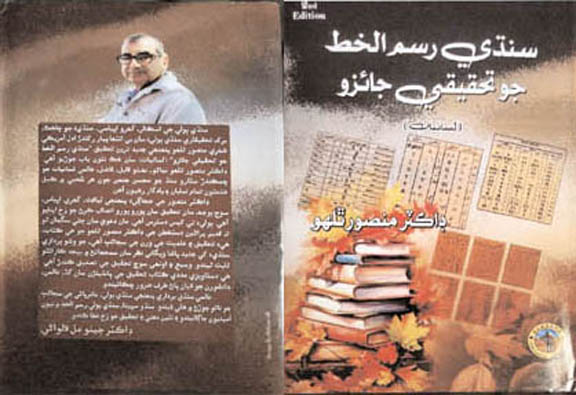

*Review by:* Ghulam Mustafa Khuhawar
*Author:* Dr. Mansoor Thalho
In the foreword to the book, renowned writer Dr. Jetho Mal Lallwani states that Dr. Mansoor has conducted an in-depth study of 13 scripts, highlighting the similarities in their letters, written forms, and structures.
Dr. Mansoor’s awareness, competence, extensive study, understanding, and research reflect his commitment to doing justice to this scholarly subject.
Dr. Jetho Mal further writes that this book by Dr. Mansoor is a true reflection of research and intellectual scholarship. The study demonstrates that the ancient symbols and written forms associated with the Sindhi script were used in ancient times not only for trade but also for written communication.
In the introductory remarks, Dr. Nawab Kaka writes that Dr. Mansoor Thalho has conducted a comparative study of Sindh’s forgotten scripts alongside scripts from different parts of the world. Through this study, he argues that letters, sounds, and symbols associated with our script remain in use in various writing systems around the world.
This book opens up several new avenues for researchers working on ancient scripts. It also offers new perspectives for reading and understanding the script of Mohenjo-daro.
The author writes that the Sindhi language was historically written in different scripts across Sindh, with more than one writing system in use. Sindhi was also used extensively in trade and commerce.
Dr. Mansoor Thalho explains that Sindhi possesses an ancient and rich writing tradition that gradually fell out of use because of neglect and a lack of awareness among its own people. Nevertheless, he argues that the letters of the Sindhi language have retained their distinctive written forms and beauty in the scripts of several other languages.
## Chapter One: Letters and Writing Systems of the Sindhi Script
The seals and other inscribed objects discovered during excavations at various archaeological sites in the Indus Valley contain written symbols and signs. According to the author, these symbols may be regarded as part of the writing system used by the inhabitants of the Indus Valley. Over time, these inscriptions developed different forms and sounds in various regions of Sindh.
The author states that the Indus Valley Civilisation maintained ancient connections with the Egyptian and Mesopotamian civilisations.
This chapter also contains charts illustrating different letters and symbols.
The author compares certain letters of a South American language with the Sindhi script and presents comparative charts showing similarities between Sindhi and other writing systems.
The researcher writes that the ancient Berber script may have developed from, or been based on, the Punic script. Some of its letters, he suggests, were adopted from South Arabian and North Arabian scripts.
The researcher provides charts of the Berber script, which is written from right to left in some of its forms.
The Berber language was historically spoken across North Africa, including parts of Egypt, the Siwa Oasis, and the Sahara region. The author also points out similarities between certain Berber written symbols and Roman numerals.
According to the researcher, several symbols in the Berber script resemble letters found in the Sindhi writing system.
## Chapter One-B: An Overview of the Ancient Writing Systems of Sindhi
In this chapter, Dr. Mansoor Thalho presents a chart of the Khudabadi script, an ancient writing system associated with the Sindhi language.
He also includes charts of several other historical scripts, including Shikarpuri, Shikri, Thatta’i, Kharai, Wingai, Rajai, Khwajaki, Memoni, Sehwan’i, and Landa’i.
These examples illustrate the diversity of writing systems historically associated with Sindhi and the different regions in which they were used.
## Chapter Two: The Relationship Between Sindhi and Other Languages
The researcher writes that, because water no longer flows into parts of the Indus Delta as it once did, the sea has engulfed several ancient settlements and archaeological sites.
He presents a comparative chart of the Multani and Sindhi scripts. He also discusses the symbols of the Telugu script known as Vatlu, explaining that some of its 36 symbols resemble letters in the Sindhi writing system.
The researcher identifies similarities among numerous letters and presents a comparative chart illustrating the resemblance between Sindhi, Gujarati, and Multani scripts.
He also provides a comparison of the Sindhi and Khwajaki scripts.
## Chapter Three-A: Research on Symbols Discovered at Bhambhore
Dr. Mansoor Thalho also examines symbols discovered at Bhambhore.
The author writes that certain symbols associated with the Tronic Notes inscriptions resemble those found on seals from the Indus Valley. A comparative chart is included to illustrate these similarities.
## Chapter Three-B: Two Aspects of a Single Script
This section examines different forms of the numeral three across various writing systems. Comparative charts are provided to demonstrate the differences and similarities in the way the numeral is written.
The author also discusses inscriptions from the Stone Age, noting that some ancient symbols appear similar to tools or implements.
## Chapter Four: Comparative Study of Letters in Different Scripts
In this chapter, the author compares individual letters from several writing systems.
The researcher argues that some symbols associated with ancient stone inscriptions continue to appear in modern scripts used by different languages today.
On page 122, the researcher writes that Etruscan inscriptions were discovered in the city of Cortona, Italy. According to his comparative study, several of these inscriptions resemble those found in the Indus Valley.
The author also refers to two tablets bearing similar inscriptions discovered at Mohenjo-daro. He considers these similarities evidence suggesting that the Indus Valley Civilisation had close and extensive connections with other civilisations around the world.
## Chapter Five: Readings of Ancient Stone Inscriptions
The author writes that the Indus Valley Civilisation was extensive in geographical reach and maintained significant connections with other ancient civilisations. He particularly highlights its relationship with Mesopotamian and Egyptian civilisations.
The researcher states that a stone preserved in the Sana’a Museum in Yemen bears symbols resembling both the Musnad script and the Indus script. On examining the two sets of symbols, he observes similarities between them and the signs found in Indus inscriptions.
The researcher also discusses certain symbols associated with the Tajik language, which he compares with signs discovered at Mohenjo-daro and other Indus Valley sites. A chart of the Tajik script is included in the book.
Furthermore, the author points out that several letters in Italian writing systems resemble symbols found at Mohenjo-daro.
## Chapter Six: Relationships and Connections Between Letters
The researcher writes that, according to some language specialists, the seals discovered at Mohenjo-daro date back approximately 5,000 years. He emphasises the historical significance of this ancient written record and argues that the inhabitants of the Indus Valley used the Indus script for writing and reading.
The author also highlights similarities between the writing systems associated with the Etruscan civilisation and those of the Indus Valley Civilisation.
### The Sindhi Script and the Japanese Alphabet
The researcher observes that certain written characters in the Sindhi script resemble characters in the Japanese Hiragana writing system.
Comparative charts of the characters from both writing systems are included to demonstrate the similarities identified by the author.
## Chapter Seven: Ashokan and Brahmi Inscriptions and the Sindhi Script
In this chapter, the author presents the views of various researchers regarding the Indus script. He also provides an outline of the Serbian writing system.
The researcher argues that certain symbols in the Sindhi script resemble characters found in inscriptions associated with the Ashokan and Brahmi periods.
He further suggests that some symbols in the ancient Neguev script resemble written characters associated with the Sindhi script.
The author includes a comparative chart to illustrate similarities between Chinese writing and inscriptions from the Indus Valley.
He also argues that the ancient Musnad script of Arabia has a close relationship with the writing system of the Indus Valley Civilisation.
## Conclusion
Dr. Mansoor Thalho’s research seeks to demonstrate that the influence of the Indus script can still be traced in writing systems used in different parts of the world. Through comparative charts, historical references, and the examination of inscriptions, the author presents a wide-ranging exploration of similarities between the Sindhi script and numerous ancient and modern writing systems.
The book also portrays the Indus script as part of a prosperous civilisation in which writing played an important role in trade and commerce.
The author ultimately advances the view that the Sindhi language and its ancient writing traditions played a significant role in the development of early linguistic and cultural connections, whose influence, he argues, has continued across the centuries.
This work offers readers an opportunity to explore the historical significance of Sindhi writing and encourages further research into the origins, development, and relationships of ancient scripts.