


















By Brig Syed Karrar Hussain (Retd.)
There are some people who become old without ever becoming outdated. They may walk slowly, read the newspaper with a magnifying glass, forget where they kept their spectacles while the spectacles are sitting on their nose, and ask the same question three times—but they still possess something that no smartphone, computer or artificial intelligence can provide: experience.
Old People’s Week is therefore not merely a week for remembering elderly people. It is a reminder that every young person is travelling towards the same destination. Today we may be laughing at Grandpa’s old-fashioned habits; tomorrow somebody may be laughing at ours.
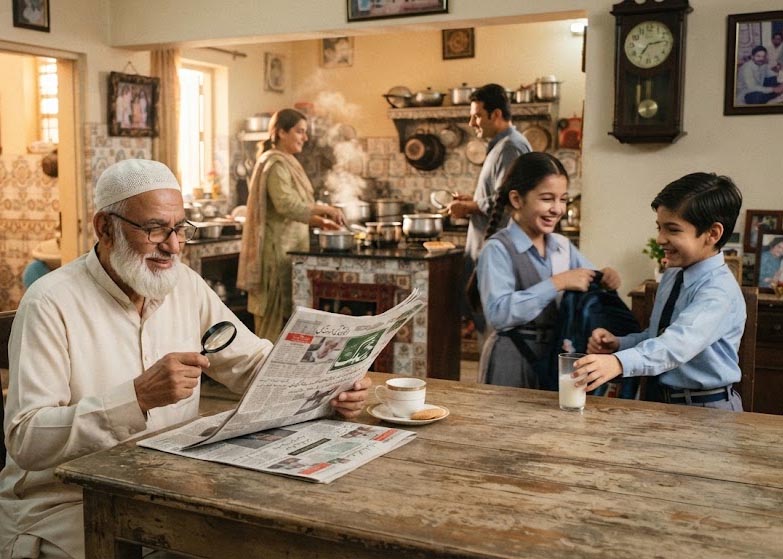
Imagine a typical Pakistani household.
Grandfather wakes up at five in the morning. Nobody else is awake. He performs his prayers, reads the newspaper and waits patiently for the rest of the family to wake up. By eight o’clock, the house is full of activity.
“Beta, where is my mobile?”
“It is on the table, Dad.”
“No, it isn’t.”
Five minutes later, everybody discovers that the mobile is in his pocket.
Then comes the television.
“Please change the channel.”
“Dad, you have the remote in your hand.”
“Oh! I was wondering why nobody was listening to me.”
And then comes the famous sentence:
“In our time, things were different.”
The children smile. The grandchildren laugh. But perhaps the old man is right.
In his time, there were no smartphones, no Google Maps, no food-delivery applications and certainly no artificial intelligence. Yet people managed to travel, communicate, raise families and survive without asking a machine, “How do I boil an egg?”
This is the gentle comedy of old age. But behind these funny moments is a serious truth: old people need respect, companionship, security and a sense of purpose.
Why Do We Celebrate Old People’s Week?
The purpose of Old People’s Week is to draw attention to the contribution, dignity and rights of senior citizens. Older people are not simply people who have stopped working. They are repositories of experience.
A retired teacher may have educated thousands of children. A retired soldier may have spent decades protecting the country. A mother may have sacrificed her entire youth raising her children. A father may have worked throughout his life so that his children could receive better education and a better future.
Retirement from employment does not mean retirement from life.
Unfortunately, modern society sometimes measures human value through income and productivity. When a person stops earning, people can unconsciously begin treating him or her as less important.
That is a dangerous attitude.
A society that respects its elderly respects its own history.
How the West Looks After Its Elderly
In many Western countries, including the United States and European countries, elderly people generally have access to formal systems of social protection. Depending on the country, these may include pensions, healthcare, retirement communities, assisted living facilities, home-care services and various social programs.
In some European societies, the elderly can live independently while receiving professional assistance with shopping, medicine, transportation and household tasks.
There are also senior centers where older people participate in social activities, exercise, education, hobbies and community events.
However, Western societies also face a different challenge.
The traditional extended family is often weaker. Children may live hundreds or thousands of miles away from their parents. An elderly person may have excellent medical care, a comfortable home and financial security—and still feel lonely.
A nurse can give medicine.
A government can provide a pension.
A care facility can provide food.
But only human companionship can cure loneliness.
The Situation in Pakistan and Developing Countries
Pakistan has traditionally possessed a great cultural advantage: the extended family system.
In our society, grandparents often live with their children and grandchildren. They participate in family decisions, religious occasions, weddings and celebrations. Their presence can provide emotional strength to the entire household.
Our religion and culture also emphasize respect for parents and elders.
But the traditional system is under pressure.
Urbanization, migration, economic difficulties, smaller houses and changing lifestyles are creating new challenges. Children may move to another city or another country. Families become smaller. Everyone becomes busy.
Sometimes an elderly father calls his son and asks:
“Beta, when are you coming?”
The son replies:
“Soon, Dad. I am very busy.”
“Very busy” can sometimes become a permanent address.
The tragedy is not that children do not love their parents. Often they do. The tragedy is that they become so busy earning a living that they forget to live a few moments with the people for whom they are earning.
And Then Come the Famous Old-Age Habits!
Let us be honest: elderly people can sometimes be wonderfully difficult!
They may complain about the air conditioner being too cold, and five minutes later complain that it is too hot.
They may say, “I don’t need anything,” and then ask for six things from the market.
They may save plastic bags for twenty years because “they might be useful.”
Grandmothers can have a remarkable ability to discover that you have eaten a samosa somewhere outside the house—even when you believe you have successfully hidden the evidence.
And Grandpa?
He knows everything.
He knows which neighbor bought a new car, which politician said what on television, why the price of tomatoes increased and why the young generation is “always looking at that little screen.”
Of course, the young generation calls this interference.
The elderly call it experience.
Perhaps both are correct!
What Should Governments Do?
Governments must treat elderly welfare as a serious social responsibility rather than an occasional charity project.
First, pension systems should be strengthened and pensions should be paid regularly and with dignity.
Second, affordable healthcare for senior citizens should be expanded. Regular medical check-ups, medicines, emergency services and geriatric care should be accessible.
Third, governments should establish senior citizens’ centers where older people can meet, exercise, read, learn and participate in community activities.
Fourth, public transport and government buildings should become more elderly-friendly.
Finally, senior citizens should not be treated merely as beneficiaries. Their experience should be utilized. Retired teachers, doctors, engineers, civil servants, military officers and professionals can contribute to mentoring younger generations.
What Should Society Do?
Society must change the language of ageing.
An old person is not a burden.
He is a living library.
Before dismissing an elderly person’s opinion as outdated, listen to it. You may discover that he has already experienced the problem you are trying to solve.
Community organizations, mosques, educational institutions and NGOs can arrange intergenerational programs in which young people spend time with senior citizens.
A young person can teach an elderly man how to use a smartphone.
The elderly man can teach the young person how to survive when the smartphone battery dies!
That is called civilization.
And What About Their Children?
This is perhaps the most important question.
Children should remember that their parents once waited for them.
They waited outside schools.
They waited for them to return home.
They stayed awake when they were sick.
They sacrificed their own wishes for their children’s future.
Now the roles have changed.
The child may have become the professional, the businessman, the officer or the overseas Pakistani. But inside every successful adult there is still a parent who helped make that success possible.
Visit them.
Call them.
Take them outside.
Listen to the same story for the tenth time.
And if they ask the same question three times, answer it three times.
One day, somebody may have to answer our questions too.
A Final Thought
Old People’s Week should not end when the week ends.
It should become a permanent attitude.
A nation that takes care of its elderly builds confidence in its young. Today’s young people need to know that ageing will not mean abandonment.
We should create a society where an elderly person can say:
“I am old, but I am not alone.”
Let us therefore celebrate our elderly—not merely with flowers, speeches and photographs, but with time, respect, healthcare, security and love.
And perhaps the next time Grandpa asks, “Where is my mobile?”, instead of saying, “You have it in your hand,” we should smile and reply:
“Here it is, Dad. And while you’re holding it, let me take you out for a cup of tea.”
Because ultimately, the greatest gift we can give our elderly is not money.
It is our time.
And unlike money, time once lost can never be returned.