
















By Brig Syed Karrar Hussain (Retd.)
A government is meaningful only when it is able to reach the people, understand their problems and provide essential services at their doorstep. The real test of governance is not the number of speeches delivered in assemblies, nor the number of development schemes announced on paper. The real test is whether an ordinary citizen has access to clean drinking water, quality education, basic healthcare, safe roads, an effective sewerage system and a responsive local administration.
Unfortunately, in many parts of Pakistan, there is a growing perception that government has become too distant from the people. This distance is not merely geographical; it is administrative, political and financial. The demand emerging from different parts of the country for new provinces or new administrative units should therefore not automatically be viewed as a threat to national unity. It should be understood as a demand for better governance, equitable development and greater access to the state.
The principle should be simple: government of the people must be close to the people.
Pakistan is a large and geographically diverse country. Its population has increased enormously since independence, while administrative structures have not evolved at the same pace. Large provinces are required to manage vast territories, huge populations and highly diverse socio-economic conditions. When decision-making remains concentrated in provincial capitals, the problems of distant districts and smaller communities can easily remain invisible or receive inadequate attention.
The issue of Karachi is perhaps one of the most visible examples.
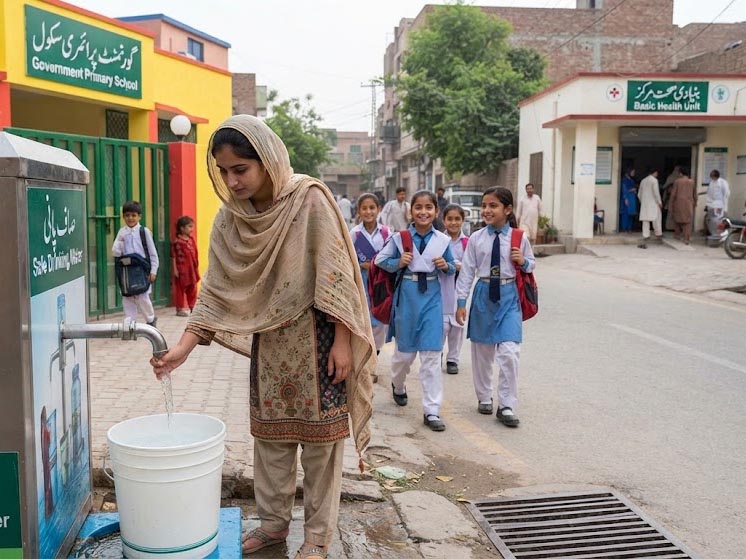
Karachi is Pakistan’s economic and commercial hub, yet millions of its residents continue to face serious problems relating to water supply, sewerage, roads, transport, waste management, healthcare and education. It is particularly disturbing that in a major metropolitan city, citizens in many areas still depend on water tankers because an adequate and reliable piped water supply does not reach their homes.
This raises a fundamental question: if water resources are available but people cannot receive water through a dependable public distribution system, where exactly is the failure?
The same question can be asked about healthcare. A poor family cannot afford expensive private hospitals and clinics every time a member falls ill. Public hospitals and basic health centres are therefore not a luxury; they are a necessity. Similarly, when a person is bitten by a stray dog, anti-rabies vaccination should be readily available through the public health system. The absence or shortage of such basic facilities can turn an otherwise manageable incident into a tragedy.
Education presents another serious challenge. The children of affluent families can attend private schools, but what about the children of low-income households? For millions of Pakistani families, government schools are the only realistic option. If these schools lack proper buildings, teachers, furniture, laboratories, sanitation and basic educational facilities, the country is effectively denying equal opportunity to its poorest citizens.
Sewerage systems, roads and municipal services tell the same story. In many urban areas, overflowing drains, broken roads, blocked sewerage lines and delayed development projects have become part of everyday life. Projects are sometimes announced with great fanfare but take years to complete, while cost overruns and administrative delays add to public frustration.
The question, therefore, is not simply who is responsible. The larger question is whether the present administrative structure is capable of delivering services effectively.
Pakistan’s National Finance Commission mechanism provides substantial financial resources to the provinces. However, the real issue is how effectively these resources are translated into services at the grassroots level. Financial decentralisation should not stop at the provincial level. Resources and decision-making authority must move further down to districts, municipalities, tehsils and union councils, accompanied by accountability and transparent systems.
If a provincial capital receives resources but the ordinary citizen at the union-council level cannot see meaningful improvement in his or her daily life, then the purpose of decentralisation remains incomplete.
This is why the debate over new provinces and administrative units deserves a serious national discussion.
From Sindh to Punjab, Khyber Pakhtunkhwa and southern Punjab, voices are emerging in favour of smaller administrative units. In Khyber Pakhtunkhwa, the demand for a separate Hazara province has existed for years. In southern Punjab, the demand for a Saraiki province reflects the aspirations of communities that believe their region deserves greater administrative attention and development.
Punjab itself provides a strong argument for examining the question objectively. Lahore is a major metropolitan centre and has benefited from significant development, but several distant regions continue to face serious developmental challenges. Areas such as Mianwali, Bhakkar, Khushab, Layyah and Dera Ghazi Khan have different geographical, economic and social needs. Similarly, parts of southern Punjab, including Bahawalpur and Rahim Yar Khan, have their own developmental challenges and aspirations.
The answer is not to blame one city or one province. The answer is to design a system in which every region receives adequate administrative attention.
The same principle applies to Sindh.
Any discussion about creating new administrative units in Sindh should not necessarily be presented as the “division” of Sindh or as an attack on Sindhi identity. Administrative boundaries and cultural identities are not necessarily the same thing. A new administrative unit can be created for better governance without destroying the historical, cultural and emotional identity of the people of Sindh.
The names can be decided through constitutional, political and public consultation. They could be based on geography, history or administrative considerations. What matters is not the name; what matters is whether the new structure improves governance.
If smaller administrative units can bring decision-making closer to citizens, improve accountability, accelerate development projects and ensure that public money reaches the people for whom it is intended, then such a reform deserves serious consideration.
However, creating new provinces alone will not solve every problem. It must be accompanied by genuine local government, fiscal decentralisation, professional administration, transparent procurement, effective auditing and strong accountability mechanisms. Otherwise, a new province could simply reproduce the same problems under a different administrative name.
The ultimate objective must be devolution of power, resources and responsibility.
Pakistan should therefore consider a comprehensive national debate on administrative restructuring. Parliament, provincial assemblies, political parties, constitutional experts, economists, civil society, academics and, most importantly, ordinary citizens should participate in this debate.
The Constitution already provides mechanisms for the creation of new provinces. The process should be constitutional, peaceful and based on consensus rather than political confrontation.
Pakistan does not need administrative arrangements designed for the population of the past. It needs a governance structure capable of serving the population of today and tomorrow.
A citizen should not have to travel hundreds of kilometres to get a government office to listen to his problem. A development project should not take years because the decision-making authority is sitting far away. A mother should not worry about the availability of basic medicine. A child should not be denied quality education simply because his parents are poor. And a family living in a major city should not have to depend on expensive water tankers for a basic necessity of life.
The purpose of government is service.
The purpose of administration is accessibility.
The purpose of public money is public welfare.
And the purpose of democracy is to give ordinary citizens a meaningful voice in the system that governs them.
Pakistan’s future does not depend merely on having bigger administrative units. It depends on having better administrative units—units that are financially empowered, professionally managed, locally accountable and genuinely connected with the people.
If new provinces or administrative units can bring government closer to the citizen, accelerate development and correct regional inequalities, then the idea should not be rejected merely because it challenges traditional administrative boundaries.
After all, the real unity of Pakistan will become stronger when every Pakistani feels that the state belongs to him or her, that government is accessible, and that development is not a privilege of a particular city or region.
The ultimate principle should therefore remain clear:
Government of the people must be government close to the people.