




















By Brig Syed Karrar Hussain (Retired)
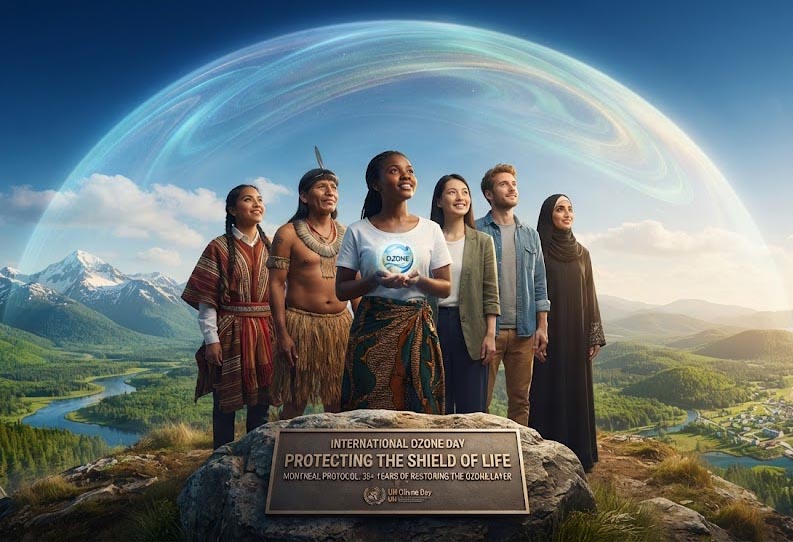
Every year, 16 September is observed as the International Day for the Preservation of the Ozone Layer, commonly known as World Ozone Day. It is not merely another day marked on the international calendar; it is a reminder of humanity’s responsibility towards the atmosphere that sustains life on Earth. The ozone layer is an invisible but extremely important shield surrounding our planet. It absorbs much of the Sun’s harmful ultraviolet radiation and thereby protects human beings, animals, plants and ecosystems.
The theme of World Ozone Day 2026 is “Global Action for a Cooler Planet.” This year’s observance also marks ten years since the adoption of the Kigali Amendment to the Montreal Protocol, which seeks to phase down hydrofluorocarbons (HFCs), powerful greenhouse gases widely used in cooling equipment.
What is the Ozone Layer?
Ozone is a form of oxygen consisting of three oxygen atoms, represented chemically as O₃. Most atmospheric ozone is concentrated in the stratosphere, roughly 10 to 40 kilometres above the Earth’s surface. Approximately 90 percent of atmospheric ozone exists in this region.
Its importance cannot be overstated. The stratospheric ozone layer absorbs harmful ultraviolet radiation from the Sun. Excessive exposure to ultraviolet radiation can increase risks to human health and damage crops, forests, marine ecosystems and other forms of life. Interestingly, ozone near the Earth’s surface can be harmful when it is produced through pollution, while stratospheric ozone is essential for protecting life.
The international community became seriously concerned when scientists established that chemicals such as chlorofluorocarbons (CFCs), halons and other ozone-depleting substances were damaging this protective layer. This led to the Vienna Convention in 1985 and, more importantly, the Montreal Protocol in 1987. The United Nations subsequently declared 16 September the International Day for the Preservation of the Ozone Layer in 1994.
The Montreal Protocol has become one of the world’s greatest examples of successful international environmental cooperation. By controlling and phasing out ozone-depleting substances, countries have put the ozone layer on a path towards recovery. This demonstrates an important lesson: when science, political will, international cooperation and responsible industry work together, humanity can solve seemingly enormous environmental problems.
Does Islam Say Anything About the Ozone Layer?
Although,
The Holy Quran does not use the modern scientific term “ozone layer, however, Islamic teachings provide a powerful ethical framework for protecting the atmosphere and the natural environment.
The Quran repeatedly draws human attention towards the heavens, the Earth and the balance established in creation. Allah Almighty says:
“And the heaven He raised and imposed the balance.”
(Surah Ar-Rahman 55:7)
The following verse commands humanity:
“So do not transgress within the balance.”
(Surah Ar-Rahman 55:8)
These verses offer a profound principle of environmental responsibility. The Earth has been created with a balance, and human beings have been warned against disturbing that balance.
Similarly, Allah says:
“And do not commit abuse on the earth, spreading corruption.”
(Surah Al-Baqarah 2:60)
And in Surah Ar-Rum:
“Corruption has appeared throughout the land and sea by reason of what the hands of people have earned.”
(Surah Ar-Rum 30:41)
These teachings are highly relevant to modern environmental challenges. Pollution, excessive consumption, irresponsible industrial activity and the destruction of natural systems are not simply scientific or economic issues; they are also questions of amanah — trust and responsibility.
Human beings have been entrusted with the Earth. Protecting the atmosphere, therefore, can be understood as part of fulfilling that responsibility.
Why Ozone Protection Matters to Pakistan
For Pakistan, ozone protection cannot be treated as a distant international environmental issue. Pakistan is a country already facing severe heat, climate variability, water stress, air pollution and increasing pressure on agriculture and public health.
The country’s hot climate means that refrigeration and air-conditioning are essential, particularly in cities such as Karachi, Lahore, Islamabad, Multan and Peshawar. Pakistan’s growing population and expanding middle class are also increasing demand for cooling.
This makes the transition towards ozone-friendly and climate-friendly cooling technologies especially important.
Pakistan’s National Ozone Unit states that the country has so far met its implementation obligations under the Montreal Protocol and works with international partners including UNEP, UNDP and UNIDO.
Pakistan must now ensure that this progress continues. The country should not only comply with international commitments but also use them as an opportunity to modernise its refrigeration, air-conditioning and industrial sectors.
The Kigali Amendment is particularly relevant because many HFCs do not destroy the ozone layer in the same way as older substances, but they can have very high global-warming potential. The transition to more efficient and sustainable cooling can therefore provide both ozone protection and climate benefits.
What Should the Government Do?
First, the government should strengthen implementation of the Montreal Protocol and Kigali Amendment through effective monitoring, licensing and enforcement.
Second, Pakistan needs a comprehensive national programme for the gradual replacement of obsolete refrigeration and air-conditioning equipment with energy-efficient and environmentally safer alternatives.
Third, customs authorities should be strengthened to prevent the illegal import and trade of controlled refrigerants. UNEP has specifically highlighted the importance of customs and enforcement capacity in controlling illegal trade in ozone-depleting substances.
Fourth, the government should establish stronger technical training programmes for refrigeration and air-conditioning technicians. Poor handling, leakage and improper disposal of refrigerants can undermine environmental gains.
Fifth, universities and research institutions should be encouraged to develop affordable cooling technologies suitable for Pakistan’s climatic conditions.
Finally, World Ozone Day should become an opportunity for national awareness, particularly in schools, colleges, universities and technical institutions. Pakistan has previously organised seminars involving government, industry, academia and research institutions, demonstrating that such cooperation is possible.
What Can Society Do?
Environmental protection cannot be left entirely to governments.
Citizens should use energy-efficient air-conditioners and refrigerators, maintain cooling equipment properly and ensure that old appliances and refrigerants are disposed of through responsible channels rather than simply releasing gases into the atmosphere.
Schools should teach children that environmental protection is not merely a Western or international concept. It is consistent with Islamic principles of balance, moderation and stewardship.
Mosques, religious scholars and community organisations can also play an important role by linking environmental responsibility with the Islamic concept of amanah.
Our society must develop a culture in which wasting electricity, damaging natural resources and polluting the environment are considered socially irresponsible behaviours.
Responsibilities of Industrialists
Industry has a particularly important role because manufacturing, refrigeration, chemicals, foam production and cooling services can directly influence the use and management of controlled substances.
Industrialists should invest in modern, energy-efficient technologies and gradually eliminate obsolete equipment dependent on environmentally harmful substances.
They should maintain proper inventories of refrigerants, prevent leakage, train technicians and ensure environmentally responsible recovery and recycling.
The transition should not be viewed merely as a regulatory burden. It can create opportunities for Pakistani industry to develop new technologies, skilled employment, energy savings and export-oriented green businesses.
A Message for the Future
The story of the ozone layer provides humanity with an extraordinary lesson. The world identified a common danger, scientists provided evidence, governments negotiated an international agreement, industries changed technologies and societies gradually adopted new practices.
The result is genuine progress.
The lesson for Pakistan is clear: environmental protection and economic development do not have to be opposing objectives.
On International Ozone Day, we should therefore move beyond speeches and ceremonies. The government must regulate and facilitate; industry must innovate responsibly; scientists must research; educational institutions must create awareness; religious scholars must remind society of its environmental responsibilities; and citizens must change their everyday habits.
The atmosphere belongs to no single country. Pollution released in one part of the world can affect the global environment. Therefore, protecting the ozone layer is a shared responsibility and a shared moral obligation.
As the world observes “Global Action for a Cooler Planet” in 2026, Pakistan should make ozone protection a part of its broader strategy for climate resilience, public health, sustainable industry and energy security.
The ozone layer is invisible, but its protection is visible in every breath we take, every crop we grow and every generation we hope to protect.
*Let us therefore treat the atmosphere as an amanah, respect the balance created by Allah Almighty, and leave behind a safer, healthier and more sustainable planet for our children and grandchildren.*