















Dr.Syed Mehboob
Senior Research Editor The News Lark
Political and Economic Analyst
Despite enormous sacrifices, deaths, financial loss, hardship, and difficulties, the Iranian nation is standing behind its leadership like a rock. Donald Trump and American policy makers who were thinking that regime change was easier, convenient, and the loftiest dream have been turned into a nightmare for them. Most of the 1.9 billion Muslims of the world are behind Iran because Israeli and American action is illegal, unjustified, and a violation of International law. Israel committed genocide againstPalestinians, killing 50,000 children, 18,000 women, destroying all mosques (masjids), churches, hospitals, schools, colleges, and everything in Gaza. The International Court of Justice and International Court of Criminals declared Netanyahu a criminal who committed the heinous crime of genocide. Still, unfortunately, the US support for Israel gives it an open ground to kill innocent people. Israeli aggression and American support for it have jeopardized the global peace.
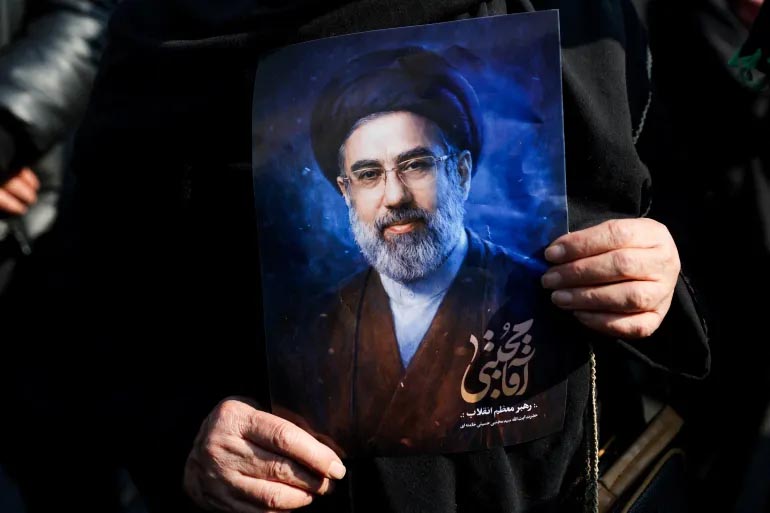
It was extreme disappointment for Donald Trump and American policy makers, the selection of Ayatollah Mujtaba Khamenei as the Supreme Leader of Iran, and on 5 March, 2026 Donal Trump said that Khamenei’s election would be unacceptable and that he had to be involved in the selection of Iran’s next leader. Following his election, Trump expressed his disappointment. Israel said it considered Khamenei, like his father, a target for assassination.
The Constitution of the Islamic Republic of Iran is based on the concept of velayat-e faqih (Guardianship of the Islamic Jurist), which grants a learned Islamic jurist (faqih) – a cleric tasked with the interpretation of sharia (divine Islamic law) – with the role of Supreme Leader. The Supreme Leader of Iran holds final religious and political authority over all affairs of the state, ruling essentially by divine right. Velayat-e faqih, as practiced in Iran, is a modern innovation in Shi’a religious doctrine based on the ideology of Ayatollah Rohullah Khomeini, the founder of the Islamic Republic. For centuries before, Shi’a Muslims traditionally adhered to a limited interpretation of velayat-e faqih, in which the clergy was responsible for the interpretation and administration of religious law, while governance was the realm of secular authorities.
In 1970, Khomeini published his book, Islamic Government, advocating for an absolute version of velayat-e faqih. According to Khomeini’s vision, the Shi’a ulema would oversee the creation and rule over an Islamic state in Iran, expanding the purview of the ulama’s role into the traditionally secular realm of governance. Khomeini built on the works of contemporary Sunni Islamist thinkers, such as Sayyid Qutb and Abul A’la Maududi, whose theocratic form of government served as a model for the Islamic Republic, and he was influenced by modern conceptions of nation-state power. He postulated that the state should be governed by sharia, and as the clergy had the greatest understanding of Islamic law, they should naturally be the guardians of state power until the return of the mahdi, or the Hidden Imam, a messianic Shi’a figure. Before Khomeini, Shi’a clergy typically advocated for quietism when it came to politics, refraining from engaging in politics or attempting to establish Islamic governance. In the traditional quietist view, because human beings are imperfect and fallible, they are thus considered incapable of establishing true, just Islamic rule in the absence of the Mahdi. Khomeini broke from this tradition, arguing that rule by clerics was justified and necessary to preserve Islam until the Mahdi’s return.
Supreme Leader of Iran, head of state in Iran, overseeing virtually all functions of government either directly or indirectly. The post was instituted as rahbar (“leader”) in 1979 with the creation of Iran’s Islamic Republic, which blends democratic elements with theocratic oversight from Islamic clerics of the Twelver Shii school of thought. AlthoughIran’s president and legislature are directly elected by the Iranian people, the concentration of power in the hands of the rahbar means that the rahbar commands tremendous sway over both policymaking and the electoral process. The duties designated for the rahbar in the constitution are broadly defined, allowing significant room for the rahbar to intervene in political affairs, maneuver the armed forces, and make appointments that determine the makeup of the government. The powers delineated in Article 110 include:
- determining the political direction of the government (in consultation with an advisory committee);
- overseeing the correct implementation of the general policies of the government;
- calling referenda;
- commanding the armed forces;
- declaring war, peace, and the mobilization of armed forces;
- appointing and dismissing:
- six of the twelve jurists of the Council of Guardians;
- the head of the judiciary;
- the head of the state broadcasting agency;
- the chief of the general staff;
- the commander in chief of the Islamic Revolutionary Guard Corps( IRGC)
- the highest commanders of the armed forces and security bodies;
- Facilitating relations between the legislative, executive, and judicial branches;
- resolving issues in governance that cannot be settled through ordinary means;
- approving the appointment of the president after the presidential election;
- dismissing the president after a judicial conviction or legislative vote of no confidence;
- pardoning or commuting sentences upon recommendation of the head of the judiciary.
The post of rahbar was created for Ruhollah Khomeini, the architect of the Islamic Revolution in 1979, who held the high and rarely bestowed clerical rank of marjaʿ-e taqlīd (“religious jurist worthy of emulation”). The constitution made that rank an essential qualification for the position, but the requirement was removed in 1989 to allow Ali Khamenei, who had a low clerical rank, to become rahbar. Amendments lowered the qualification to any jurist of Islamic law who is judged to be just and pious and can project political and social leadership.
The rahbar is selected by the Assembly of Experts, a deliberative body of Islamic jurists who are directly elected every eight years (although the jurists must first be approved by the Council of Guardians to run). The Assembly may also remove the rahbar if it deems that he is no longer qualified.
Ayatullah Mujtaba Khamenei is a ditto picture of his martyred father and a nightmare for Trump. The only way to restore peace is for the US policymakers to realize the reality that their unjustified backing and support to Isreal has placed America on the wrong side of history,and even more than 60% of American people are against war, and Israeli support in America is at the lowest level. A SEPARATE Palestinian state and accepting Iran as a reality is the solution to the problem, but do US policymakers have such a sense that they are losing ground and the sole superpower status has been snatched from them?