















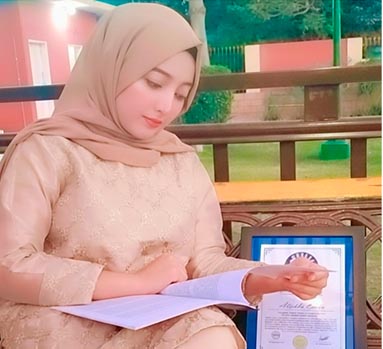
Dr. Alishba Eman is a young, enthusiastic, highly talented Pakistani scientist and the first lady whose research on Artificial Intelligence-based human brain has received international acclaim and recognition, an honor and pride for the whole of Pakistan. The News Lark has been honoured to introduce Pakistani youth’s talent here and abroad. Dr. Syed Mehboob, Senior Research Editor of the News Lark, met with Dr. Alishba Eman and had an interview with her. Here is an excerpt of her interview.
for the whole of Pakistan.
Q1: Please tell us about your educational background.
I have a strong academic background and have consistently been a dedicated and high-performing student throughout my educational journey. As an aspiring doctor, my core focus has always been medical sciences, neuroscience, and patient-centered care. Alongside my formal education, I actively pursued research, academic writing, and interdisciplinary learning, particularly integrating artificial intelligence with healthcare. This combination of clinical understanding, academic excellence, and innovation-driven learning shaped my ability to contribute meaningfully to medical research and AI-based health solutions. I am also the author of four books and have contributed to more than ten research publications, reflecting my strong commitment to scientific inquiry, medical innovation, and knowledge dissemination.
Q2: How did it come to your mind to work on an AI brain model?
During my academic and research journey, I observed that many brain and mental health conditions, including brain tumors, are often diagnosed late due to limitations in conventional diagnostic methods. This motivated me to explore how artificial intelligence could assist in early detection by analysing complex brain patterns, ultimately supporting clinicians and improving patient outcomes.
Q3: Please tell us some details about your AI brain model.
This project was a collaborative effort between me and my brother. As a medical professional, I contributed the neuroscience foundation, clinical understanding of brain tumors, data interpretation, and dataset guidance to ensure medical relevance. My brother, with his technical expertise, developed and trained the artificial intelligence model. Together, we created a brain tumor detection model that integrates medical knowledge with advanced AI techniques to support accurate and meaningful analysis.
Q4: How is this model useful in diagnosing brain diseases?
The model assists in early screening by identifying subtle patterns associated with brain tumors that may be missed during initial assessments. Early detection allows timely intervention, better treatment planning, and improved prognosis. The model is designed to support doctors in clinical decision-making rather than replace human expertise.
Q5: How do you feel after having such a great achievement?
I feel deeply grateful and humbled. This achievement is not only personal but also represents the potential of Pakistani youth, especially young women, to contribute to science, innovation, and global healthcare solutions.
Q6: Is there any recognition from provincial or federal government?
Yes, I have received official recognition from the Deputy Commissioner Karachi South in the form of a certificate, endorsement, and a letter of recommendation. Additionally, I was awarded a certificate by the Human Rights Department, Government of Sindh, for being the youngest female author and for contributing to idea building of an AI-based application aimed at supporting human rights processes. This initiative indirectly promotes mental well-being, as resolving social and legal concerns significantly improves psychological health. Moreover, my work and journey have also been recognized through an interview by WomenInTechPK, highlighting my contribution as a young woman working at the intersection of healthcare and artificial intelligence.
Q7: Who is your source of inspiration?
My inspiration comes from religious personalities, especially Bibi Fatima Zahra (S), who symbolizes strength, wisdom, and excellence for women. Her life teaches that women can work, lead, and achieve greatness with purpose and dignity. I am also inspired by my family and by self-motivation, constantly striving to become the best version of myself and to grow as a young scientist.
Q8: What is your future plan?
My future plan is to continue advanced research at the intersection of artificial intelligence and brain health, develop ethical AI-based healthcare tools, expand educational initiatives for underprivileged youth, and represent Pakistan through meaningful scientific contributions at international platforms.
Q9: There is a deliberate plan to disappoint our youth from Pakistan’s future. What do you suggest our youth to get achievements like yours?
I believe the strongest response is persistence and self-belief. Pakistani youth should focus on skill development, critical thinking, and continuous learning. Even when opportunities seem limited, consistency, discipline, and ethical hard work can create success pathways.
Q10: How do you feel about your country after this great achievement and contribution for your country?
I feel proud to represent Pakistan. Despite challenges, our country is rich in talent and potential. I hope my work encourages confidence in our youth and highlights Pakistan as a nation capable of innovation, intellect, and positive globally.