
















By: Shama Munshi
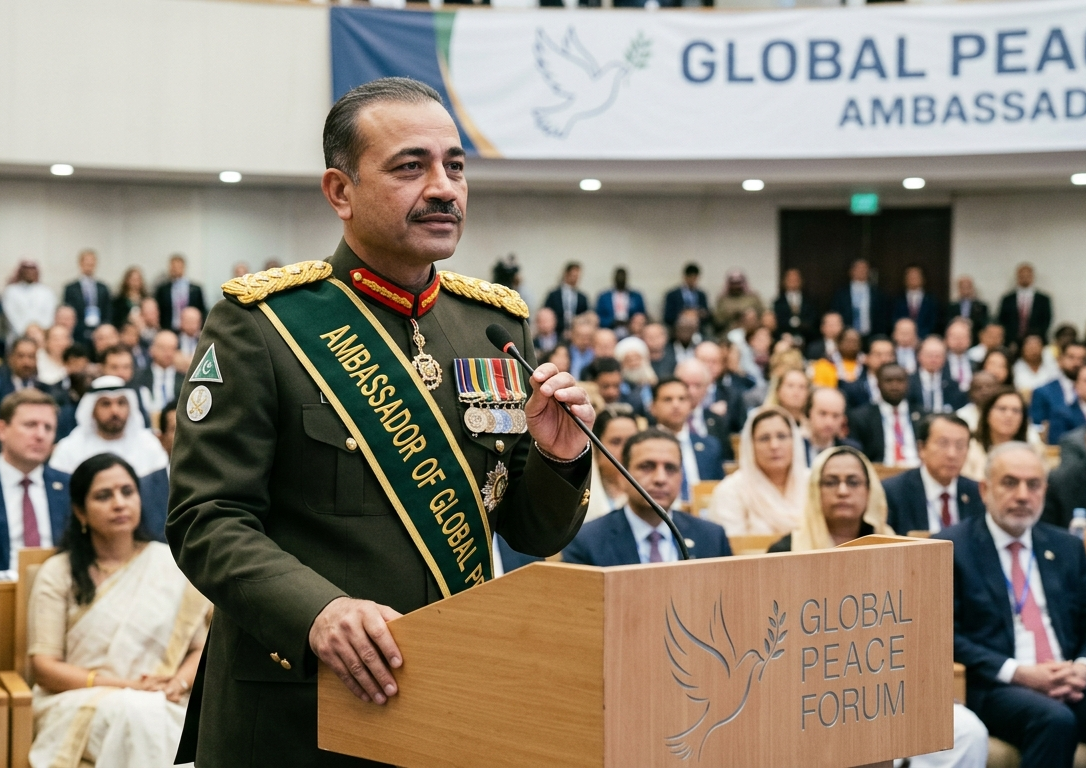
“War on the borders, peace at the table” — Field Marshal Asim Munir, Ambassador of Global Peace
In the annals of history, few military leaders speak with such fearlessness and authority on foreign soil as Field Marshal Syed Asim Munir, NI (M), HJ, Chief of Army Staff and Chief of the Defence Forces of Pakistan. Standing in the United States, he issued a statement that resonated like thunder: any threat to Pakistan, however minor, would unleash consequences felt across the globe.
A warrior, a strategist, a guardian—Field Marshal Munir embodies the unwavering resolve of a sovereign Muslim nuclear state. During the India-Pakistan conflict of May 2025, “Marka-E-Haq” , his leadership proved decisive. Seven French-origin Rafale fighter jets of India were neutralized, compelling New Delhi, through U.S. mediation, to request an immediate ceasefire, with President Donald Trump personally playing the role of mediator.
Field Marshal Munir is more than a military leader—he is the embodiment of principle, strength, and vigilance. When Iran violated Pakistan’s airspace, a swift, calculated response was delivered within twenty-four hours. Pakistan, under his command, has transformed from a posture of “soft restraint” into one of resolute power, capable of defending its sovereignty without hesitation.
In Afghanistan, Pakistan combats the remnants of extremist factions Talibans with unrelenting determination. Operation Ghazab-ul-Lil-Haq shattered Taliban terror networks, striking at those who, with external Indian notorious RAW sponsored support, sought to destabilize the region.
Under Field Marshal Munir, Pakistan has risen as a strategic power, trusted both regionally and globally. Leadership of this caliber demands more than authority—it requires vision, patience, and the wisdom to bring adversaries to the negotiating table, even in the most perilous circumstances.
During a period of intense tension in the Middle East, when conflict between Iran, Israel, and the United States threatened to spiral out of control, Field Marshal Munir acted as a stabilizing force. Through discreet diplomacy, military acumen, and unyielding resolve, he averted escalation, proving that true strength lies not only in military might but in the ability to prevent war.
Today, Pakistan under Field Marshal Munir is not merely a participant in global affairs—it is a decisive actor shaping outcomes. U.S. Vice President J.D. Vance, after engaging with Israeli leadership, arrived in Islamabad to pursue de-escalation with Iran, while an Iranian delegation engaged in high-level talks on Pakistani soil. These negotiations, orchestrated through Pakistan’s strategic vision, underscore the nation’s emerging role as a central hub of influence.
Witkoff and global officials are in Islamabad for a negotiated settlement of the West Asia war. Pakistan has emerged as a centre of gravity amid sensitive diplomatic maneuvering, while this development marks a brutal strategic setback for India’s megalomaniac foreign policy.
Despite hostile narratives from India, which through heinous motives only highlight isolated incidents to malign Pakistan,the international community recognizes Pakistan’s leadership, resilient ,resolve, and pivotal role in fostering regional stability. The credit for this historic positioning belongs unequivocally to Pakistan’s military leadership, particularly Field Marshal Syed Asim Munir.
“Pakistan’s efforts for a ceasefire are commendable, says Iranian spokesperson.
Along with Pakistan, other countries are also making efforts.
Pakistan is being praised in Tehran, and its foreign policy is being appreciated.
The deserving recipient of the Nobel Peace Prize is the Field Marshal Syed Asim Munir.
His courage and wisdom steered a major crisis towards peace instead of letting it turn into full fledged war. This is an example of real leadership that makes decisions with balance, prudence, and wisdom even in the most difficult situations.
This is the Pakistan that defies predictions of its demise. Once marginalized, it now commands the center stage of global decision-making. It is not a nation of chance but of purpose, vision, and unshakable resolve.
This year on “Pakistan Day” 23rd March 2026, leaders from over a hundred nations extended congratulations. High-level dignitaries from the United States and Iran visiting Islamabad to strike a deal for “Cease Fire,”.
Page 17 of my book ” Concept of the Terrorism in Post Cold World War Era ” captures a reality that is becoming clearer with each passing year. The global order is shifting, and new centers of influence are emerging. In this changing landscape, Pakistan is steadily positioning itself as a significant power with the ability to influence regional and global affairs.
Pakistan’s strategic geography, its resilient people, and its growing diplomatic engagement are shaping a future where the country plays a much larger role on the world stage. As traditional power structures evolve, Pakistan has the potential to act as a bridge between regions, cultures, and economic blocs. Its voice in international dialogue is becoming more relevant, particularly in matters of security, economic cooperation, and regional stability.
At the same time, leadership plays a defining role in how nations navigate moments of global transition. Field Marshal Asim Munir is increasingly seen as a leader whose decisions and strategic outlook carry weight beyond national boundaries. His approach to security, regional balance, and dialogue has positioned him as a figure whose involvement is often sought when complex regional issues arise.
In an era marked by geopolitical tensions, economic uncertainty, and shifting alliances, leaders who can balance strength with diplomacy are rare. Field Marshal Asim Munir represents a leadership style that emphasizes stability, strategic patience, and constructive engagement with the international community.
As predicted in the second edition of my book ” Concept of the Terrorism in the Post Cold War Era ,launched in October 2024, I already had predicted on Page Number 17 that if current trends continue, Pakistan is likely to emerge not only as a key regional actor but also as a country whose perspective matters in shaping broader global discussions.
Page 17 of my book, therefore does more than describe a moment in time. It highlights the early signs of a future in which Pakistan’s role becomes more prominent and its leadership increasingly relevant in addressing both regional challenges and wider global concerns.
The world now acknowledges: Pakistan was never destined to perish—it is destined to lead.
As Sufi Barkat Ali foresaw, the time will come” when Pakistan will make the decisions of “yes” and “no” for the nations of the world.
Today, ,the world witnesses Pakistan—not as a follower, but as a decisive force in global affairs.
Long live Pakistan.
Long live the Pakistan Armed Forces.