



















Dr. Syed Mehboob
Senior Business and Political Analyst
http//: www.thenewslark.com
Email:drmehboob.thenewslark@gmail.com
Online education, including MOOCs, has thrived, with over 52,500 MOOCs available online and millions of students earning academic credits. China has also achieved inclusive expansion, with 240 million in higher education and a gross enrolment rate surging from 30% to 57.8% . making it a global leader in education accessibility. Peaking University moved from 17th to 14th position this year.
While Time Higher Education (THE) is a widely respect university ranking board, there are other prestigious ranking boards that use different methodologies to rank universities. For example, the QS World University Rankings and the Academic Ranking of World Universities (ARWU) both place a greater emphasis on research output than Time Higher Education does.
This year, China’s universities have been consistently recognized by other ranking boards. In the QS World University Ranking, Peking University and Tsinghua University were 12th and 14th positions respectively. Also recognized among China’s leading schools were The University of Hong Kong 21, Fudan University 34, and The Chinese University of Hong Kong 38.
The statistics around students who choose to study abroad in China further show the rising popularity of universities in China.
The number of international students in China has increased significantly from 2009, by over 106%. And there were 492,185 International Students enrolled in Chinese Universities.International students from 50,600 students make for the majority of international students in China .According to a report by Erudera, 71.3 % of international students agreed that they choose China because of the higher standard and better quality of education there and highly professional staff.
Here at China Admissions, it has been noticed a trend of more students from developed countries interested in studying in China. They are attracted by great value. including lower costs, quality of education, and the opportunity to live and explore a fascinating country and culture.
China’s rise in the rankings is a testament to its investment in higher education and research. China’s top universities are well on their way to becoming world-class institutions. Be a part of this academic renaissance by applying to your dream program in China.
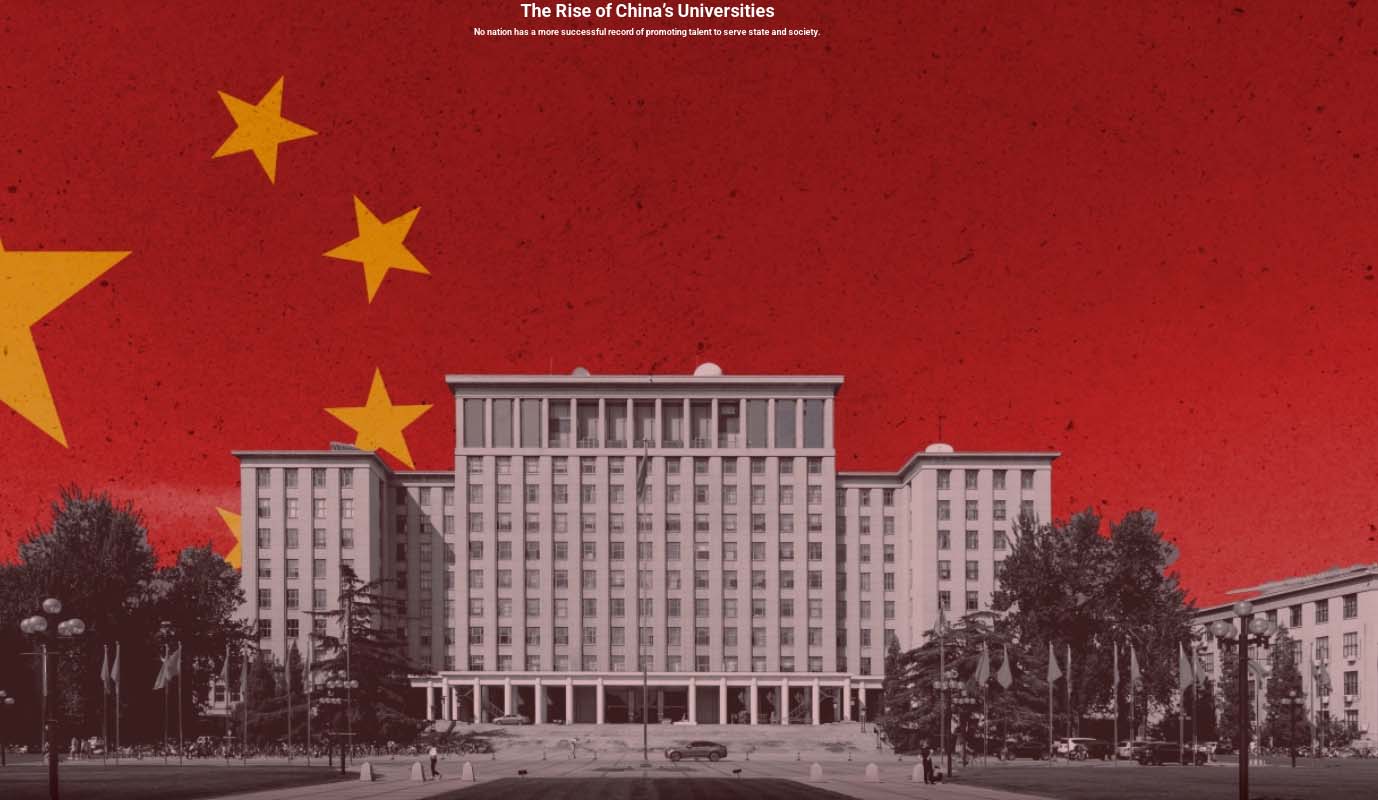
Chinese universities are climbing higher in the global rankings this year, with Tsinghua and Peking universities now placed 12th and 13th in the 2025 Times Higher Education World University Rankings.The jump reflects China’s long-term push to improve its higher education sector through increased funding, research output, and international partnerships.
The international academic hierarchy is being drastically reshaped as Chinese universities continue their consistent upward trajectory in global university rankings, a reflection of a 10-year strategy of higher education investment, reform, and innovation.
The 2025 Times Higher Education (THE) World University Rankings position Tsinghua University and Peking University at positions 12 and 13 in the world, a reminder of their status as China’s top academic powerhouses.
Along with Peking University and Tsinghua University, other elite Chinese universities—Zhejiang University, Fudan University, and Shanghai Jiao Tong University—have reached positions in the world’s top 60, thus highlighting China’s improved academic status.
This is evident in the 2025 QS World University Rankings, where mainland China ranks second globally at 71 universities listed, behind the United States (197) but ahead of the United Kingdom (60).
Experts attribute this expansion to a convergence of factors, including rising research activity, global collaborations, large sums of money invested in science and innovation, and targeted recruitment of faculty and students from abroad.
This has rendered Chinese institutions competitive with, and in various ways better than, their Western counterparts.
Dr. Liu Ming, a Shanghai higher education analyst, said, “The quick growth of Chinese universities is no coincidence.” He proceeded to add, “It’s the result of a well-designed national research excellence, internationalization, and academic reform agenda.”
Despite the dominance of the traditional powers like Harvard, Oxford, and Stanford in the top ten spots, Chinese universities are catching up fast. The entry of more Chinese universities into the top 100 ranks is a sign of a revolutionary shift in the world knowledge economy.
The 2025 rankings are not only a national success but also a global reconfiguration in higher education, where China is establishing itself as a significant contributor to scholarship and research innovation.
With the expansion of international cooperation and increased mobility of students, Chinese universities are redefining the fate of global scholarship, thereby establishing closer competition and collaboration between the East and the West.
It is interesting to note that China produces 1,300,000 engineers per year, while America produces just 130,000. This 10 to one gap matter.
This year, China saw 21 percent of its universities rise in the Times Higher Education (THE) World University Rankings for 2026. China now has five universities in the top 40 and 35 in the top 500. There’s no doubt this new ranking provides evidence that the balance of power in the global research and knowledge economy continues to shift from the West to the East. It is a thought-provoking phenomenon that invites a deep inquiry: what contributes to the remarkable progress in China’s higher education.
Chinese higher education is its emphasis on the “collective good” over individual gain. From university lectures to public discourse, Chinese students are taught that while economic success is acceptable, the true purpose of disciplines like economics is to apply knowledge for the betterment of society as a whole. In this regard, rather than treating education as a means to achieve short-term economic gains, China has aligned its higher education system with national long-term development strategies and public needs.
China’s emphasis on STEM education has become a powerful catalyst for real-world progress – moving beyond theoretical instruction to generate tangible improvements that benefit people’s lives. From high-speed rail systems that connect the country within hours, to electric vehicles leading global markets, and AI technologies transforming fields such as healthcare and agriculture – these achievements all stem from China’s sustained commitment to building a robust STEM education ecosystem aimed at elevating living standards. The commitment to advancing national development priorities has been the driving force behind the ongoing success and evolution of Chinese higher education.
The growth of Chinese universities’ global standing has also been in large part due to the significant government investment into higher education and the deep-seated social respect for teachers and education. Consistent and substantial funding, particularly in scientific research and technological development, has enabled Chinese universities to attract top faculty, accelerate academic output, and compete internationally for talent. This long-term vision is further demonstrated by the ongoing expansion of educational infrastructure at all levels, from primary schools to universities, broadening access to quality education nationwide. Moreover, in China, respecting teachers is a virtue valued not only by students but by the entire nation. In contrast, US universities face challenges such as declining federal support, contentious debates over academic freedom, restrictions on the international students and politically motivated funding cuts. In recent decades, many US cities have seen public schools close and educational budgets shrink, limiting opportunities for younger generations.
What strikes most about Chinese government’s approach to higher education investment is the principle of equality. Rather than concentrating resources solely in a handful of elite universities, funding has been strategically directed toward a broad range of universities, including those in remote and less developed regions. About 1,980,000 college teachers in western China have been trained on massive open online courses (MOOC). The substantial figure represents Chinese government’s resolve to bridge regional disparities and ensure wider access to high-quality educational resources across the country.
China’s commitment to peace offers another clear edge. Chinese students are raised in an environment that actively cultivates expectations of peace, both domestically and globally. This is not merely an abstract ideal but a principle put into practice: through initiatives such as the Belt and Road Initiative, China promotes international partnerships based on mutual benefit and shared progress, rejecting zero-sum outcomes. This stable and cooperative global posture in turn creates a favorable environment for the sustained development.