













By Lal Dino Mari Baloch
The story of Pakistan–Saudi Arabia relations is as old as Pakistan itself, rooted in faith, fraternity, and shared destiny. From the very beginning, when Pakistan emerged on the map in 1947, Riyadh extended a hand of recognition and friendship. The two nations discovered in each other not just partners in diplomacy but companions bound by a common religious identity and cultural affinity. This spiritual kinship soon evolved into a political bond, fortified by trust and solidarity.
Saudi Arabia’s support during Pakistan’s formative years was more than symbolic; it was substantive. Whether in the wars of 1965 and 1971 or in times of economic crises, the Kingdom stood shoulder to shoulder with Islamabad. Such gestures built confidence and created a legacy of mutual reliance. Over time, the millions of Pakistanis who migrated to Saudi Arabia further cemented this relationship. They became not only an economic bridge—sending home vital remittances—but also cultural ambassadors, strengthening people-to-people ties.
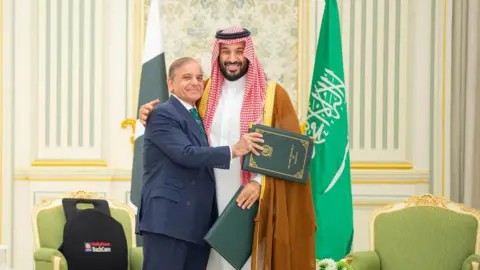
Defense cooperation has always been the backbone of this relationship. Pakistani military expertise has long been sought after in Riyadh, with generations of Saudi officers trained by Pakistan’s armed forces. The deployment of Pakistani troops for advisory roles and joint exercises are milestones that reflect not just military collaboration but deep strategic trust. On 17 September 2025, this longstanding bond entered an unprecedented phase when Prime Minister Shehbaz Sharif and Crown Prince Mohammed bin Salman signed a Strategic Mutual Defense Agreement in Riyadh. The accord pledged that any aggression against one would be treated as an attack on both—an explicit collective-defense guarantee that formalizes decades of cooperation. What had long been implicit through training missions, joint exercises, and advisory roles is now written into a shared security doctrine.
The implications are wide-ranging. For India, the pact complicates strategic planning by introducing the prospect of Saudi political and logistical support to Pakistan in any crisis, while for Iran it signals a more consolidated Sunni bloc on its western and eastern flanks. Israel and the United States, though longstanding Saudi partners, will watch cautiously: Washington sees in the agreement both a diversification of Riyadh’s security ties and a reminder that Gulf states are no longer wholly reliant on American protection, while Israel is wary of a nuclear-armed Pakistan becoming a formal guarantor of Arab security. For the wider Muslim world, the symbolism is powerful. The only nuclear-armed Muslim state aligning so closely with the custodian of Islam’s holiest sites projects a sense of collective deterrence, even if operational details remain undefined. Economically, such a pact is never divorced from material incentives: Riyadh’s defense umbrella is likely to be accompanied by large investment commitments and long-term energy assurances, potentially stabilizing Pakistan’s fragile economy. Regionally, it reshapes the calculus from South Asia to the Middle East and even Afghanistan, where Saudi and Pakistani coordination could alter future political equations. In essence, the defense pact crystallizes trust into treaty form, carrying both promise and peril. It elevates Pakistan–Saudi relations to a level that commands global attention and will test both capitals in turning lofty vows into workable security and economic dividends.
On the economic front, Saudi Arabia’s role has always been decisive. As a primary energy supplier, Riyadh’s oil exports have kept Pakistan’s wheels of industry turning. Major investments, such as the proposed multibillion-dollar oil refinery at Gwadar, underline the depth of economic cooperation.
An equally significant dimension of this partnership is the way it increasingly intersects with Pakistan’s all-weather friendship with China. The China–Pakistan Economic Corridor (CPEC), a flagship project of the Belt and Road Initiative, provides the natural platform for trilateral cooperation. Saudi Arabia’s interest in establishing a multibillion-dollar oil refinery at Gwadar is not merely an investment in Pakistan but a strategic entry into a corridor that links the Arabian Sea to western China. In this sense, Pakistan becomes the vital bridge—China offering infrastructure and technology, Saudi Arabia bringing capital and energy, and Pakistan providing the geography and manpower to tie it all together. For Beijing, a stable and secure Pakistan–Saudi partnership ensures safer energy routes and strengthens the very arteries of CPEC. For Riyadh, alignment with China’s long-term vision complements its own Vision 2030, opening the door to technological collaboration and new markets. What emerges is not just a bilateral relationship but a broader Asian alignment where the world’s largest energy producer and the world’s most dynamic rising power converge through Pakistan’s soil. This triangular cooperation, if nurtured wisely, carries the promise of transforming the economic destiny of the region and giving new depth to Pakistan–Saudi Arabia relations.
Meanwhile, the remittances from the vast Pakistani workforce in the Kingdom form a lifeline for Pakistan’s economy, injecting billions of dollars annually. With Saudi Arabia’s Vision 2030 opening new avenues in technology, infrastructure, and tourism, Pakistan finds fresh opportunities to partner in a future-oriented development strategy.
Religious and cultural bonds have never been marginal. The shared Islamic identity remains the cornerstone of bilateral ties, visible most clearly in Pakistan’s role in managing Hajj operations and facilitating the travel of thousands of pilgrims every year. Saudi support for religious and cultural institutions in Pakistan, while sometimes debated, has undeniably shaped aspects of Pakistani society and reinforced spiritual linkages.
Geopolitically, this partnership resonates across the Middle East and South Asia. For Riyadh, Islamabad is a vital ally in a volatile region. For Pakistan, Saudi Arabia is not just an economic patron but a strategic counterweight in balancing delicate relations with Iran. This tightrope walk—maintaining neutrality between Tehran and Riyadh—has tested Islamabad’s diplomacy, especially during crises like the Yemen conflict. On global Islamic issues such as Palestine and Kashmir, however, the two countries have often spoken with a united voice, amplifying their moral and political weight. Relations with other Gulf states like the UAE and Qatar are also influenced by the strength of Pakistan–Saudi cooperation, creating ripples across the Gulf Cooperation Council.
In recent years, this relationship has entered a renewed phase of dynamism. High-level visits, particularly by Crown Prince Mohammed bin Salman, have produced significant memorandums of understanding and multi-billion-dollar pledges of investment. His repeated assertions about a long-term partnership with Pakistan carry immense symbolic and practical value. For a country struggling with economic challenges, Saudi commitments signal not just immediate relief but prospects for sustained growth. The integration of Saudi Arabia into projects linked to the China–Pakistan Economic Corridor (CPEC) points to Riyadh’s strategic interest in Pakistan as a gateway to regional connectivity.
Of course, the journey has not been without turbulence. There have been moments of strain, whether due to Pakistan’s cautious stance on Yemen or the challenges of balancing ties with both Riyadh and Tehran. Analysts often speak of “ups and downs” in the friendship, but the resilience of the relationship lies in its ability to withstand such pressures. The real challenge remains in converting political goodwill into durable economic transformation. Despite grand announcements, the pace of materializing investments sometimes lags behind expectations, raising questions about implementation.
Looking ahead, the trajectory appears promising. Over the next decade, the relationship is likely to expand beyond traditional defense and energy cooperation. Technology transfer, renewable energy projects, tourism, and human capital development are poised to become focal points. Saudi Arabia, with its deep pockets and ambitious development agenda, has the capacity to stabilize Pakistan’s economic future if investments are strategically sustained. For Islamabad, this partnership is not optional; it is central to its foreign policy priorities in the 21st century.
Ultimately, Pakistan–Saudi Arabia relations are more than a bilateral affair. They hold the potential to serve as a model of Muslim unity and collective progress in an era of fragmentation. If harnessed wisely, this partnership can inspire a broader spirit of solidarity across the Islamic world. Today, as the ties reach new heights, one cannot escape the sense that the relationship between Islamabad and Riyadh is not just about two states—it is about the shared dreams of millions who look to this bond as a symbol of faith, friendship, and a future full of promise.