

















Review By Ghulam Mustafa Khuhawar
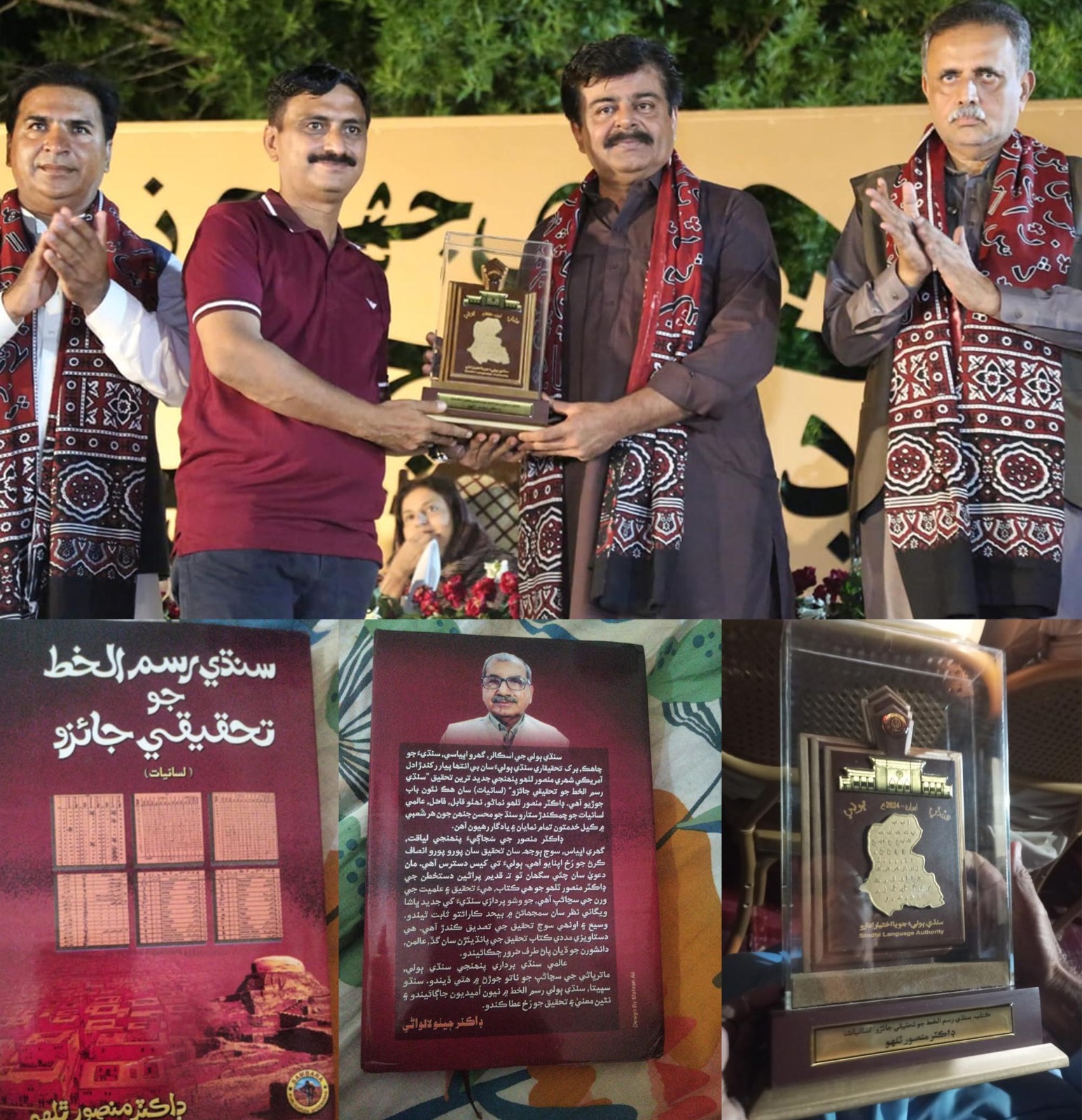
Dr. Mansoor Thahlo is currently living a busy life in the USA. Despite living far away, he maintains a heartfelt connection to his homeland and language. His books on linguistics and various other subjects continue to be published. Recently, this year, his book “A Research Study of the Sindhi Script” ( Sindhi Rasam _ul_Khat jo Tahqiqi jayzo (Linguistic ) has been published. Congratulations to him from the heart.
In the preface of his book, written with affection and titled “Where No Bird Has Set Foot” (by Dr. Nawab Kaka), it is stated:
Human society has gone through many stages of evolution to reach the present era. The earliest human settlements were established in areas where fresh water sources were available. That is why the world’s oldest civilizations developed along riverbanks. Among such ancient rivers are the Nile, Euphrates, and Indus, on whose banks the Babylonian, Sumerian, and Mohenjo-daro civilizations flourished. It is impossible to think that they had no language.
Languages evolved alongside human society, though writing came later. The written form can be considered the first step in human consciousness and civilization. This was the childhood of human awareness, when writing consisted of various symbols — some depicting animals, birds, and humans. The art of writing was humanity’s greatest invention, enabling it to preserve history, culture, science, philosophy, literature, and many other fields. Due to trade and other needs, written symbols for sounds became essential, strengthening the written form of languages.
Language is an inseparable part of human existence. The history, culture, and complete records of individuals, nations, and societies can only be preserved through language. This historical record is not only passed from generation to generation but also reaches the entire world. Developed nations, alongside progress in other fields, have paid special attention to the originality, history, and development of their languages.
Research on various aspects of the Sindhi language began during the British period. The script of the language of the Indus civilization, which stood alongside other great and ancient civilizations, has faced the same fate as the nation itself — its originality and identity have been lost in the dust of time. The ancient Mohenjo-daro society, like other aspects of life, also focused on language and developed a script for writing. For a long time, there was doubt as to whether this was actually a meaningful script. References we have to prove this mostly come from foreign scholars.
Developing the ancient script further — by comparing its symbols with other scripts of the world — is a difficult task that must be undertaken by a native scholar. Computational technology experts like Professor Rajesh Rao and Asko Parpola have, based on evidence, recognized the Indus script as a linguistic system, though they admitted their failure to fully read it. Another researcher, Iravatham Mahadevan, acknowledged in one paper: “In short, my opinion is that archaeological evidence and the science of linguistics show that the Indus script is a writing system that contains a spoken language.”
In Sindh, efforts to study the history of language, archaeology, and script have been made by scholars such as Dr. Nabi Bux Khan Baloch, Dr. Ghulam Ali Alana, Siraj Memon, Dr. Murlidhar Jetley, M.H. Panhwar, and Atta Muhammad Bhanbhro. Under a Sindh University project, Bhanbhro wrote an extensive research book in English titled “Indus Script”, in which he carried out a comparative study of scripts found in Mohenjo-daro and provided their possible readings. This was an important contribution to script studies.
Before Partition, scholars like Grierson, Bhairo Mal, Mirza Qaleech Beg, and others also made important contributions to the antiquity and history of the Sindhi language.
Dr. Mansoor Thahlo’s “A Research Study of the Sindhi Script” is a continuation of the work of the scholars mentioned above. He has previously published research works on linguistics and various other subjects. Living in Europe, Dr. Mansoor is well-versed in the fundamental principles and requirements of research, and he closely follows research being conducted in linguistics and related areas. His love for Sindh, the Sindhi language, and literature is evident from his choice of unstudied yet important topics. In pursuit of primary sources for his research, he does not shy away from making difficult journeys.
This book is a very important work on linguistics. Dr. Mansoor compares neglected Sindhi scripts with scripts from around the world and demonstrates that even today, some letters, sounds, and symbols from our script remain in use globally. He also provides readings of Mohenjo-daro script samples.
The book discusses forgotten scripts such as Devanagari Siohani Babra, Memoni Thatta, Shikarpuri, Hawawadi, Khwajki, Sindhi Sukkur script, Sindhi Rajai script, and Southern Lehnda, which were used in various parts of Sindh before the adoption of the current script in 1853.
Dr. Mansoor also presents evidence of Sindhi language and script influencing the languages of regions where Sindhi traders traveled, as noted by Asko Parpola: “Harappan trade agents in the Gulf or Mesopotamia became bilingual, adopting local names but writing their foreign names in Indus script so that Harappans could read them.”
The book is divided into five chapters, each with subtopics in alphabetical order. Topics include Sindhi script letters and writings, ancient Sindhi scripts, relationships with other languages, ancient stone inscriptions, letter connections, Ashokan Brahmi inscriptions and Sindhi script, and more.
Through comparative charts, Dr. Mansoor identifies similarities between Mohenjo-daro signs and scripts from Palestine, Sumatra, Libya, Nepal, Gujarati, Chinese, Old Italian, and many other languages. He even finds striking similarities between some Indus signs and the script used in the Psalms of David preserved in Yemen’s Sana Museum.
This unique and unconventional work opens new paths for researchers of ancient scripts. Dr. Mansoor has uncovered forgotten writing samples and compared them with global scripts, presenting fresh findings that could only have come from a dedicated native researcher.
For this important work, Dr. Mansoor received an award from the Sindhi Language Authority — his second such award. However, as he himself says, “I work out of love for my language; the award is not what matters.”