



















By Brig Syed Karrar Shah retired.
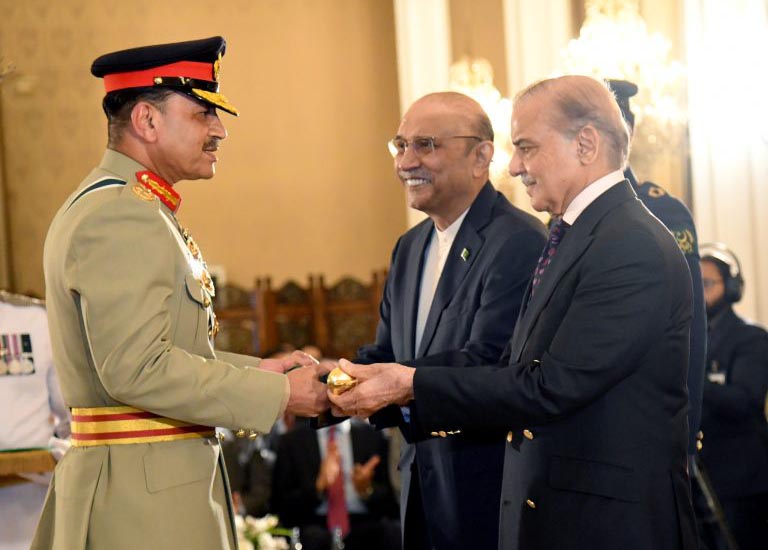
In a moment of strategic and national significance, the elevation of Chief of Army Staff General Hafiz Asim Munir to the rank of Field Marshal marks a glorious chapter in Pakistan’s military and national history. This rare honour is not only a recognition of his well-earned leadership but a testament to his visionary role in shaping a modern, responsive, and strategically aware Pakistan Army.
General Asim Munir, known for his integrity, professionalism, and deep Islamic values as a Hafiz-e-Quran, has guided the armed forces through a time of critical transformation. His leadership has been instrumental not just in enhancing operational readiness but also in extending the military’s role in support of national resilience — particularly in the economic sphere. Under his supervision, other key initiatives were to stabilize the economy, foster internal accountability, and improve strategic communication with allies and adversaries alike.
One of his most commendable responses was in the aftermath of the Indian-orchestrated Pahalgam drama — a staged incident aimed at maligning Pakistan in winning the election in Bihar. General Asim Munir’s calm and firm rebuttal, supported by intelligence and diplomatic engagement, not only exposed the fabrication but reaffirmed Pakistan’s global credibility. His posture blends deterrence with dignity, and modern warfare preparedness with traditional values — making his leadership exemplary in both military and ideological terms.
The rank of Field Marshal is a rare military distinction globally, reserved for commanders who redefine the doctrine of war or represent the nation’s highest trust in its defence structure. In the Islamic and global context, many historic commanders earned recognition for guiding their nations during defining moments.
Inspiration from Islamic Military History
One of the earliest and most significant nominations by the Holy Prophet Muhammad (PBUH) himself was Hazrat Ali (A.S.), appointed as commander during the Battle of Khyber (Ghazwa-e-Khyber). The Prophet (PBUH) declared, “Tomorrow I will give the flag to a man who loves Allah and His Messenger and is loved by Allah and His Messenger.” Hazrat Ali (A.S.) was chosen, and under his command, the Muslims achieved a decisive and miraculous victory over the Jewish stronghold of Khyber. His bravery, spiritual stature, and strategic genius have become a timeless symbol of ideal military leadership in Islam.
Few Prominent Field Marshals in Modern History:
Field Marshal Bernard Law Montgomery (UK): A key figure in the Allied victory during World War II, especially known for his leadership in the North African campaign and the Battle of El Alamein. He restored morale and brought tactical innovation to the British forces.
Field Marshal Erwin Rommel (Germany): Also known as the “Desert Fox,” Rommel was admired for his brilliant tactics in North Africa. Even his enemies respected him for his chivalry and battlefield genius.
Field Marshal Georgy Zhukov (USSR): The architect of Soviet victory in World War II, Zhukov played decisive roles in the battles of Stalingrad and Berlin, reshaping the Eastern Front and defeating Nazi Germany.
Field Marshal Ayub Khan (Pakistan): Pakistan’s first Field Martial, Ayub Khan led the military during critical periods and served from 1958 to 1969. His era saw significant industrial growth, though political and military assessments of his tenure are mixed.
Field Marshal Muhammad Abdel Hakim Amer (Egypt): Known for his role during the Suez Crisis of 1956. Though later criticized for his handling of the 1967 war, he held significant influence over Egypt’s military build-up.
Field Marshal Tito (Yugoslavia): As leader of the Yugoslav Partisans during World War II, Tito led one of the most successful resistance movements in occupied Europe and later became a leader of the Non-Aligned Movement.
Glorious Commanders of the Ottoman Empire
The Ottoman Empire produced some of the most formidable military minds in Islamic history:
Sultan Mehmed II (Mehmed the Conqueror): Captured Constantinople in 1453, ending the Byzantine Empire and changing the course of history. His conquest marked the true rise of Ottoman global power.
Sultan Selim I (Selim the Grim): Expanded the empire significantly, including the conquest of the Arab world, Mecca, and Medina, becoming the first Ottoman Caliph. His reign laid the groundwork for Ottoman dominance in the Islamic world.
Sultan Suleiman the Magnificent: Known for his strategic brilliance, legal reforms, and naval dominance, he led the empire to its political and military zenith during the 16th century.
Piri Reis (Ottoman Admiral): A master naval strategist and cartographer, Piri Reis helped the Ottoman navy control the Mediterranean and challenged Portuguese dominance in the Indian Ocean.
Their legacy reminds us that great nations are built not only by territory or power, but by discipline, vision, and values — all of which resonate in General Asim Munir’s military philosophy.
General Asim Munir’s promotion places him among these rare historical figures whose leadership redefined military direction and national posture. For Pakistan, it is also a message of continuity, institutional maturity, and strategic foresight in an era marked by hybrid threats and regional instability.
To India, this promotion carries strategic implications. It sends a clear signal that Pakistan’s military leadership is not in flux but evolving toward a more consolidated and long-term defence doctrine. The timing — especially after recent provocations — highlights Pakistan’s shift from reaction to proactive deterrence and strategic depth.