

















ISLAMABAD: Chairman Senate Syed Yousuf Raza Gilani emphasized the importance of strengthening parliamentary cooperation, institutional exchanges and mutual learning between Pakistan and China.
While addressing the inauguration of the Pakistan-China Research Center for Party and State Governance he said that China’s experience in governance, institutional development, long-term planning and economic transformation offers valuable insights for strengthening Pakistan’s legislative and policy institutions.
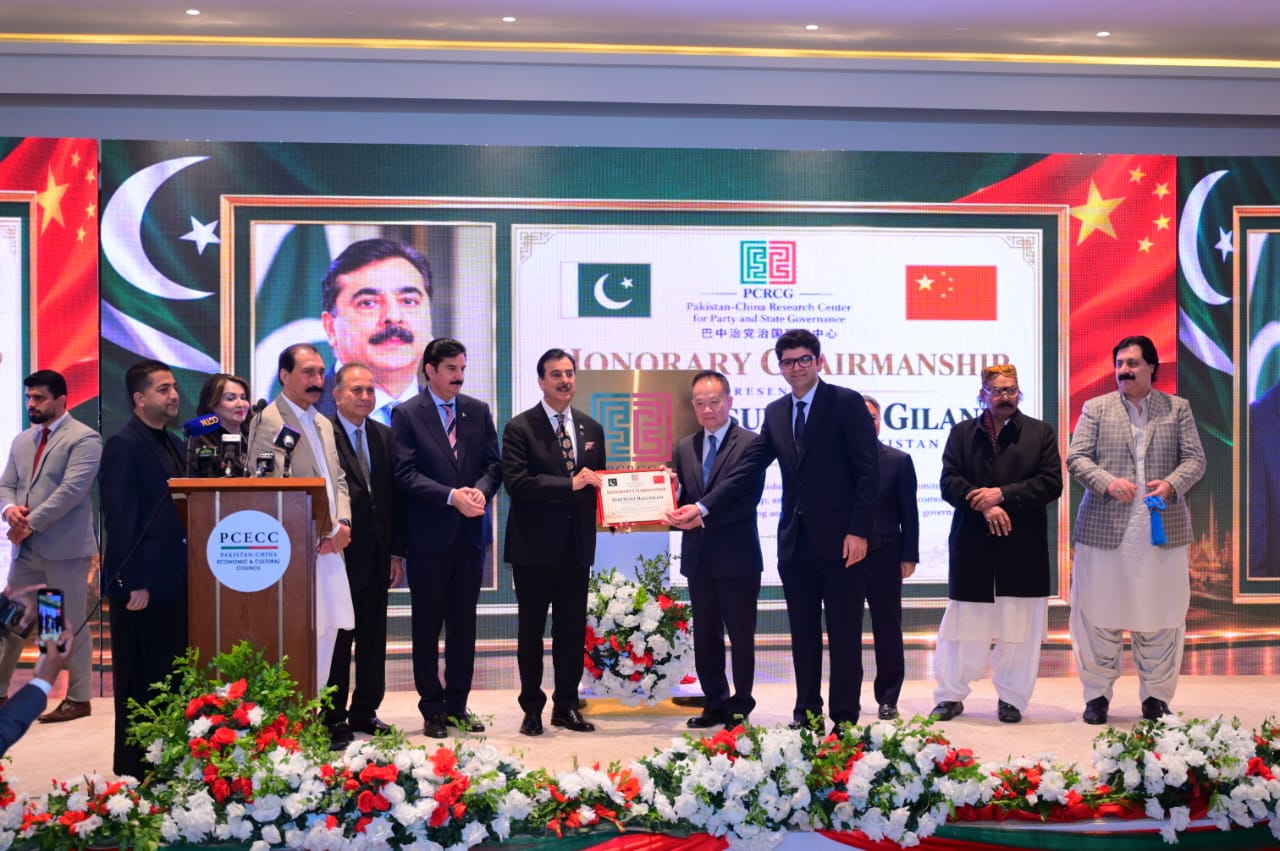
Gilani also accepted the honorary chairmanship of the research center which will contribute towards strengthening multidimensional cooperation through research and development.
The Chairman Senate warmly welcomed Leo Hye-shing, Minister of the International Department of the Communist Party of China (CPC) Central Committee, and his distinguished delegation to Pakistan. He congratulated the Pakistan-China Economic and Cultural Council (PCECC) on establishing the Research Center and expressed gratitude for being invited to serve as its Honorary Chairman, a responsibility he accepted with humility and commitment.
Referring to the photo exhibition showcasing the history of Pakistan-China relations, Gilani said the photographs reflected much more than diplomatic milestones, depicting an enduring friendship rooted in mutual respect, trust and people-to-people connections. Recalling his family’s historical association with China, he noted that his father had visited China in 1956 as a member of Pakistan’s first Constituent Assembly, describing this connection as a cherished legacy that must be carried forward by future generations.
Highlighting the 75th anniversary of diplomatic relations between Pakistan and China, the Chairman Senate said that the Senate of Pakistan had commemorated this historic milestone through a unanimous resolution, reaffirming that the friendship between the two countries transcends political affiliations and social backgrounds. He stressed that Pakistan’s commitment to its all-weather friendship and iron brotherhood with China represents a shared national consensus.
Recalling his engagements with Chinese leadership, Gilani mentioned welcoming Chinese Premier Wen Jiabao to the Parliament of Pakistan in 2010 during his tenure as Prime Minister, as well as receiving a high-level delegation of the National People’s Congress during his tenure as Chairman Senate. He said such high-level parliamentary exchanges reflected the depth and continuity of bilateral relations.
Referring to the Communist Party of China’s 105th anniversary, the Chairman Senate said that China’s institutional continuity, long-term planning and development experience deserved serious academic and institutional study. He highlighted China progress in poverty reduction, rural development, digital governance, industrial growth and public administration, noting that these experiences could provide valuable lessons for improving public service delivery and strengthening governance institutions in Pakistan.
He emphasized that the Senate of Pakistan remained committed to improving its legislative and oversight functions through informed decision-making and institutional learning. He said exchanges of knowledge and successful governance practices could contribute meaningfully to better policymaking.
On economic cooperation, Gilani observed that CPEC 2.0 offered significant opportunities to expand collaboration in agriculture, industrial development, information technology, innovation, green growth and regional connectivity.
He stressed that the next phase of the partnership should focus on translating opportunities into tangible outcomes, including investment, employment generation, skills development and improved living standards.
The Chairman Senate said the establishment of the Pakistan-China Research Center for Party and State Governance was particularly timely, as it would provide an institutional platform for research, policy dialogue and practical cooperation.
He expressed confidence that the Center could bridge the gap between research and policymaking by bringing together scholars, universities, think tanks, public institutions and relevant parliamentary forums to address governance and development challenges.
Gilani expressed his commitment to encouraging the Center’s engagement with parliamentary institutions and research organizations, while promoting stronger exchanges among parliamentarians, policymakers, academics and younger generations of both countries.
Concluding his address, the Chairman Senate underscored that Pakistan-China friendship was not merely a legacy of the past but a shared responsibility for the future.
He called for deeper parliamentary exchanges and institutional cooperation to ensure that the longstanding friendship continued to grow stronger and was passed on to future generations with renewed commitment and purpose.
“Our friendship is a legacy, but its future is a shared responsibility,” he remarked, reaffirming Pakistan’s commitment to strengthening the enduring partnership with China.