






















By Muhammad Zeb
A nation is not judged only by the strength of its government, the size of its economy or the number of laws written in its books. It is judged by a much simpler question: Does the ordinary citizen believe that someone will listen when he or she asks for justice?
This question deserves serious attention.
Across societies, people approach public institutions with legitimate expectations. They seek justice, protection, documentation, services, answers and equal treatment. Yet for many citizens, the greatest frustration is not always an outright refusal. It is being ignored.
A complaint disappears into a file. An application remains unanswered. An investigation moves slowly. A citizen is repeatedly asked to return another day. Eventually, frustration replaces confidence, and confidence is one of the most valuable assets any institution can possess.
When citizens lose confidence in institutions, the consequences extend far beyond individual complaints. People begin to believe that connections matter more than merit, influence matters more than evidence, and status matters more than law.
That perception is dangerous.
Public institutions exist because society entrusts them with authority. Police officers, administrators, regulators, courts and other public bodies are not merely occupying offices; they are exercising responsibilities on behalf of the public. With authority comes a corresponding obligation to act fairly, transparently and within the law.
This does not mean that every complaint must automatically be accepted as true. A responsible institution must investigate claims objectively, examine evidence and protect the rights of every party involved. But an investigation that is fair and an investigation that is ignored are two entirely different things.
The citizen does not always demand that the state agree with him.
Often, the citizen simply wants to know that his complaint was heard, his evidence was considered and a reasoned decision was made.
That basic principle can restore enormous public trust.
There is also a wider responsibility for those who document public grievances, particularly journalists and civil society workers. Raising a voice for accountability should never mean abandoning accuracy. Allegations must be verified, documents examined and the position of the accused sought before conclusions are presented as facts.
Responsible journalism does not serve individuals. It serves the truth.
At the same time, institutions should not regard legitimate criticism as an attack. A mature institution understands that scrutiny is part of public accountability. Questions are not necessarily hostility, and criticism is not necessarily disrespect.
Strong institutions do not fear questions. They answer them.
The real test of governance is therefore not how officials respond when everything is going well. It is how they respond when a citizen challenges a decision, reports wrongdoing or asks why an official action has affected his rights.
A system that listens only to the powerful cannot claim to represent everyone.
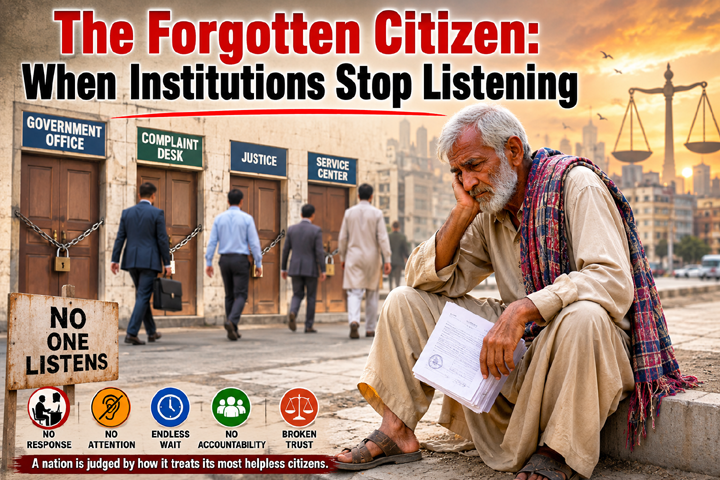
The forgotten citizen is not necessarily someone living in poverty or standing outside an office. Sometimes the forgotten citizen is an educated professional, a businessperson, a worker, a journalist, a student or an ordinary family seeking a lawful remedy.
Anyone can become powerless when an institution stops listening.
For that reason, accountability must not be selective, justice must not depend upon influence, and public service must never become a privilege exercised without scrutiny.
The citizen should not have to know an influential person to receive a lawful response.
He should not need political connections to have his complaint examined.
He should not have to raise his voice repeatedly simply to be heard.
A functioning state does not promise every citizen a favorable decision. It promises something more fundamental: fair treatment under the law.
That promise is the foundation of public trust.
And when institutions remember that their authority ultimately comes with responsibility, the distance between the state and the citizen begins to disappear.
The strongest government is not the one that is feared.
It is the one that is trusted.