



















(In the loving memory of my late father Justice(R) Syed Ali Aslam Jaffri ,who seteaching and guidancemademewhoI amtoday.Eventhoughhemaynolongerbeamongus,hisprayersandbestwisheswillcontinuetoshineuponme)
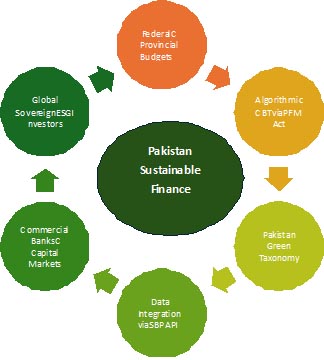
Pakistanisfacinganestimated$348billionclimatefinancinggapthrough2030,thereforeit’s imperativetocarry outfundamentally restructuringoffiscal architecture. Byshifting from traditional budgeting to an automated, data-driven Green Finance System and integrating algorithmic Climate Budget Tagging (CBT) directly into the federal Public Financial Management (PFM)framework,Pakistanaimstoeliminatediscretionaryspendingleaks.Thisdigitaloverhaul ensures that every rupee allocatedtoward climate resilience is tracked, verified, andalignedwith nationaladaptationgoalsinrealtime.
ArtificialIntelligence (AI) isplaying anincreasinglyimportant role inclimate budgeting by helping government, businesses, and organizations allocate financial resources more effectively to climate action specifically in mostof the advanced countries. Thisishappeningbecause AI analyses large data sets to identify areas most vulnerable to climate change,prioritizing funding whereitsisneededmost.AIalsoaidinpredictiveanalytics,resourceoptimization,Monitoring andEvaluation,carbonemissionanalysisanddisasterpreparedness.
Globally,thisstructuralpivotalignsPakistanwithanexpandinginternationalnetworkoftech-drivensustainablefinanceframeworkssuchasArtificialIntelligence(AI),CloudComputing, blockchain, Big Data, and specialized Application Programming Interfaces (APIs)—into the financialecosystem.Theirprimarypurposeistoautomate,track,andverifyenvironmental, social, and governance (ESG) compliance in real time. Emerging economies like Colombia, Indonesia, and South Africa have already demonstrated that digital taxonomy integration significantlyreducessovereignriskpremiumsbyprovidingtransparentdatasetstotheglobal market.ThebackboneofthismodernizationisthenewlydeployedPakistanGreenTaxonomy (PGT),spearheadedbytheStateBankofPakistan(SBP)andtheMinistryofClimateChange
(MoCC). Through specialized application programming interfaces (APIs), the taxonomy standardizes environmental compliance across the commercial banking sector. This digital integrationautomaticallyscreenscorporatelendingportfolios,categorizesassetsintostrict “green,transitional,orred”tiers,andprovidesthetransparentdataverificationrequiredto eliminatecorporategreenwashing.
Byestablishingadigitizedpublicledger,Pakistanissuccessfullypositioningitselftoattract international environmental, social, and governance (ESG) capital. The Ministry of Finance Sovereign Sustainable Financing Framework (SFF) leverages this verified data to issue sophisticatedmarketinstruments.TheseincludeoversubscriptionofconventionalandIslamic instrumentsaimtofinanceenvironmentallyfriendly,social,andsustainableprojectsaligned with National Adaptation Plan, National Climate Change Policy, Nationally Determined Contributions,andNationalClimateFinanceStrategyoftheGovernmentofPakistan.These digital tracing mechanisms give global institutional investors clear visibility into the exact ecologicalimpactoftheircapital.
Pakistanisactivelyleveragingthisclimate-linkedIslamicfinancestructuretotransitionfrom traditional public funding to private institutional capital for ecological infrastructure. A premier exampleisthegovernment’shistoricPKR32billiondomesticSovereignGreenSukuk,which legallyring-fencescapitalforkeyadaptationeffortsliketheGaruk,Naigaj,andShagarthang projects.ThisdomesticpushcomplementsinternationalmilestoneslikeWAPDA’s$500million “Indus Bond” on the London Stock Exchange, proving that data-verified digital metrics can effectivelyunlockglobalESGmarketseveninachallengingmacroeconomicclimate.
Simultaneously,thefederalcabinet’spolicyguidelinesforcarbonmarketsarepavingthewayfor localized carbon pricing and an automated national emissions registry.Operating under Article6 oftheParisAgreement,thisframeworkallowslocalprojectdeveloperstotokenizeandmonetize ecosystemservices.Navigatingthistransitionsuccessfullywillrequiredeepcoordinationacross federalandprovinciallinestolegallyembedthesedigitalmetricsintoallfuturepublicsector developmentprograms.Ultimately,Pakistan’slocalizedintegrationofthePFMActandthePGT servesasascalableblueprintforotherclimate-vulnerableGlobalSouthnations,provingthat institutionaltransparencycansuccessfullybridgethecapitaldeficitintheinternationalcarbon andsovereigndebtmarkets.