






















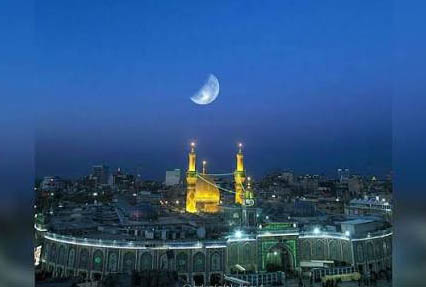

(www.thenewslark.com)
By Brigadier Syed Karrar Hussain (Retired)
Every year on 20 July, the world observes International Moon Day, commemorating one of humanity’s greatest scientific achievements—the first human landing on the Moon in 1969. It is a day that celebrates scientific curiosity, peaceful exploration of outer space, technological innovation, and international cooperation.
Yet, while science looks at the Moon through telescopes and spacecraft, literature, culture, and faith have looked at it through the eyes of beauty, hope, and inspiration for thousands of years.
Perhaps no celestial body has inspired mankind as profoundly as the Moon.
The Moon: Humanity’s First Companion in the Night Sky
Long before satellites and observatories existed, people measured time through the Moon. Farmers planned their seasons according to its phases. Sailors navigated oceans under its light. Poets found in it the language of love, while philosophers saw it as a symbol of reflection and permanence.
The Moon governs tides, influences Earth’s natural balance, and has become an essential destination for modern space exploration. International Moon Day therefore reminds humanity that knowledge advances when nations cooperate rather than compete.
Today, several countries are planning permanent lunar missions, scientific laboratories, and future human settlements on the Moon. What once belonged to imagination is gradually becoming scientific reality.
The Moon in Urdu Literature
In the Urdu language, the Moon is far more than an astronomical object.
It is the most cherished symbol of beauty.
A husband lovingly calls his wife, “Mera Chand”—my moon.
A wife affectionately refers to her husband as her moon.
A mother embraces her little son and whispers, “Mera Chand.”
Grandparents lovingly call their grandchildren “little moons.”
Poets compare the radiant face of the beloved with the Moon, while mothers sing lullabies inviting the Moon to bless their sleeping children.
Thus, in South Asian culture, the Moon represents love, innocence, affection, hope, and emotional warmth.
Scientific achievements have increased our knowledge of the Moon, but poetry continues to preserve its soul.
The Moon in Islamic Civilization
For Muslims, the Moon possesses both practical and spiritual significance.
The Islamic calendar is based upon lunar months.
The sighting of the crescent announces Ramadan, Eid-ul-Fitr, Eid-ul-Adha, Hajj, and the beginning of every Islamic month.
Generations of Muslim astronomers made remarkable contributions to lunar observations, navigation, mathematics, and astronomy, laying foundations upon which later scientific discoveries were built.
Thus, for Muslims, the Moon is not merely a heavenly body but also a guide in religious life and the measurement of sacred time.
Qamar-e-Bani Hashim (A.S.): The Moon That Illuminated Human Character
While International Moon Day celebrates the Moon that shines in the sky, Islamic history remembers another “Moon” whose light continues to illuminate human hearts.
That Moon is Hazrat Abbas ibn Ali (A.S.), forever remembered as Qamar-e-Bani Hashim—the Moon of the Bani Hashim.
He was the beloved son of Hazrat Ali ibn Abi Talib (A.S.), the Lion of Allah, and Hazrat Umm-ul-Banin (A.S.), whose devotion to the Household of the Prophet became an everlasting example of sacrifice.
Hazrat Abbas (A.S.) inherited courage from his father, dignity from his noble family, and unwavering loyalty to his brother, Hazrat Imam Hussain (A.S.).
Although history records his extraordinary physical beauty, it was his character—not merely his appearance—that earned him the title of Qamar-e-Bani Hashim.
His personality reflected bravery, humility, generosity, patience, honour, and absolute faithfulness.
Alamdar-e-Karbala
The defining chapter of Hazrat Abbas’s life unfolded on the deserts of Karbala in 680 CE.
He was entrusted with carrying the standard of Imam Hussain (A.S.).
When the children of the Prophet’s family suffered unbearable thirst after access to the Euphrates was blocked, Hazrat Abbas courageously reached the river.
Despite his own intense thirst, he refused to drink before the thirsty children.
Returning with water, he was surrounded by enemy forces.
His arms were severed.
His body was wounded.
Yet history remembers that the standard of truth never bowed in his hands.
His martyrdom transformed loyalty into an eternal human value.
Today, military academies discuss courage.
Leadership institutions teach commitment.
History honours sacrifice.
Hazrat Abbas (A.S.) demonstrated all these qualities fourteen centuries ago.
The Alam of Hazrat Abbas (A.S.)
Across Pakistan, Iraq, Iran, Lebanon, India, Europe, Africa, North America, and many other parts of the world, the Alam of Hazrat Abbas (A.S.) is respectfully displayed during Muharram.
For millions, it is not merely a flag.
It symbolizes loyalty, trustworthiness, sacrifice, protection of the weak, and steadfastness in the defence of truth.
Every year, during the historic Arbaeen Walk, millions of pilgrims travel on foot from Najaf to Karbala.
Among the most moving scenes are countless devotees carrying the Alam of Hazrat Abbas (A.S.) on their shoulders.
Different nationalities.
Different languages.
Different cultures.
Yet one message.
Loyalty to truth.
Service to humanity.
Love for Imam Hussain (A.S.).
It is perhaps the largest annual peaceful gathering in the world, demonstrating that moral ideals continue to unite humanity beyond race, nationality, and language.
Two Moons, Two Messages
International Moon Day celebrates humanity’s ability to reach the Moon through science.
Qamar-e-Bani Hashim reminds humanity how high the human soul can rise through faith, courage, and selfless sacrifice.
One Moon lights the darkness of the night.
The other illuminates the darkness of the human conscience.
One symbolizes scientific discovery.
The other symbolizes moral greatness.
Human civilization requires both.
Without science, societies cannot progress.
Without character, progress loses its purpose.
Conclusion
As the world marks International Moon Day, it is appropriate to celebrate scientific achievement while also reflecting upon those timeless personalities whose moral brilliance continues to guide mankind.
The Moon in the heavens reminds us to explore.
The Moon in our literature reminds us to love.
The Moon in Islam reminds us to worship.
And Qamar-e-Bani Hashim (A.S.) reminds us to remain loyal to truth, compassionate toward humanity, and steadfast in the face of oppression.
Scientific discoveries may conquer space.
But only noble character conquers hearts.
That is why, after more than fourteen centuries, the radiant legacy of Hazrat Abbas (A.S.), the eternal Qamar-e-Bani Hashim, continues to shine across the world—just as brilliantly as the Moon itself.
ALLAH HO AKBAR