















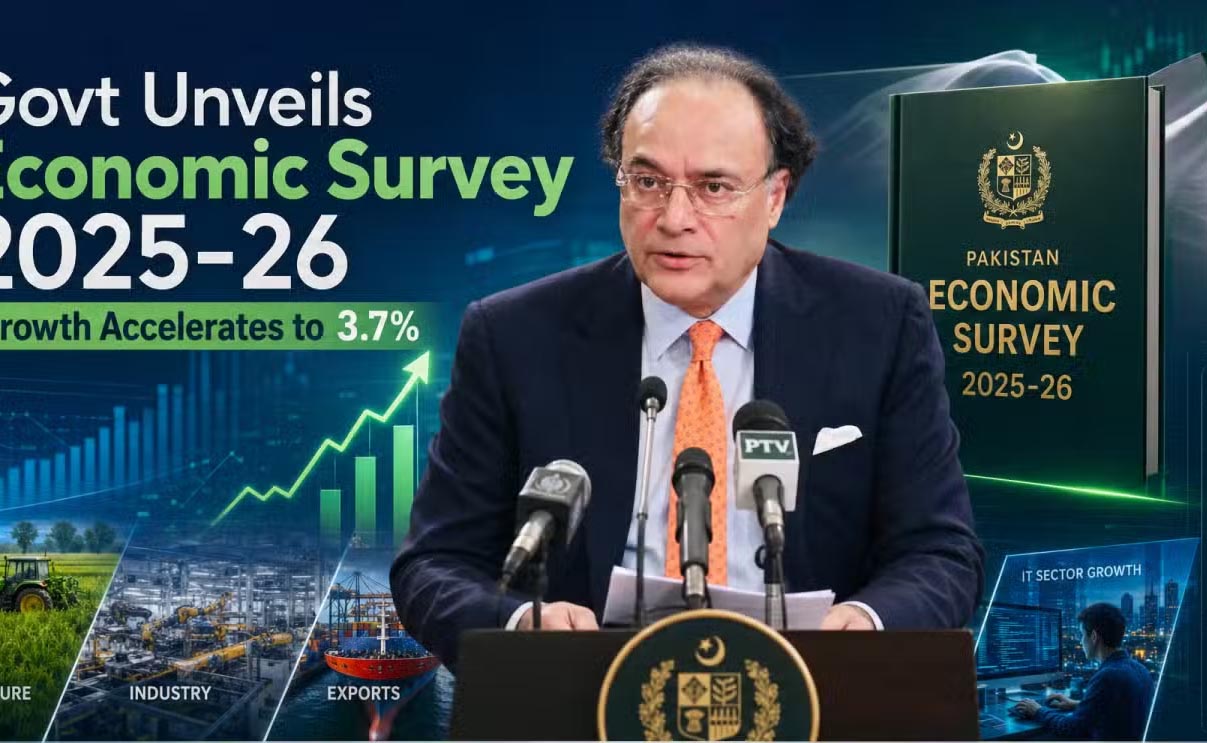
ISLAMABAD:Pakistan has recorded significant progress in women’s financial inclusion, economic empowerment, and gender equality, according to the Economic Survey of Pakistan 2025-26 unveiled by Federal Minister for Finance and Revenue Senator Muhammad Aurangzeb on Thursday.
The survey highlights a series of reforms and initiatives undertaken by the government, the National Commission on the Status of Women (NCSW), and the State Bank of Pakistan (SBP) aimed at expanding opportunities for women and reducing gender disparities across various sectors.
According to the survey, NCSW strengthened gender-responsive policymaking by launching national consultations on gender data, establishing a National Task Force on Gender Data, developing a Gender Equality Index, and expanding the Gender Data Portal. The commission is also preparing Pakistan’s National Gender Parity Report to provide a comprehensive assessment of gender equality indicators nationwide.
To address gender-based violence, NCSW introduced a Multi-Channel Complaint Management System (CMS-II) and a Gender Justice Tracking System to improve reporting, referrals, and monitoring of cases involving women.
The survey noted that the commission also promoted women’s leadership in climate action through initiatives such as the “Aik Beti Aik Shajar” programme and contributed to the development of a gender-responsive national climate framework. It further strengthened international engagement through cooperation with development partners, including the European Union under the GSP+ framework.
On the economic front, NCSW partnered with various organizations to promote women’s entrepreneurship, digital skills development, economic inclusion, and recognition of the care economy. It also launched a Media Fellowship Programme to encourage gender-sensitive and ethical reporting on women’s issues.
A key achievement highlighted in the survey is the progress made under the State Bank of Pakistan’s flagship “Banking on Equality” policy, launched in 2021 to reduce the gender gap in financial inclusion.
The survey revealed that women’s financial inclusion increased from 39 percent in 2021 to 52 percent in 2025, while the gender gap in access to financial services narrowed from 39 percent to 30 percent during the same period. The number of women-owned active bank accounts surpassed 38 million, reflecting growing participation of women in the formal financial system.
The report further stated that banks across the country are implementing gender mainstreaming policies approved by their boards. Women now constitute 17 percent of the banking workforce, moving toward the policy target of 20 percent.
Additionally, 79 percent of bank staff have received gender-sensitivity training, while women champions have been appointed at 80 percent of bank branches to facilitate female customers.
The Economic Survey also cited findings from the World Bank’s Women, Business and the Law 2026 Report, which underscores the importance of legal reforms and effective implementation mechanisms to improve women’s economic participation. The report notes that women globally enjoy less than two-thirds of the legal rights available to men, while only four percent of women live in economies approaching full legal equality.
The survey emphasized that increasing women’s participation in the labor force is critical for sustainable economic growth. With nearly 1.2 billion young people expected to enter the global workforce over the next decade, half of them women, governments must accelerate reforms that remove barriers to women’s economic inclusion.
The Finance Minister said that Pakistan remains committed to strengthening women’s access to finance, entrepreneurship opportunities, education, digital skills, and legal protections as part of broader efforts to achieve inclusive and sustainable economic development.