













ISLAMABAD:Federal Minister for Education and Professional Training, Dr Khalid Maqbool Siddiqui, stated that Pakistan’s young population represents a valuable asset capable of meeting emerging international demands and fostering economic growth through education, skills development, and global engagement.
He made these remarks during inauguration ceremony of the Korea-Pakistan Education Corridor (KPEC) Expo in Islamabad.
The ceremony brought together distinguished academics, diplomats, and education leaders, including Ambassador Syed Moazzam H. Khan, Ambassador of Pakistan to the Republic of Korea; Professor Dr. Choi Jong-in, President of Tongwon University, Republic of Korea; and Professor Dr Anis Ahmad, Vice Chancellor of Riphah International University and others, said a press release on Monday.
While addressing, the Minister emphasized the immense potential of Pakistan’s youth to contribute not only to the national economy but also to addressing global workforce and demographic challenges.
He also highlighted the remarkable development journey of the Republic of Korea, describing it as a model of progress, innovation, and self-reliance from which Pakistan can draw important lessons.
He noted that strengthening educational cooperation between Pakistan and Korea would create new opportunities for Pakistani students and contribute to the development of a highly skilled workforce.
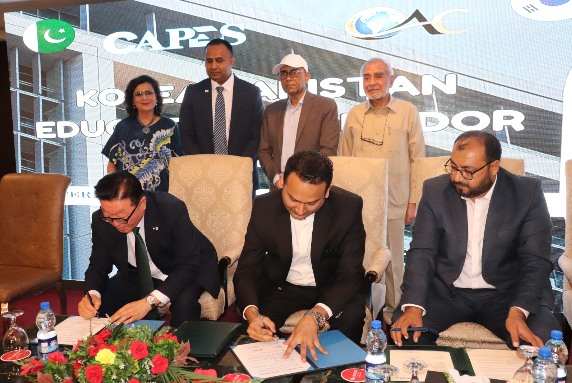
The Korea-Pakistan Education Corridor (KPEC), launched by the Consortium of Asia-Pacific and Eurasian Studies (CAPES), aims to promote educational collaboration between the two countries through a series of initiatives focused on higher education, academic exchanges, skills development, and student mobility.
Addressing the gathering, Ambassador Syed Moazzam H. Khan highlighted the efforts of Pakistan’s Embassy in Seoul to establish a sustainable educational corridor with the Republic of Korea. He stated that the initiative is designed to promote educational exchanges, technical training, and workforce mobility between the two countries. He further informed the audience that four Korean language centres have already been established in Lahore, while similar centres are planned for Islamabad to facilitate greater educational and professional engagement.
Professor Dr. Choi Jong-in expressed Tongwon University’s strong commitment to enhancing academic cooperation between Pakistan and Korea. He acknowledged the growing interest of Pakistani students in Korean higher education and emphasized the university’s willingness to support educational partnerships. He also noted the challenges faced by some students in obtaining study visas despite securing admissions and assured participants of continued efforts to facilitate greater academic mobility.
Professor Dr Anis Ahmad underscored the historical role of the East as a centre of knowledge and intellectual advancement. He encouraged students to broaden their perspectives and align their educational aspirations with global responsibilities, stressing the importance of developing a vision that contributes to society and humanity at large.
Earlier, Dr Khurram Iqbal, President of CAPES, welcomed the participants and highlighted the shift of educational innovation and technological advancement towards Asia in the twenty-first century. He observed that countries such as the Republic of Korea and Japan have emerged as global leaders in technology, industry, and research, making them increasingly attractive destinations for Pakistani students seeking quality education and international exposure.
The event was moderated by Dr Umair Pervez Khan, General Secretary of CAPES, and concluded with a shared commitment to further strengthening educational ties between Pakistan and the Republic of Korea through meaningful partnerships, academic exchanges, and collaborative initiatives aimed at empowering future generations.