
















QUETTA: Balochistan Chief Minister Mir Sarfraz Bugti on Wednesday announced the arrest of a would-be-female suicide bomber in Khuzdar, saying that that militant groups are increasingly exploiting women to carry out attacks against civilians.
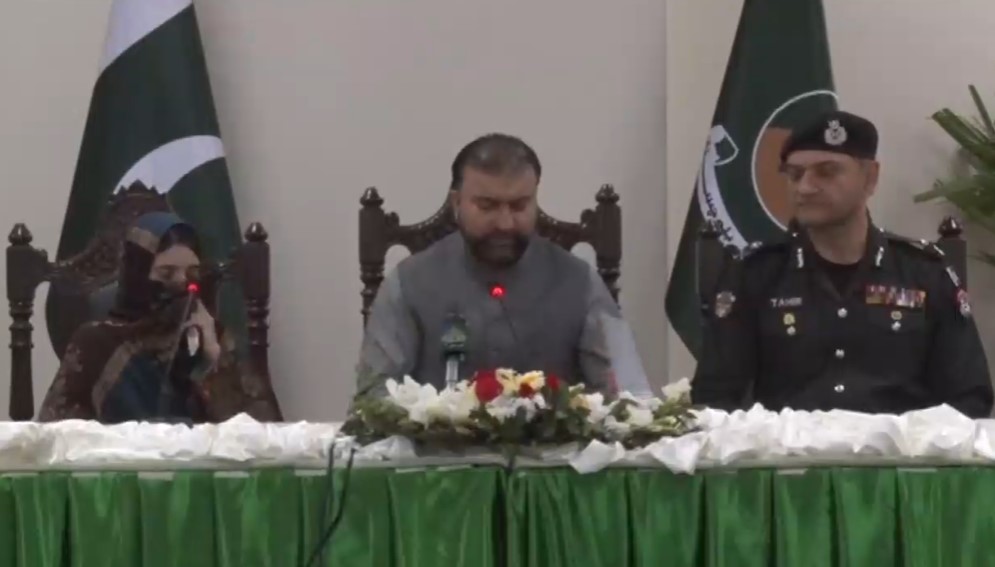
Speaking at a press conference here, Sarfraz Bugti, accompanied by Home Minister Mir Zia Ullah Langau and Additional Chief Secretary Hamza Shafqaat, IG Police Muhammad Tahir Khan and Shahid Rind, he said that security forces successfully averted a large-scale catastrophe by arresting a female would-be suicide bomber, identified as Laiba (also known as Farzana), in the Khuzdar district.
He said that the security forces arrested the suspects during an intelligence-based operation relying entirely on human intelligence. He credited local residents for providing critical information that helped avert a major catastrophe.
Sarfraz Bugti added that the suspect had been misled and manipulated and would be placed in a rehabilitation center for three months, where authorities will conduct a full investigation alongside a de-radicalization program aimed at reintegrating her into society.
He emphasized humane treatment, noting that all procedures would be conducted in the presence of female police officers and without harassment.
“We are different from terrorists. Even someone who came to take innocent lives is being treated with dignity and respect,” Bugti said.
The CM accused the banned Balochistan Liberation Army (BLA) and its leadership, including Bashir Zaib, of degrading societal values by using women as instruments of violence. He stressed that in Baloch and Pashtun traditions, women hold a respected position, and their use in suicide attacks violates cultural norms.
Sarfraz Bugti warned that such tactics have forced security forces to reconsider operational procedures, including checking vehicles carrying women, something traditionally avoided out of respect.
During the press conference, the detainee, Laiba, shared her journey into radicalization, that she had been indoctrinated by militant commander Ibrahim alias Qazi Mama who connected her with Dil Jan, who in turn introduced her to Dr. Sabiha, a key figure in the terrorist network and reportedly associated with the Baloch Yakjehti Committee (BYC).
According to Laiba, Dr. Sabiha lures and exploits girls—particularly those from financially vulnerable backgrounds—through psychological manipulation, personal exploitation, and radicalization to prepare them for extremist activities, including suicide bombings.
Laiba disclosed that she was tasked with recruiting more girls for suicide attackers. Commander Dil Jan had planned to meet her, take her to a camp, and assign her a specific target for the suicide mission. However, she was apprehended by security forces upon reaching Khuzdar, foiling the plot.
She admitted she had been tasked with recruiting other young women for suicide missions.
“I was mentally prepared for a suicide attack,” she said, adding that she now regrets her actions and urged other girls to avoid such a way.
Laiba said that she was “brainwashed” into becoming a suicide bomber by a Tehreek-i-Taliban Pakistan (TTP) commander, whom she met last year.
Sarfraz Bugti reiterated that the insurgency in Balochistan is a futile war that brings only destruction, pointing to damaged infrastructure, closed schools, and lost opportunities for youth. He rejected claims that the unrest is political, describing it instead as a matter of state authority and law enforcement.
He said that such groups recruit people through the internet and organisations with names such as the Baloch Yakhjeti Council, looking for people who could be radicalised against the state of Pakistan.
He announced that three battalions of the Federal Constabulary have been requested to support security operations. On missing persons, Bugti claimed the state is not responsible for enforced disappearances, alleging that banned groups are involved in kidnappings.
Sarfraz Bugti also highlighted regional security concerns, accusing militant elements in Afghanistan of orchestrating attacks inside Pakistan.
The chief minister said the repatriation of Afghan refugees is part of state policy and will be carried out with dignity. He noted Pakistan’s decades-long role in hosting refugees but stressed that current security concerns necessitate action.
Sarfraz Bugti reiterated the government’s openness to dialogue with individuals willing to engage in serious negotiations, while maintaining that decisions will be made strictly in accordance with the constitution and law. He also emphasized merit-based recruitment and constructive opportunities to steer youth away from extremism.
CM Sarfraz Bugti reaffirmed the government’s commitment to combating terrorism, curbing corruption, and ensuring peace and development in the province.