



















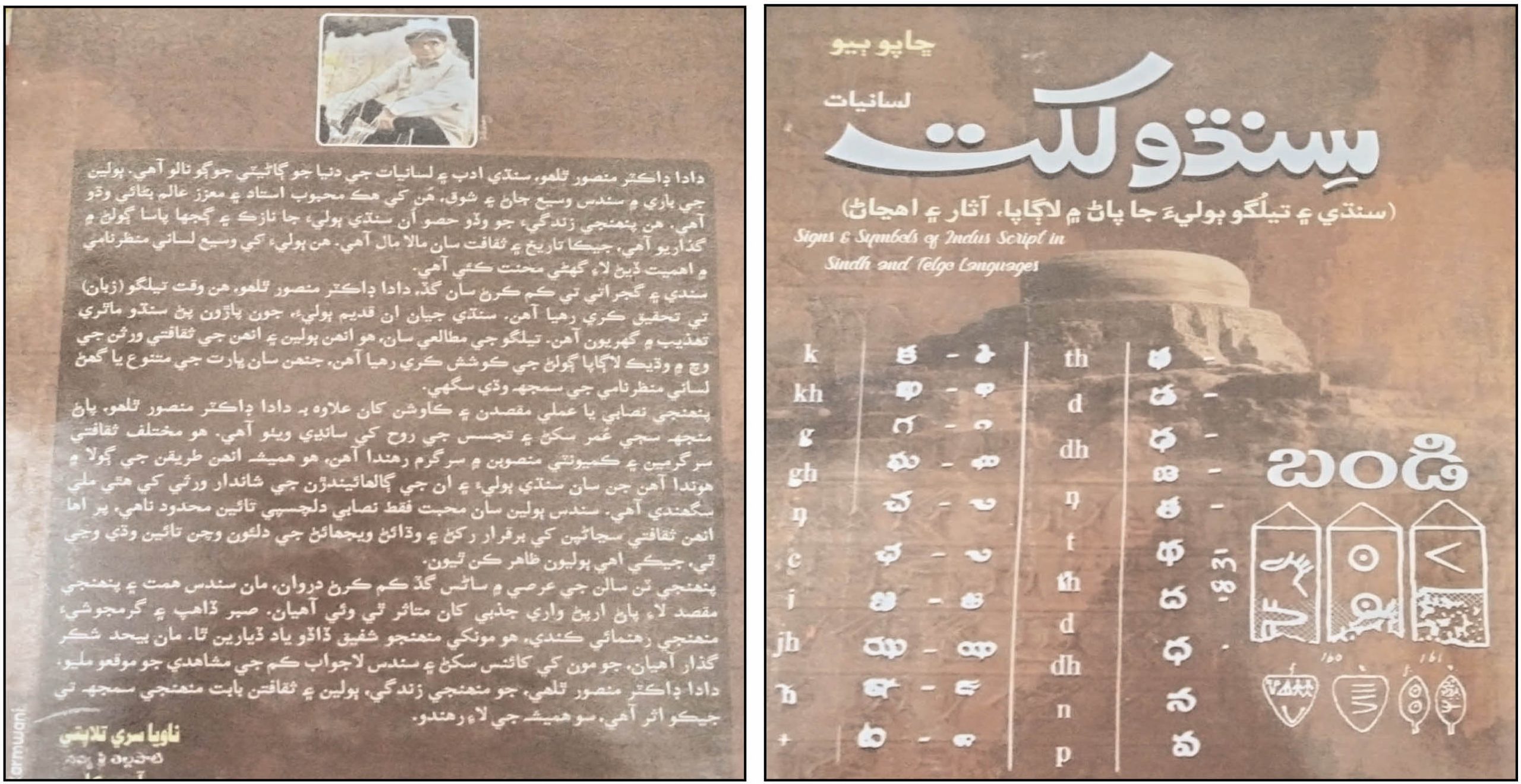

Navya Sri Talapati writes that Dada Dr. Mansoor Thalho is a distinguished name in the fields of Sindhi literature and linguistics. Dr. Mansoor Thalho demonstrates how these languages have influenced one another at different periods in history.
Deedar Sham writes that Dr. Mansoor Thalho explores the antiquity of the Sindhi language. His books suggest that the language spoken by the people of Mohenjo-daro was Sindhi and that its ancient symbols bear similarities to the signs found at Mohenjo-daro.
Renowned writer Dr. Badr Dhamraha states in the foreword that Dr. Mansoor Thalho has a singular focus: investigating the script of Mohenjo-daro and tracing its influence on the scripts of languages around the world. According to him, Dr. Thalho has achieved remarkable success in this endeavour.
Dr. Mansoor Thalho has highlighted the similarities and variations between the signs of the Mohenjo-daro script and those of the Telugu script.
The author’s primary objective is to decipher the symbols engraved on the seals discovered at Mohenjo-daro and make their meanings understandable.
In the introductory section, the author explains that linguists have altered the orientations of early symbols to represent different sounds. Similar patterns, he argues, can also be found in the languages associated with the Indus Valley Civilisation.
The author writes that many sound symbols in the Sindhi and Telugu languages resemble inscriptions engraved on pottery discovered at Mohenjo-daro, Harappa and Bhambore.
He further states that a children’s book in Sindhi was published in 1938, containing thirteen basic components of letters. These symbols resemble the Matralu and Vattulu signs used in the Telugu writing system.
# Chapter One
## Telugu Vattulu Symbols and Sindhi Letters
In this chapter, the author presents a chart of the Telugu alphabet, including vowels and consonants, and compares Telugu symbols with those found in the Indus script.
He also presents evidence to support his proposed connections between symbols discovered at Mohenjo-daro and Telugu characters. In addition, he provides an outline of the Burmese script.
Under the heading “Horseshoes Displayed in Villages, Cities and Shops,” the author discusses teachers and describes his meetings with Abid Hassan Jalbani and Mashooq Ali Morio. One of the observations mentioned is that horseshoes were traditionally placed outside houses to ward off the evil eye.
The author also refers to Chhelo Wah, a canal that once carried a strong flow of water but now suffers from water scarcity.
He recounts his conversation with Ramdas and describes his meeting with Raza Muhammad Mangnehar, a horse enthusiast.
The chapter also includes a chart showing the Telugu numbers from one to twenty.
# Chapter Two
## The Sindhi Letter “Dhal” and the Telugu Consonant “La”
The author writes that similarities can be found among the shapes of letters and numerals in several scripts associated with the languages of the Indus Valley region, including Gujarati, Brahmi and Nepali scripts.
He observes that the shape of the letter “Meem” in the Shikarpuri script of Sindhi resembles the Telugu Vattulu symbol represented as “m.”
The author also provides a chart of the Vangai script of the Sindhi language.
### A Children’s Book and the Components of Letters
The author compares the basic components of Sindhi letters with Telugu symbols and presents a chart illustrating the similarities he has identified between Telugu signs and the Indus script.
# Chapter Three
## Matralu Symbols and the Components of Sindhi Letters
The author explains that consonant letters in Telugu are referred to as Hallulu and states that there are thirty-six such letters.
He provides a chart of Vattulu symbols and observes that the Telugu symbol “ta” and the Sindhi writing form associated with the pesh diacritic have similar shapes.
The author also includes a chart of the Rajai script of Sindhi.
An illustration of an inscription or symbol engraved on pottery from Bhambore is reproduced in the book.
The author compares a symbol from Mohenjo-daro with the Telugu Vattulu symbol represented by “r.”
He further writes that merchants in Mohenjo-daro were engaged in reading and writing.
### The Cypriot Script and the Inscriptions of Mohenjo-daro
Under this heading, the author discusses similarities between the Sindhi script and the symbols engraved on seals discovered at Mohenjo-daro.
# Chapter Four
## The Telugu Varnamala Script, the Sindhi Script and Vattulu Symbols
The author describes Telugu as a classical language whose script, in his view, has similarities to the Sindhi writing system.
He provides examples of Telugu vocabulary, noting that a dog is called kukka, a house is called illu, and a pigeon is referred to as paavuram.
The chapter also includes a chart of the Semitic script.
### Telugu Letters and the Shapes of Birds
The author explains that early forms of writing in ancient civilisations often developed from pictures depicting birds, animals, trees and plants.
He identifies three symbols in the Indus script whose shapes, he argues, resemble ducks.
### The Seals of Mohenjo-daro
The seals discovered at Mohenjo-daro contain images of birds and animals.
According to the author, some symbols on these seals also appear similar to signs found in ancient European writing systems.
He further observes that certain forms of Telugu letters resemble signs found in Maya-related inscriptions, while those inscriptions also exhibit similarities in shape to symbols of the Indus script.
# Chapter Five
## Forms of Sindhi Letters and Similarities with Telugu and Other Scripts
The author writes that several words in Sindhi and Telugu end with the sound “m.”
He gives the example of the Sindhi word chhati, noting that a corresponding term in Telugu is chatramu.
The author argues that the ancient Sindhi writing system, inscriptions of the Indus Valley and symbols from the period of Emperor Ashoka share considerable similarities.
He also refers to inscriptions dating to approximately 252 BCE, in which he claims that Telugu words can be identified.
According to the author, the letters and written forms of the ancient Sindhi script can be found in several writing systems associated with the Indus Civilisation.
# Chapter Six
## Dotted and Circular Symbols on Ancient Stones
The researcher explains that a dot is called tippu in Sindhi and bottu in Telugu. A dot-like symbol is also found on seals discovered at Mohenjo-daro.
He further notes that dot-shaped markings were engraved on stone pillars during the period of Emperor Ashoka.
# Chapter Seven
## Leaf-Shaped Inscriptions Resembling Peepal Leaves
The researcher presents charts of Telugu Hallulu and Vattulu characters, observing that some Telugu letter forms resemble peepal leaves and betel leaves.
He states that Telugu inscriptions share numerous similarities with the symbols found on the seals and other inscribed objects discovered at Mohenjo-daro.
The written form of the Telugu numeral for four, he notes, also resembles the shape of an ox.
The number one in Telugu is called okati. According to the researcher, its written form resembles a symbol found at Mohenjo-daro.
The researcher concludes that, beyond the Indus Valley region, ancient linguistic and phonetic connections with foreign languages also appear to be extensive and significant.
Editorial note: This translation preserves the author’s arguments and the claims attributed to the cited writers. Historical and linguistic claims have not been independently verified. Some technical terms and transliterations in the Sindhi source may require checking against the original book, particularly the names of scripts, letter forms and Telugu vocabulary.