















By: Sharjeel Inam Memon
Sindh Senior Minister for Information, Transport and Mass Transit
Some tragedies become etched into the pages of history in such a way that no storm of passing time can erase them. The passage of time covers many wounds with dust, generations change, the forms of promises and commitments change, and thrones and crowns pass into the hands of new heirs. But certain days are engraved not only in human memory but also upon the collective conscience of nations. 18 October 2007, was one such day in our national history; a day whose morning was filled with the light of democratic hopes and whose evening was full of an immense expression of public love, but whose night became associated with the smell of gunpowder, the redness of blood, the cries of mothers, the sobs of sisters, and the helplessness of orphaned children.
The Karsaz tragedy is not merely the name of a terrorist attack; rather, it is a blood-soaked chapter in the political history of that era, in which an attempt was made to confine the democratic aspirations of the people of Pakistan within a circle of fear. It is the story of the sacrifices of countless people who had left their homes to welcome their leader, Shaheed Mohtarma Benazir Bhutto; whose hearts were lit with lamps of hope; whose eyes held the dream of a democratic, just, and dignified Pakistan; and who perhaps had never even imagined that, on the soil of their own homeland, they would have to pay for expressing their own democratic right with their lives.
When Shaheed Mohtarma Benazir Bhutto returned to her homeland on 18 October 2007, after eight years of exile, the roads of Karachi became witnesses to an unprecedented scene of public love. The city’s neighbourhoods and marketplaces, its lanes and roads, were filled in every direction with a surging sea of people. Some elderly people waited eagerly to catch a glimpse of their beloved leader; some young people stood with dreams of their future in their eyes; some mothers had brought their children with them; the hands of some labourers carried lines of hope; and the faces of the deprived and oppressed classes shone with the belief that perhaps their voices would once again reach the halls of power.
This was not merely the return of a political leader to her homeland; it was the beginning of a new chapter in a long political struggle. It was the hope of restoring the continuity of democracy that dictatorship, political restrictions, exile, and struggles for power had repeatedly attempted to interrupt. The people had come out not merely to welcome their leader, but, in reality, to welcome their aspirations, their political rights, their collective identity, and their democratic future.
A long and difficult political journey lay behind Mohtarma Benazir Bhutto’s return. She was the daughter of this land, which had witnessed her father, Quaid-e-Awam Shaheed Zulfiqar Ali Bhutto, being led to the gallows. She was the custodian of a political legacy in which popular sovereignty, the supremacy of the Constitution, the strengthening of democratic institutions, and the inclusion of deprived sections of society in power and authority held fundamental importance. Her life was not merely the story of a political family; it was also the struggle of a woman who, despite political resistance, imprisonment, exile, personal tragedies, and constant threats in a complex society like Pakistan, chose the path of public politics.
She decided to return to her homeland at a time when fears of danger were present. But, in her view, politics was not merely a means of gaining access to power; it was also a matter of honouring the commitment made to the people. She knew that the path of democracy passed through rugged valleys, that this journey held trials and the possibility of sacrifices, but her political resolve could not persuade her to remain away from her people.
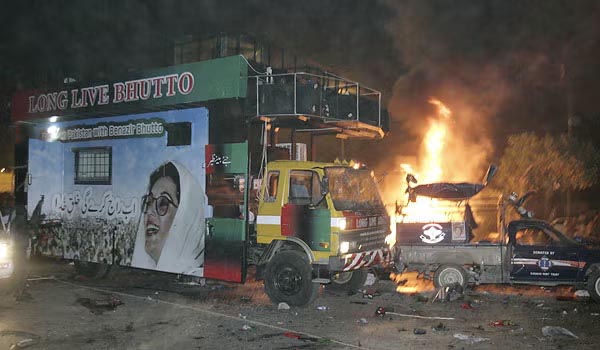
It was against this backdrop that Karachi witnessed a historic scene on the evening of 18 October. As Mohtarma Benazir Bhutto’s convoy passed along Shahrah-e-Faisal and reached the Karsaz area, two successive blasts shook the atmosphere. Within moments, the celebration of the welcome turned into mourning. Chants of joy turned into screams, the lights of illumination were covered by shadows of smoke, and the road where people had gathered to express their love for their leader became stained with human blood.
This scene was not apocalyptic only for those who were caught in the tragedy; it was a collective shock for the whole of Pakistan. The loss of human lives, the helplessness of the injured, the agony of families searching for their loved ones, and the chaos spread everywhere turned that night into an unforgettable tragedy in the nation’s memory. According to various historical reports, approximately two hundred people were killed and more than five hundred were injured in the attack. They included ordinary citizens as well as Pakistan Peoples Party workers. These figures have their place, but behind every number was an entire life; a home, a family, a mother’s prayer, a child’s hope, and the wait for the return of a loved one.
Just imagine those homes where a father left to welcome his beloved leader and never returned; think of the condition of those mothers who had happily sent off their children but, as evening fell, were left with waiting, anxiety, and then a lifetime of grief; consider the sorrow of those children who had to accept, in a single moment, the reality that their fathers would never again knock on the door of their home. The true scale of a human tragedy cannot be contained in official statistics. Its real magnitude can be seen in those empty chairs, those silent homes, and those eyes whose tears do not dry even after years.
While remembering the martyrs of the Karsaz tragedy, it must not be forgotten that their sacrifice is not merely part of the internal history of a single political party. They were citizens of Pakistan, inhabitants of this homeland, and they had the right to live with their political affiliations and the right to peaceful assembly. In any civilised society, protecting the lives, freedom, and dignity of citizens is a fundamental responsibility of the state. When a public gathering is targeted by terrorism, it does not mean only the end of a few lives; it also damages the basic trust of citizens upon which the structure of a democratic society stands.
The memory of the Karsaz tragedy holds exceptional importance for the Pakistan Peoples Party because it has become a symbol of the extraordinary commitment, loyalty, and political steadfastness of its workers. These workers formed a human shield around their leader, fulfilled their responsibilities despite the dangers, and remained steadfast even under circumstances in which protecting their lives had become a serious question. Their sacrifice reminds us that political parties do not come into existence merely through slogans, election symbols, or the halls of power; their true foundation is formed by those workers who believe in their ideology, make their association with their party part of their identity, and do not abandon their commitment even under the most difficult circumstances.
However, reducing the sacrifices of the martyrs to words of emotional devotion alone would not do justice to them. The true demand of remembering them is that their dreams be understood, their political resolve be viewed in its historical context, and the values for which they left their homes be given a place in practical life. If injustice, political intolerance, deprivation, and violations of citizens’ rights continue in society even after their sacrifices, we must review our collective conduct afresh. The most meaningful way to pay tribute to the martyrs is to connect their memory with public service, constitutional governance, social justice, and the protection of human dignity.
When the political history of Pakistan is studied, the struggles of Shaheed Zulfiqar Ali Bhutto and Shaheed Mohtarma Benazir Bhutto emerge not as two separate events but as a continuation of a long political tradition. Zulfiqar Ali Bhutto sought to involve the people in the political process, give voice to their rights, and highlight the importance of public representation in the state system. Even those who disagree with his politics cannot deny the fact that his era had a profound impact on Pakistan’s political life. The Constitution of 1973 is an important historical document of that period, which gave constitutional form to the foundations of a federal parliamentary system.
After his martyrdom, Mohtarma Benazir Bhutto took charge of a political legacy associated with countless hopes, painful memories, and extraordinary responsibilities. She struggled against dictatorship, played her role in the political arena for the restoration of the democratic process, and reached the office of prime minister twice. Her political life was marked by successes and failures, disagreements and controversies, hopes and trials; but one prominent aspect of her history was that she gave a new dimension to the role of women in leadership and the concept of public representation in Pakistan’s politics.
The Karsaz tragedy took place right in the middle of this long struggle. Mohtarma Benazir Bhutto survived the attack, but hundreds of people accompanying her lost their lives. This incident demonstrated the bitter reality of how destructive the consequences can be when attempts are made to stop the political process through terrorism. Attacking any political leader, targeting their supporters, and spreading fear among citizens are contrary to the fundamental principles of a democratic society. The answer to political disagreement is not violence but reason; the way to confront opposing thought is not the gun but dialogue; and the outcome of a struggle for power should not be decided by gunpowder but by the people’s free right to choose.
But history still had another painful turn in store after this tragedy. On 27 December 2007, Mohtarma Benazir Bhutto was martyred in another attack at Liaquat Bagh in Rawalpindi. Thus, while the wounds of Karsaz were still fresh, the nation had to endure another irreparable shock. Within a few months, Pakistan lost a leader whose political life was deeply connected with questions concerning the country’s constitutional and democratic future. The distance from Karsaz to Liaquat Bagh was not merely geographical; it became a symbol of those tragic events that permanently affected Pakistani politics.
After the martyrdom of Mohtarma Benazir Bhutto, her husband, Asif Ali Zardari’s slogan, “Pakistan Khappay” (Pakistan Must Endure), emerged as an important symbol in the country’s national political history. Despite the profound grief, the slogan expressed a commitment to the continuity of the state, national unity, and Pakistan’s future. At a time when emotions were running high, emphasising Pakistan’s survival and security was both a political message and a reminder of national responsibility. One lesson that can be drawn from this is that, after major national tragedies, the test of leadership lies not only in expressing grief but also in protecting society from disorder, maintaining the supremacy of law, and finding a way towards state stability despite political differences.
Today, Pakistan Peoples Party Chairman Bilawal Bhutto Zardari and the new generation of the party face the historical responsibility of not limiting their political legacy to commemorative ceremonies and formal statements, but of taking it forward in line with the demands of the present age. Every era brings its own new questions. Today’s Pakistan faces problems such as economic difficulties, unemployment, social inequality, terrorism, institutional tensions, and political distrust. Under these circumstances, strengthening democracy requires political parties to give public issues a prominent place among their priorities, make parliament effective, respect differences of opinion, and seek solutions to political problems within the constitutional framework.
Here, an important question also deserves our attention: have we learned the lessons from the Karsaz tragedy that a democratic society needs? Have we given the security of public gatherings, the protection of citizens, and institutional preparedness against terrorism the place among our national priorities that this tragedy demanded? Have we kept alive the requirements of justice and accountability for the victims of this incident and their families?
These questions are not limited to a single political party, a single government, or a single institution. They concern the collective conscience of the state and society. Finding answers to them requires not only emotional commitment but also historical integrity, transparency, and an assessment based on facts.
The question of investigating the Karsaz tragedy and identifying those responsible is of fundamental importance in this context. Even after many years, serious questions have continued to be raised about progress in bringing the planners and those responsible for this incident to justice. News of investigative committees and measures emerged at different times, but the question of justice for the affected families has not been fully resolved. In October 2022, a detailed report by the daily Dawn also pointed out that, fifteen years after the tragedy, the affected families were still waiting for justice.
This should be a serious moment of accountability for our collective justice system. Providing justice to the victims of any tragedy is not merely a government’s political priority; it is a fundamental requirement of the rule of law. Investigations must be transparent, responsibility must be determined on the basis of evidence, the relevant institutions must perform their duties, and the families of the victims must be kept informed of progress. Justice does not require declaring any individual or group guilty in advance; justice requires that the truth be brought to light on the basis of evidence and that accountability be ensured in accordance with the law.
The beauty of democracy lies precisely in this: it considers no one above accountability. Whether it is the government or the opposition, a political party or a state institution, every party is subject to the Constitution and the law. Impartial investigations into incidents such as the Karsaz tragedy are important for this very reason: they can not only provide justice to the affected families but also lay the foundation for effective measures to prevent such tragedies in the future. Historical memory becomes meaningful only when it gives us the courage to face facts rather than escape from them.
Another profound lesson of this tragedy concerns political tolerance and respect for humanity. Democracy is not merely the act of casting a vote or forming a government; it is a cultural and moral system in which there is room to listen to the voice of an opponent as well. Turning political disagreement into treason, enmity, or personal revenge is dangerous for a democratic society. When hatred takes the place of dialogue in politics, when contempt replaces disagreement and threats replace reason, the foundations of society begin to weaken.
Pakistan is a federal, multicultural, and diverse society. Citizens belonging to its different provinces, languages, ethnic identities, and political tendencies must live under a common constitutional order. Instead of treating this diversity as a weakness, it is necessary to turn it into a democratic strength. The people of every province should have confidence in matters concerning their rights, resources, language, culture, and political representation. The strength of the federation depends on ensuring that the people of all its federating units feel that they are equal citizens of the state and that their legitimate constitutional rights are respected.
The memory of the Karsaz tragedy also tells us that the national struggle against terrorism must rise above political differences. Terrorism is not the problem of a single party, province, or class; it is a threat to the peace, human lives, and future of the entire society. Countering it requires the professional capacity of law enforcement agencies, intelligence cooperation, an effective judicial system, public trust, and the seriousness of political leadership. Instead of limiting the memory of the victims of terrorism to a political slogan, it should be linked to national policy, public safety, and improvements in the justice system.
In this regard, it is also important that the protection of any public gathering should not be treated as merely an administrative exercise. Citizens’ rights to peaceful assembly, freedom of expression, and political affiliation are fundamental rights. It is the state’s responsibility to provide a safe environment for the exercise of these rights. Political parties also have a responsibility to play their part in protecting citizens by planning gatherings properly, training volunteers, and coordinating with the relevant institutions. Taking the experience of the Karsaz tragedy seriously means placing the protection of human life above every political and administrative priority.
The sacrifices of workers have always held an important place in the history of the Pakistan Peoples Party. But true loyalty to workers also requires giving importance to their lives, their families, and their economic and social problems. The education of martyrs’ children, the welfare of their families, the care of the injured, and the protection of the dignity of the victims should be fundamental parts of any political tradition of remembrance. The memory of sacrifices does not remain alive merely by laying flowers; it remains alive when the people connected with those sacrifices are not forgotten.
Every year, 18 October gives us an opportunity to look back at our past, but its purpose should not be merely to remain trapped in the past. The real benefit of history is that it guides us in understanding the present and determining the direction of the future. If we remember the Karsaz tragedy only as a sorrowful incident, its significance will remain limited; but if we view it in the context of democratic rights, human dignity, state responsibility, the rule of law, and political tolerance, its memory can become a national lesson.
Today, we need to tell our young people that democracy is not a gift that, once obtained, remains ours forever; it is an ongoing responsibility. Its protection requires awareness, tolerance, dialogue, respect for the law, and civic participation. The younger generation must understand that differences of opinion are part of the intellectual life of society, and respecting the rights of people who disagree with a political ideology is also an essential part of democratic ethics. The strength of any ideology lies not in silencing its opponents but in building trust through its arguments, conduct, and practical performance.
Likewise, democracy cannot be limited merely to relations among political leaders. Its true measure is reflected in the lives of ordinary citizens: do they receive justice? Do their children have access to educational opportunities? Do they have employment, healthcare, and basic facilities? Can they express their opinions without fear? Do state institutions protect their rights? If the answers to these questions are positive, democracy becomes a living reality in people’s lives; otherwise, its meaning remains limited to constitutional and political terminology.
In the name of the martyrs of Karsaz, our greatest responsibility is to make this very commitment: to connect democracy with people’s everyday lives. Public service must be made a political priority, deprived sections of society must be provided with opportunities for development, the participation of women and young people must be promoted, the rights of the federating units must be respected, and relations among institutions must remain within constitutional limits. The success of democracy lies not merely in the formation of governments, but in strengthening public trust, ensuring that the law is equal for everyone, and making certain that the state treats all its citizens justly.
While paying tribute to the martyrs of the Karsaz tragedy, we must also listen to the silence of those families who have been carrying the burden of separation from their loved ones for years. Some sorrows do not fade with time; they become part of the ordinary routines of human life. No festival can make up for their absence, no ceremony can take their place, and no words of condolence can completely fill the void created by the loss of a loved one. Our responsibility towards such families is not to tie their grief to changing political seasons, but to recognise that they are always entitled to respect, compassion, and justice.
The memory of 18 October also confronts us with the reality that Pakistan’s history is not merely the history of rulers, governments, and political parties; it is also the history of the sacrifices, hopes, struggles, and deprivations of ordinary people. This history includes those workers whose names may not be recorded in national history books, but who gave meaning to political life through their actions. It also includes the mothers who lost their sons, the children who experienced the loss of their parents’ affection, and the families who continued their life’s journey while silently bearing their grief.
We cannot fully honour the memory of these martyrs until we make efforts to preserve their names and sacrifices with human dignity. Their stories should be passed on to the younger generation, historical records should be preserved, research into the facts of the tragedy should be encouraged, and the experiences of the affected families should become part of our collective memory. A nation’s cultural maturity can also be measured by how it remembers its dead, its oppressed, and its martyrs.
While studying the political legacy of Shaheed Mohtarma Benazir Bhutto, it is also necessary to understand the complex political circumstances of her era, her achievements, and the criticism directed at her with historical integrity. The legacy of any leader is assessed not only through the measure of devotion but also in the context of their political role, decisions, public impact, and historical circumstances. Similarly, the true responsibility of a political party is to draw strength from its past while also examining its weaknesses and adopting better paths for the future. Loyalty to history does not mean avoiding questions about it; rather, it means developing the courage to understand all its aspects.
The memory of the Karsaz tragedy teaches us that protecting democracy is not the work of a single political party but the shared responsibility of the entire society. Political parties play an important role in this process, but democratic culture cannot become firmly established without the participation of citizens, journalists, teachers, lawyers, intellectuals, labourers, farmers, and young people. A society where there is freedom to ask questions, where differences are tolerated, where power is kept subject to the law, and where the protection of citizens’ fundamental rights is ensured can stand on stronger foundations against terrorism and political violence.
It should also be remembered that the journey of democracy does not always move forward in a straight line. It encounters interruptions, crises arise, and sometimes events occur that leave an entire nation in despair. But the real strength of democratic societies lies in their ability to learn from their crises, improve their institutions, resolve their differences peacefully, and make continuous efforts to restore public trust. The memory of the Karsaz tragedy calls us towards this same collective maturity.
We must pledge that no citizen’s blood will be allowed to become meaningless, no plea from an affected family will be allowed to fall victim to indifference, and no national tragedy will be forgotten merely with the passage of time. Justice, accountability, and human respect are fundamental values without which democracy loses its soul. Therefore, the demand to identify those responsible for the Karsaz tragedy and hold them accountable in accordance with the law is not merely a question about the past; it is also a requirement for protecting the future.
Today, when we remember the martyrs of Karsaz, our eyes do not see only that dark night; they also see the sea of people who had come out to welcome their leader. We remember the faces filled with hope, think of the steps taken to express a democratic right, and feel the sorrow of the families whose lives were changed forever by this tragedy. This memory contains grief, respect, questions, and a commitment that must be passed on to future generations.
The sacrifices of the martyrs of the Karsaz tragedy remind us that, against every attempt to suppress the people’s voice, it is necessary to strengthen democratic awareness, human dignity, and the rule of law. This is not a claim that all of history’s problems can be solved by determination alone; history demands that determination be turned into action, principles into policy, and remembrance into responsibility. The greatest service in the name of the martyrs is to continue striving to build Pakistan into a society where citizens have security instead of fear, opportunities instead of deprivation, law instead of injustice, and dialogue instead of hatred.
The memory of 18 October does not call upon us to remain prisoners of mourning for the past; it awakens us to build the future. This day tells us that political affiliation cannot be considered more valuable than human life, power cannot be placed above the law, and disagreement cannot be used to justify violence. True respect for democracy is possible only when we recognise our opponents’ right to life, right to express their opinions, and right to political participation in the same way that we demand these rights for ourselves.
Let us turn the memory of the martyrs of Karsaz into a living commitment. A commitment in which respect for human life is the foremost principle, the supremacy of the Constitution is non-negotiable, the provision of justice is considered a state responsibility, political disagreement is accepted as a beauty of democracy, and public welfare is made the true purpose of politics. This is the path through which we can honour the grief of those families who lost their loved ones and protect the dreams with which thousands of citizens came out onto the streets of Karachi on 18 October 2007.
Our salutations to the martyrs of Karsaz; salutations to the mothers who lost their beloved children; salutations to the children who endured the pain of separation at a young age; salutations to the workers who sacrificed their lives; and tribute to Shaheed Mohtarma Benazir Bhutto, whose return to her homeland remains an unforgettable chapter in Pakistan’s political history.
The blood shed on the land of Karsaz is a trust entrusted to us by history. This trust demands that we remember it not to fan the flames of hatred, but to light the lamps of justice, tolerance, human dignity, and democratic awareness. The true meaning of remembering the martyrs is to continue striving, in their name, to build a Pakistan where differences of opinion are not a crime, political affiliation does not become a life-threatening danger, the law is not helpless before power, and no citizen has to pay for expressing their democratic right with their life, because nations do not merely remember their martyrs; they also determine the direction of their future through their sacrifices.