

















Farzana chandio
The twenty-first century is often described as an age of science, technology, globalisation and unprecedented human progress. Yet, alongside these achievements, the world is witnessing a disturbing rise in wars, armed conflicts and geopolitical tensions. While humanity is exploring space, developing artificial intelligence and making remarkable advances in medicine, millions of people are still struggling to survive wars, displacement, hunger and violence.
From the Russia–Ukraine war to the Israel–Palestine conflict, from the Middle East to Sudan and Myanmar, armed conflicts continue to affect millions of people. These conflicts are not merely military confrontations between armies. They have profound consequences for civilians, economies, international trade, energy security, food supplies and global diplomacy.
The most important question before the international community is no longer simply who will win a war, but rather how humanity can prevent conflicts from destroying its common future.
Whdefencears Increasing?
No single explanation accounts for the conflicts taking place around the world. Every conflict has its own historical, political and geographical background. However, several common factors can be identified.
1. Competition for Global Power
Major powers compete for political influence, economic interests and strategic advantages. Rivalries among powerful states can transform local disputes into international crises.
When major powers support different sides in a conflict, negotiations often become more complicated. The competition for influence can also increase military spending and encourage countries to strengthen their armed forces.
2. Territorial Disputes
Borders remain a major source of conflict. Disputes over territory, sovereignty and strategic locations can create long-term tensions betweenneighbouringg states.
History has shown that when territorial disputes are not resolved through diplomacy, they can eventually turn into military confrontations.
3. Political Instability
Political instability is another major cause of conflict. When political institutions become weak and different groups compete for power, peaceful political disagreements can develop into violence.
The situations in Sudan and Myanmar demonstrate how political crises can gradually develop into prolonged armed conflicts.
4. Competition Over Natural Resources
Oil, gas, minerals, water and other natural resources have enormous strategic importance. Competition over these resources can contribute to political tensions, particularly in regions where economic inequality and weak institutions already exist.
As climate change increases pressure on water and food resources, competition over essential resources may become an even greater international challenge.
Russia–Ukraine War: A Major Challenge to European Security
The Russia–Ukraine war has become one of the most important geopolitical conflicts of the modern era. The conflict has caused enormous human suffering and has significantly affected European security.
Millions of people have been displaced, infrastructure has been damaged and both sides have suffered substantial military and economic costs.
The consequences have extended far beyond Eastern Europe. The war has affected energy markets, food supplies, international trade and relations between Russia and Western countries.
It has also encouraged European states to reconsider their defense policies and security arrangements.
The conflict demonstrates that a war between two countries can quickly create consequences for the entire international system.
Israel and Palestine: A Conflict with Deep Historical Roots
The Israel–Palestine conflict remains one of the world’s longest-running and most sensitive disputes. The conflict has political, territorial, historical and security dimensions.
Violence, particularly in Gaza and other Palestinian territories, has resulted in severe humanitarian consequences. Civilians have suffered loss of life, displacement and destruction of homes and essential infrastructure.
The conflict has also increased tensions throughout the Middle East and has become an important issue in international diplomacy.
A lasting solution requires more than military action. Political negotiations, international law, humanitarian protection and a credible political framework are essential elements of any sustainable peace process.
The Middle East: A Region Under Constant Pressure
The Middle East remains one of the most strategically important and politically sensitive regions of the world.
Tensions involving Iran, Israel, the United States and other regional actors have the potential to affect security far beyond the region.
The importance of the Middle East is not only political. The region is central to global energy supplies and international shipping routes. Any major disruption can influence oil prices, transportation costs and inflation around the world.
For developing countries that depend heavily on imported energy, prolonged instability in the region can create serious economic difficulties.
Therefore, peace in the Middle East is not merely a regional necessity; it is also important for global economic stability.
Sudan: A Humanitarian Crisis
Sudan’s armed conflict has developed into one of the world’s serious humanitarian crises. Fighting between rival military forces has displaced millions of people and severely damaged essential infrastructure.
Hospitals, schools, markets and other civilian facilities have been affected, while access to food and medical assistance remains a major concern.
The situation in Sudan demonstrates the consequences of allowing political disputes to develop into prolonged armed confrontation.
It also shows that military solutions alone rarely address the political causes of a conflict.
Myanmar: From Political Crisis to Civil War
Myanmar has experienced prolonged political instability and armed conflict involving the military government, resistance groups and ethnic armed organizations.
The conflict has disrupted ordinary life and contributed to displacement, economic hardship and humanitarian difficulties.
Myanmar provides another example of how the failure of political dialogue can deepen divisions within a society.
Political participation, inclusive institutions and negotiations are essential if a country is to move from conflict toward stability.
The Greatest Victims of War: Ordinary People
When wars are discussed, attention often focuses on soldiers, weapons, military strategies and territorial gains. But the real victims of war are frequently ordinary civilians.
A mother may lose her child. A child may lose a parent. A family may be forced to abandon its home. A student may lose years of education. A young person may see an entire future disappear because of violence.
The consequences of war do not end when the guns become silent. Psychological trauma, poverty, unemployment, disability, destroyed infrastructure and disrupted education can affect communities for generations.
This is why the true cost of war cannot be measured only in military expenditure or territorial changes. Its deepest cost is human.
The Economic Cost of War
Modern wars have serious consequences for the global economy.
When conflict affects oil-producing regions, energy prices can rise. Higher energy prices increase transportation and industrial costs, which can eventually affect the prices of food and other essential goods.
Wars can also disrupt international shipping routes and supply chains. Businesses may reduce investment because of uncertainty, while developing countries can face greater pressure on their foreign-exchange reserves.
Thus, even people living thousands of kilometers away from a battlefield may feel the economic consequences of war through higher prices and weaker economic growth.
Wars and Their Impact on Pakistan
Pakistan cannot remain completely isolated from international conflicts because of its geographical position and economic connections.
Developments in the Middle East can affect Pakistan through changes in oil prices and overseas employment opportunities. Global food and energy disruptions can also place pressure on Pakistan’s economy.
The security situation in Afghanistan is particularly important for Pakistan because of the shared border and longstanding regional connections.
For Pakistan, regional peace is therefore closely connected with economic stability, border security and development.
Pakistan’s long-term interests are better served by regional stability, peaceful trade and diplomatic engagement rather than prolonged regional confrontation.
Is the World Moving Towards a Third World War?
The existence of several simultaneous conflicts does not automatically mean that the world is heading toward another world war. However, the involvement of major powers in different regional crises makes international diplomacy increasingly important.
The existence of nuclear weapons makes direct confrontation between nuclear-armed states particularly dangerous. Even a limited military confrontation could have consequences far beyond the battlefield.
Therefore, major powers have a special responsibility to prevent escalation, maintain communication channels and use diplomacy during periods of crisis.
The Role of the United Nations
The United Nations was established with the fundamental objective of promoting international peace and security. Its institutions provide an important platform for negotiations, humanitarian assistance and conflict resolution.
However, political disagreements among major powers can limit the effectiveness of international institutions.
The international community therefore needs stronger mechanisms for conflict prevention, humanitarian protection and peaceful dispute resolution.
The United Nations and regional organizations can play an important role, but their success ultimately depends on the willingness of states to cooperate.
Diplomacy Must Replace the Logic of War
Starting a war can sometimes take only hours, but ending one may take years or even decades.
A missile can destroy a building within seconds, but rebuilding a city can require generations of investment. A military operation may achieve a short-term objective, but it cannot automatically solve the political, economic and social causes of a conflict.
Diplomacy, mediation, dialogue and confidence-building measures therefore remain essential.
Countries must recognize that compromise is not necessarily weakness. In international relations, peaceful negotiation can prevent enormous human and economic losses.
The Future of Global Peace
The future of humanity depends on how countries respond to today’s conflicts.
The international community needs to strengthen diplomatic institutions, respect international law, protect civilians and address the root causes of conflict.
Education, economic development and political inclusion are also important. Societies with strong institutions and opportunities for young people are better positioned to manage disagreements peacefully.
The world also needs responsible leadership. Political leaders must understand that decisions made in government offices can affect millions of ordinary people.
Conclusion
The modern world presents a remarkable contradiction. Humanity has achieved extraordinary progress in science, medicine, communication and technology, yet millions of people continue to live under the shadow of war.
The conflicts in Ukraine, Palestine, the Middle East, Sudan, Myanmar and other regions remind us that military power alone cannot guarantee lasting peace.
The real challenge of the twenty-first century is not simply to build more powerful weapons. It is to build stronger institutions, fairer societies and more effective diplomatic mechanisms capable of preventing wars before they begin.
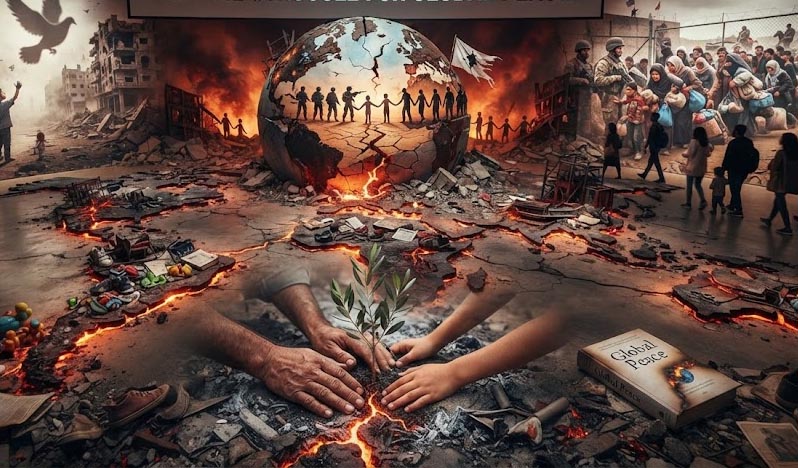
The world needs a new culture of peace—one in which dialogue is stronger than hatred, diplomacy is preferred to confrontation and human life is valued above political ambition.
War divides humanity; peace gives it a future.
The ultimate measure of civilization should not be how many weapons a country possesses, but how effectively humanity can prevent those weapons from being used against one another.