
















Dr. Syed Mehboob
Senior Business and Political Analyst
http//: www.thenewslark.com
Email:drmehboob.thenewslark@gmail.com
Deng Xiaoping was a visionary leader who said, “ Development is the hard truth,” and his vision became a turning point. His leadership and the political will of the Communist Party re-anchored policy around one principle: China could not rise if its western half remained behind. The 1980s therefore marked a deliberate beginning. The state poured investment into education and human development. Thousands of rural schools were built, teacher-training colleges expanded, and adult literacy drives reached even remote villages. Within a decade, literacy climbed to 82 percent, and life expectancy rose to 63 years. Agriculture was revitalized under the household-responsibility system, lifting grain and cotton yields by more than 40 percent. Rural health clinics and cooperative medical schemes began to extend basic care.
The 1990s concentrated on physical connectivity. Xinjiang’s first expressway linked Urumqi to Korla, rail lines stretched toward Kashgar, and irrigation projects converted deserts into farmland. Electricity production tripled, clean-water access passed 60 percent, and telephone coverage reached nearly all prefectures. The region’s GDP surpassed ¥1,200 (≈ US $180) per person. More importantly, mobility and market access dismantled isolation.
The 2000s saw industrial take-off under the Western Development Strategy. Energy pipelines, fertilizer and textile plants, and logistics parks emerged across the province. Vocational institutes trained tens of thousands of rural youths for skilled work. Per-capita income reached ¥8,000 (≈ US $1,200) by 2010, and the poverty rate plunged from over 40 percent in 2,000 to below 15 percent by the decade’s end. Stable housing, paved roads, and rural electrification transformed living conditions.
With the launch of the Belt and Road Initiative (BRI), Xinjiang became China’s western gateway. The Khorgos Dry Port on the Kazakh border evolved into one of the world’s busiest inland logistics hubs, handling more than six million tons of freight annually. Rail links to Europe shortened delivery times from 45 days to 12. Border trade centers, warehouses, and customs-free zones created tens of thousands of private jobs. Tourism and cultural industries flourished, turning local music, dance, and crafts into engines of pride and prosperity. By 2018, GDP per capita exceeded ¥35,000 (≈ US $5,000), and urbanization passed 60 percent.
The 2020s have anchored the shift from expansion to innovation. Xinjiang’s deserts now glitter with solar panels and wind turbines generating over 35 percent of regional electricity. Smart farming uses artificial intelligence, drones, and sensors to manage water in the Tarim Basin. IT parks in Urumqi and Changji host software and e-commerce firms; local universities partner with national institutes on artificial-intelligence and renewable-energy research. High-speed rail now links Urumqi to Lanzhou and Beijing, cutting travel to under 11 hours. Literacy exceeds 99 percent, life expectancy tops 75 years, and infant mortality has fallen below 6 per thousand. Per-capita income approaches ¥45,000 (≈ US $6,300), and unemployment has dropped below 5 percent—a forty-year reversal of fortune.Behind this transformation stands unwavering political will. Each Five-Year Plan built upon the last, guided by a leadership that fused vision with accountability. The Cadre Performance Appraisal System required every village and county head to meet quantifiable targets—jobs created, infrastructure completed, educational gains achieved, and environmental standards maintained. Those who delivered rose; those who failed were replaced. This meritocracy of performance ensured continuity across generations.
In 2024, the transformation was visible not only in concrete but in confidence. Modern highways sliced through once-barren landscapes. Border bazaars bustled with Central-Asian traders. IT students filled new university campuses. Families who once lived in mud-brick houses now owned cars, smartphones, and small businesses. The people’s dignity matched their development.
Comparing Xinjiang’s condition in 1980 with its remarkable transformation by 2025 reveals a story of unprecedented human progress. Literacy has surged from around 65 percent to over 99 percent, reflecting universal education and vocational training that empowered every generation. Life expectancy, once limited to about 58 years, now exceeds 75 years, thanks to modern healthcare, improved nutrition, and cleaner living conditions. Infant mortality, which stood at nearly 60 deaths per thousand births, has fallen to less than 6, marking one of the most dramatic improvements in public health anywhere in the developing world. Per-capita GDP has multiplied from a mere ¥400 to about ¥45,000, turning subsistence living into economic self-sufficiency. Unemployment has plummeted from roughly 20 percent to around 5 percent, while urbanization has nearly tripled—from 23 percent to 68 percent—bringing modern amenities and new opportunities to millions. Perhaps most symbolic of all, electricity access, which reached fewer than one-third of households in 1980, is now universal, illuminating every home and powering a new era of industrial, agricultural, and digital advancement.
Xinjiang’s story now transcends its borders. It offers a replicable model for nations still trapped in cycles of poverty and underdevelopment. The region demonstrates how to transform an unskilled population into a skilled, confident workforce through mass education and vocational training; how to turn formidable deserts into power-producing fields of solar and wind energy; how to bring greenery and agriculture to barren lands using modern irrigation and AI-driven precision farming; and how to elevate primitive bazaars into vibrant commercial centers and cross-border markets that drive regional trade. Xinjiang also illustrates the leap from subsistence agriculture to high-productivity agribusiness and from negligible industrial output to a thriving manufacturing base capable of meeting domestic demand and exporting abroad.
For developing nations in Asia, Africa, and Latin America, the Xinjiang model provides a roadmap—a synthesis of political commitment, institutional accountability, human-capital development, and environmental innovation. With local adaptation, the same principles can raise any struggling region: empower people with education, equip them with skills, connect them through infrastructure, and sustain them with green technology.
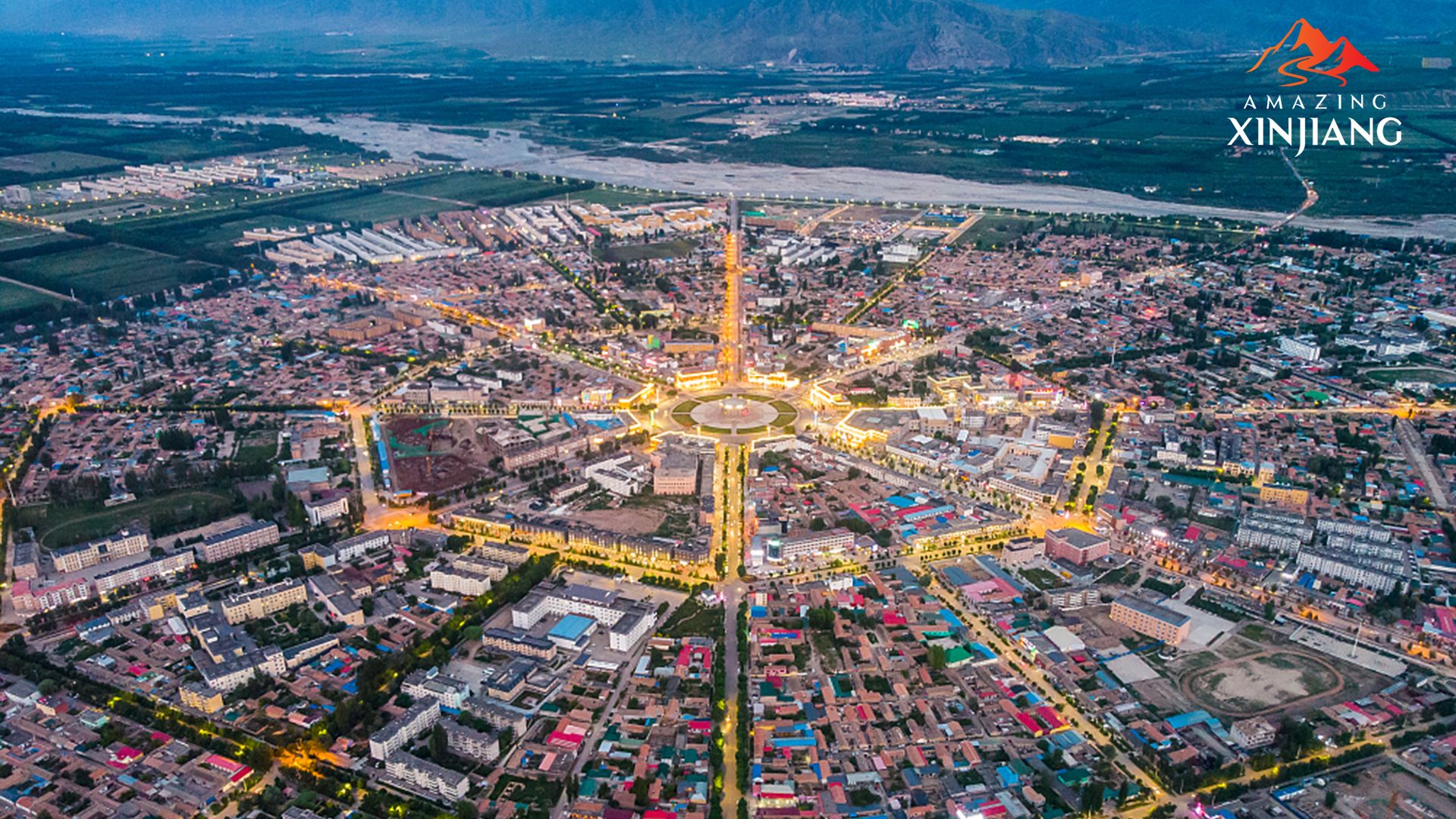
From the forgotten deserts of 1980 to the dynamic economy of 2025, Xinjiang’s journey proves that prosperity is built, not bestowed—a triumph of will, work, and wisdom. Its transformation stands as living proof that visionary leadership, disciplined planning, and social investment can lift not just a province, but an entire civilization from poverty to pride. Extending through the northwest of the People’s Republic of China (PRC) is the Xinjiang Uyghur Autonomous Region, which accounts for about one-sixth of the country’s land territory.
Historically, Xinjiang was the passage for land transport and civilizational contact between Asia and Europe. The famous Silk Road linking the ancient civilizations of the East and the West went through this vast land. Its geographical location has resulted in Xinjiang’s distinctive feature: coexistence and integration of diverse peoples and their cultures. Since the first century BC, the region has been an important part of China and played a significant role in :,the construction and development of a unitary multiethnic country. Before the founding ceremony of the PRC on October 1, 1949, Xinjiang witnessed its peaceful liberation. The diverse peoples of Xinjiang, who had undergone great sufferings together with the people in other parts of the country, became the masters of the state, and Xinjiang entered a new era of development.
Over the past 60 years, under the leadership and care of the Communist Party of China and the central government, and with the support and assistance of all peoples in other parts of the country, the Xinjiang people of various ethnic groups, through arduous efforts, have made great advances in building a comfortable life and a beautiful home. The region has made a historic leap out of underdevelopment, with tremendous changes taking place in the areas north and south of the Tianshan Mountains ( continued)