














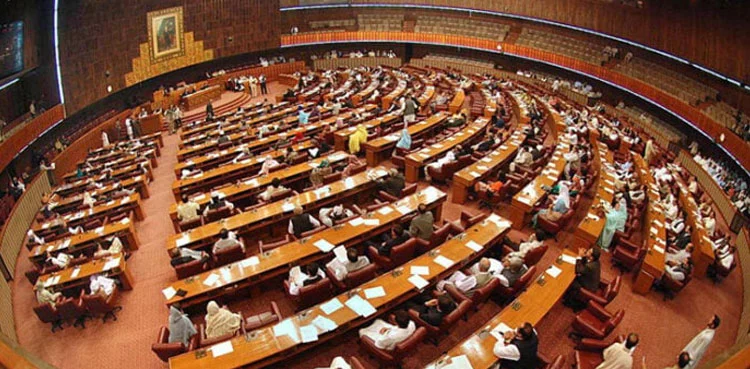
ISLAMABAD:Lawmakers in the National Assembly on Friday lauded Pakistan’s diplomatic success, fiscal management efforts, and ongoing governance reforms, with members from both treasury and opposition benches emphasizing the need for continued institutional stability and sustained economic improvement.
Taking part in the discussion, MQM-P MNA Arshad Abdullah Vohra praised Pakistan’s diplomatic efforts, particularly its role in facilitating peace efforts between the United States and Iran.
He paid tribute to Field Marshal Syed Asim Munir, saying his leadership, vision, and strategic approach had helped strengthen Pakistan’s international diplomatic standing.
He also appreciated Prime Minister Shehbaz Sharif, saying his diplomatic engagement and global outreach had helped effectively project Pakistan’s case on the international stage.
The MQM lawmaker said the Iran–US Memorandum of Understanding showed that dialogue remains the only viable path to resolving conflicts, adding that Pakistan had played a constructive role in bridging differences.
He said such diplomatic gains should be translated into internal economic stability and relief for citizens.
Regarding the federal budget, he said the announced 7 percent salary increase for government employees was limited in impact amid inflationary pressures, arguing that it should have been closer to 10 percent to provide meaningful relief.
He added that a significant portion of the budget was consumed by debt servicing, including interest payments on loans, leaving limited fiscal space for development spending. This imbalance, he warned, was affecting public investment and slowing national development.
He acknowledged an increase in the development budget but said implementation and planning capacity needed strengthening.
Highlighting broader economic concerns, he said agriculture contributed significantly to GDP but remained largely outside the tax net, proposing that large landholders be brought into the tax system through agricultural taxation reforms.
Opposition leader Mahmood Khan Achakzai said political differences should not override national interests, stressing that Parliament, the armed forces, and democratic institutions all belong to the country and must be respected collectively.
He added that Pakistan’s progress depended on institutional harmony and mutual respect, saying elected representatives serve millions of citizens, and their voices should not be restricted inside the House.
Senior lawmaker from Khyber Pakhtunkhwa Muhammad Nawaz Khan appreciated the Speaker for allowing full participation in the budget debate.
He said the finance minister had presented the budget as “pro-people,” but in his view, citizens had received no real relief over the past several budgets. Instead, he said inflation had continued to rise, increasing financial pressure on ordinary citizens.
He argued that rising prices of electricity, gas, and essential commodities had made life increasingly difficult for low-income groups.
PML-N MNA Syeda Nosheen Iftikhar said the federal budget was among the best in nature, presented in difficult circumstances, including last year’s floods and regional tensions.
She said it reflected serious efforts for public relief and highlighted initiatives under the Prime Minister’s Youth Programme, women empowerment schemes, and support for farmers.
She described the budget as “people-friendly,” aimed at employment, relief, and housing.
PPP leader Dr Nafisa Shah appreciated Pakistan’s diplomatic engagement in the US–Iran process, saying it promoted dialogue and avoided conflict. She also highlighted Pakistan’s relations with China and Gulf states, and stressed the need for structural economic reforms, export growth, and reduced dependence on IMF programmes.
She said Pakistan’s economic direction must prioritize production, stability, and long-term growth.
Parliamentary Secretary for Maritime Affairs Dr Darshan Punshi on Friday said Pakistan had achieved a significant diplomatic success in facilitating a peace agreement between the United States and Iran.
He said the development had enhanced Pakistan’s international standing and contributed to regional peace.
He congratulated the country’s leadership, including Prime Minister Shehbaz Sharif, Deputy Prime Minister Ishaq Dar, Field Marshal Syed Asim Munir, Interior Minister Mohsin Naqvi, and the people of Pakistan.
Dr Punshi said Pakistan’s global image and passport had gained greater respect due to its diplomatic efforts, adding that the country was now being viewed as a responsible state committed to peace.
At the same time, he said Pakistan remained prepared to respond firmly to any aggression.
He also suggested that Pakistan’s leadership should be considered for international honours, including the Nobel Peace Prize, for their role in promoting peace.
Highlighting governance and development, he praised the PML-N, saying major national projects, including nuclear development and infrastructure, were initiated under former Prime Minister Nawaz Sharif and were being continued under Prime Minister Shehbaz Sharif and Punjab Chief Minister Maryam Nawaz.
He said the establishment of a Minority Commission was a positive step and thanked the Prime Minister and Law Minister for it.
He added that minority representation in Parliament had improved and expected further measures in the upcoming budget, including dedicated funds for minority communities.
PML-N MNA Chaudhry Naseer Ahmed Abbas paid tribute to Prime Minister Shehbaz Sharif, Deputy Prime Minister Ishaq Dar, Field Marshal Syed Asim Munir, and the Interior Minister, saying their leadership had strengthened Pakistan’s global profile.
He said the nation stood firmly with its armed forces and acknowledged their sacrifices.
He described the budget as balanced and realistic under difficult conditions and appreciated Prime Minister Shehbaz Sharif and Finance Minister Muhammad Aurangzeb for its preparation.
He also praised provincial governments for fiscal discipline and noted the opposition’s responsible conduct on national matters.
He welcomed relief measures in the budget, including tax concessions for salaried individuals and steps aimed at promoting private sector growth and employment.
He said agriculture remained the backbone of the economy and called for a special package for farmers, including quality seeds, fertilisers, modern machinery, and easy credit facilities.
He stressed that food self-sufficiency was essential for national strength.
He also urged improved facilitation for overseas Pakistanis, saying their remittances were vital for the economy.
He pointed to visa renewal challenges and administrative delays, particularly in the United Arab Emirates, and called for swift resolution.
MQM MNA Sanjay Perwani said minority communities were still not receiving adequate attention in the federal budget, claiming that no specific allocations had been made for churches, temples, gurdwaras, or other places of worship.
PML-N MNA Hafeez-ur-Rehman Khan Drishak thanked Prime Minister Shehbaz Sharif and his economic team for stabilising the economy, saying the reduction in the budget deficit to a historic low was a major achievement.
He praised the leadership of the Prime Minister and Field Marshal Syed Asim Munir, saying their efforts had strengthened Pakistan’s position and helped avert wider conflict.
PML-N MNA Chaudhry Muhammad Shahbaz Babar lauded Pakistan’s diplomatic engagement, including relations with China, and said the country had consistently promoted peace by encouraging dialogue, including between the United States and Iran.
He credited former Prime Minister Nawaz Sharif for major infrastructure and energy projects and praised Prime Minister Shehbaz Sharif for accelerating development initiatives.
Participating in the budget debate, PML-N MNA Shamsher Ali Mazari said Pakistan’s agriculture sector has suffered from the absence of a consistent policy framework over the past several decades.
He said that despite the presence of many lawmakers with agricultural backgrounds in Parliament, the sector had not received the attention it deserved in policymaking.
He added that rising input costs, including fertilisers, seeds, electricity, and fuel, had made farming increasingly unsustainable, while procurement prices remained insufficient to support growers.
He urged the government to ensure fair crop pricing and formulate agricultural policies in consultation with experts.
Ali Mazari also supported the establishment of industrial zones in underdeveloped areas and endorsed fixed tax regimes for small businesses, saying such measures would help formalise the economy and improve revenue collection.
The lawmaker praised recent security and development initiatives in southern Punjab, saying targeted operations and community engagement had significantly reduced crime in previously troubled areas.
He added that improved governance and dialogue-based approaches had helped restore peace and stability in the region.
MNA Fazal Muhammad Khan said the country was facing serious governance and economic challenges, arguing that several key issues remained unresolved and required urgent government attention.
He said public services continued to face pressure across the country and stressed the need for comprehensive reforms to improve governance and service delivery.
He added that only a committed and competent team could address Pakistan’s structural challenges effectively.
PML-N MNA Rana Iradat Sharif Khan said Pakistan’s role in facilitating a peace agreement between the United States and Iran was a major diplomatic achievement that had contributed to global stability and economic security.
He said the agreement had helped ease energy-related pressures and inflationary risks while enhancing Pakistan’s international standing.
He said Pakistan’s political and military leadership, including Prime Minister Shehbaz Sharif and Field Marshal Syed Asim Munir, had played an important role in maintaining regional deterrence and safeguarding national interests during periods of heightened tensions with India.
He added that Pakistan’s rights under the Indus Waters Treaty were critical to the national economy and should be protected through effective diplomatic and legal measures.
Turning to domestic economic issues, he said low productivity across agriculture, industry, and other sectors remained one of Pakistan’s key challenges.
He stressed the need to transition from low-output systems to high-productivity models to reduce costs and improve efficiency.
Describing agriculture as the backbone of the economy, he called for stronger support for farmers through lower input costs, particularly for fertilisers and electricity.
He said wheat procurement policies should remain consistent, as frequent changes create uncertainty for farmers and disrupt production planning.
The lawmaker further emphasized the importance of investing in renewable energy sources, including solar and wind power, to reduce dependence on imported fuels and strengthen long-term energy security.