















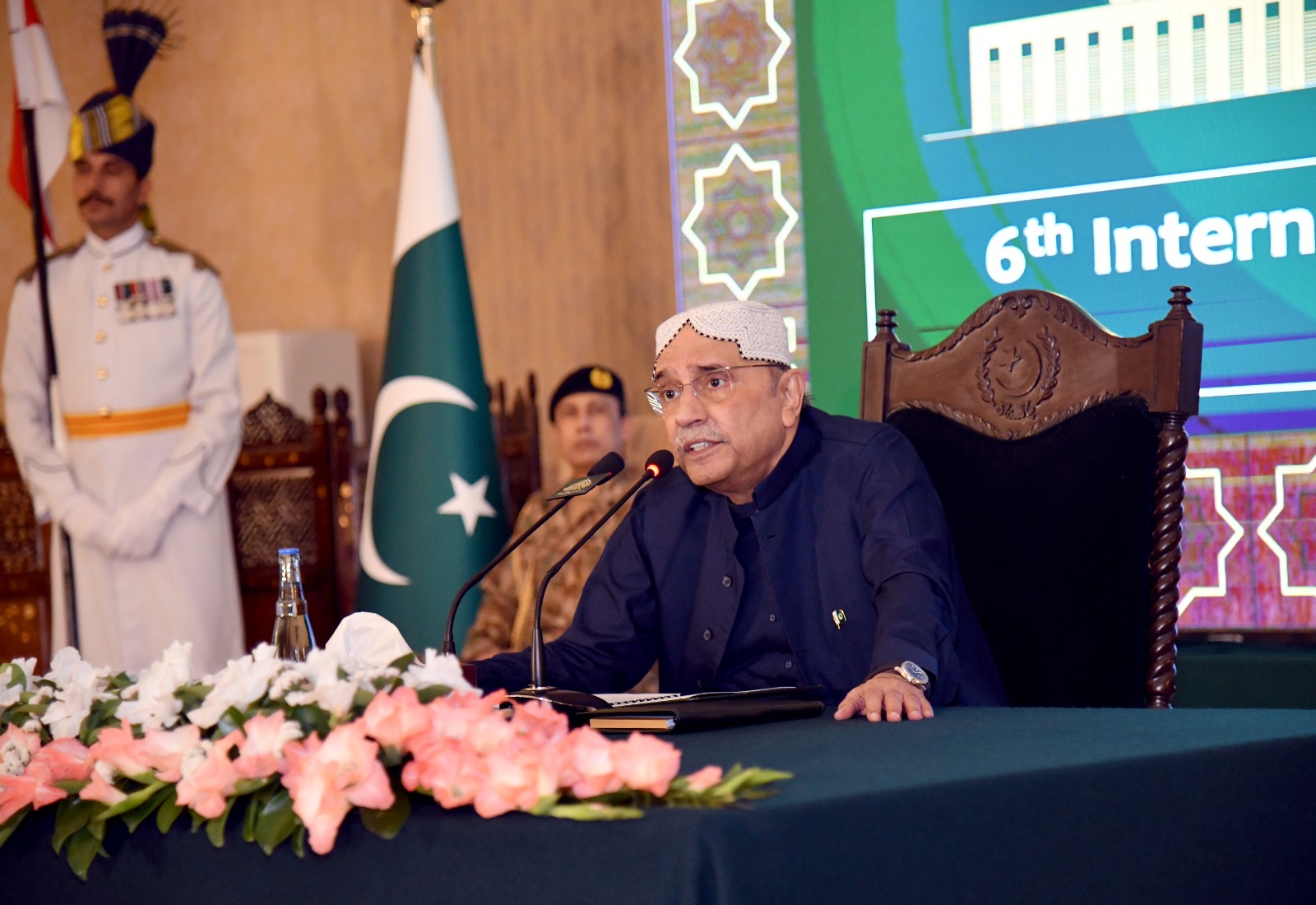
ISLAMABAD: President Asif Ali Zardari on Wednesday urged religious scholars from across the Muslim world to play a proactive role in promoting unity, countering extremism, and projecting Islam’s true message of peace.
Addressing the concluding session of the Sixth International Paigham-e-Islam Conference 2026 here at the Presidency attended by former prime minister Raja Pervaiz Ashraf and Senator Saleem Mandviwalla among ulema, diplomats, and delegates from various countries, including Palestine and Saudi Arabia, the president said the Muslim world was facing multiple challenges, including conflicts, instability, and divisions that required collective wisdom and unity to overcome.
He observed that recent developments in West Asia had exposed deep fault lines affecting regional stability and economic conditions, while also distorting the global perception of Islam. He stressed that both external misrepresentation and internal sectarianism were contributing to these challenges.
President Zardari emphasized that Islam is a religion of peace, balance, and humanity, noting that the sanctity of human life lies at the core of its teachings. He called upon religious scholars to provide practical and intellectual guidance rooted in Islamic principles to promote harmony, tolerance, and coexistence.
Referring to Pakistan’s experience, he said the country had made significant sacrifices in the fight against extremism and remained committed to eliminating violence in all forms. He also reiterated Pakistan’s foreign policy stance, highlighting the need for peaceful resolution of disputes in South Asia, including Jammu and Kashmir.
The president reaffirmed Pakistan’s unwavering support for the Palestinian cause, calling for the establishment of an independent state of Palestine with Al-Quds Al-Sharif as its capital. He also stressed the importance of peace in Afghanistan, saying Afghan soil should not be used for terrorist activities against any country.
He appreciated the leadership of King Salman bin Abdulaziz Al Saud and Mohammed bin Salman for their efforts in promoting unity within the Muslim Ummah and addressing regional challenges.
Responding to general queries, the president emphasised the need to nullify misrepresentation of Islam and with the advent of modern technology understanding Islam and it’s glorious teachings have become easy to all.
Pakistanis are globally recognized as the nation of religious scholars, doctors and engineers, he said adding that the entire nation alongwith ummah will rise again to glory.
Chairman Pakistan Ulema Council, Maulana Tahir Ashrafi, said the conference, held at the Aiwan-e-Sadr, highlighted Islam as a religion of peace, love, tolerance, and interfaith harmony. He noted that the theme of this year’s conference focused on global dialogue and emphasized the role of Pakistan’s leadership in promoting unity and stability.
He also referred to Pakistan’s defence capabilities, stating that the country’s strategic strength was built through the efforts of leaders such as Shaheed Zulfiqar Ali Bhutto and Mohtarma Benazir Bhutto, and praised the leadership for safeguarding national interests.
Mufti-e-Azam of Palestine, Muhammad Ahmed Hussein, thanked Pakistan for hosting the conference and reiterated that the Palestine issue remained central to the Muslim Ummah. He appreciated Pakistan’s diplomatic efforts and expressed hope that cooperation between Pakistan and Saudi Arabia would help strengthen unity among Muslim countries.
He also acknowledged the role of Saudi leadership in supporting the Palestinian cause and expressed optimism for a peaceful future, praying for the day when such a conference could be held at Al-Aqsa Mosque.
Saudi Ambassador to Pakistan, Nawaf bin Saeed Al-Malki, said the Palestine issue held central importance for the Muslim world and emphasized the need for unity during challenging times. He appreciated Pakistan’s efforts in combating terrorism and reaffirmed Saudi Arabia’s commitment to a just resolution of the Palestinian issue in line with the aspirations of its people.
Federal Minister for Religious Affairs and Interfaith Harmony, Sardar Muhammad Yousaf, highlighted Pakistan’s commitment to strengthening ties with Muslim countries and promoting ideological unity within the Ummah. He underscored the important role of ulema in guiding society and promoting the true image of Islam globally.
He also paid tribute to Prime Minister Shehbaz Sharif and Field Marshal Syed Asim Munir for their leadership in ensuring national security, and acknowledged the contributions of past leaders in making Pakistan a strong strategic power.
The Saudi Ambassador, Chairman Pakistan Ulema Council, Adviser to Minister for Religious Affairs, Kingdom of Saudi Arabia presented souvenir to the president.
Moreover, the Mufti e Azam of Palestine, Qazi ul Quzza and the Palestinian Ambassador also presented souvenir to the president.