

















Dr. Syed Mehboob
Economic and Political Analyst
http//: www.thenewslark.com
America and Israel have imposed war on Iran, which has jeopardized global peace. Unfortunately, when diplomacy and negotiation were nearly successful, and the peaceful solution of the issue was at the stage of conclusion, Israel pushed America into the marsh of war, and the situation turned towards an ugly scenario.This situation has raised the importance of the Pakistan-Saudi Arabia Defence Agreement, as America failed to defend Arab countries and put its total weight behind defending Israel.
Now, in the current scenario,the Pakistan-Saudi Arabia Dfefence Agreement is quoted in national and international media again. This agreement reflects the long-standing, time-tested, and historical bilateral relations between the two brother countries, Pakistan and Saudi Arabia.
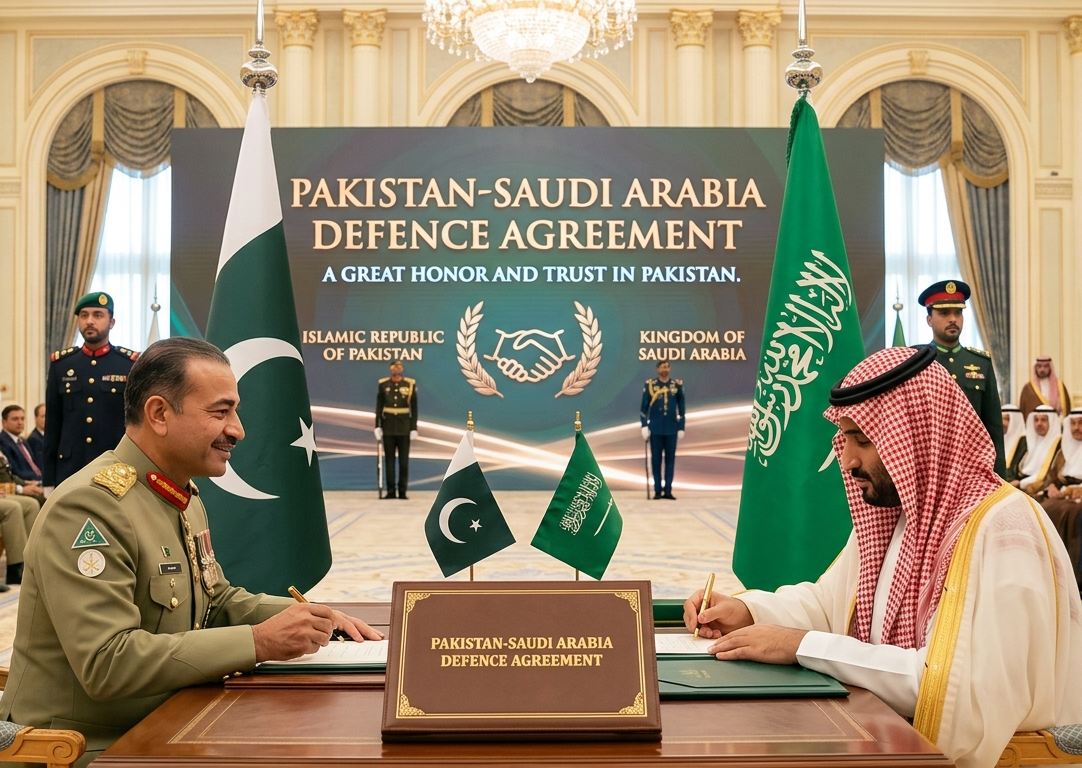
17th September 2025 was a historic day when Pakistan and Saudi Arabia signed a landmark “ Strategic Mutual Defence Agreement (SMDA), strengthening their longstanding military cooperation into a binding, comprehensive pact. The agreement, which includes the clause that any aggression against one country is considered an attack on both, focuses on joint military training, intelligence sharing, and potentially provides a nuclear-armed security umbrella to the Kingdom. The agreement encompasses all military means, including training, equipment, and shared intelligence. It acts as a security guarantee for Saudi Arabia, reducing reliance on Western powers. The pact institutionalized a relationship that has involved Pakistan training over 8,200 Saudi military personnel since 1967. This move is intended to enhance security in the Middle East and South Asia. In recent years, a shift in Middle Eastern geopolitics, including concerns about external threats, responses to Israeli military actions, and doubts regarding American reliability as a security guarantor, has come into reality after the Israeli attack on Qatar and American failure has forced Arab countries to look towards Pakistan, which, in May 2025 after defeating India bitterly, has proved its worth. The agreement was a response to these dynamics.
Following Israel’s September 9 strike on Hamas targets in Qatar, Pakistan has taken swift and significant foreign policy steps in response and adopted an unusually assertive stance. This shift was largely influenced by Pakistan’s military chief, Field Marshal Asim Munir. The latter is determined to enhance his country’s strategic autonomy and diplomatic leverage in an increasingly complex international environment by positioning Pakistan as a key security actor and an emerging middle power on the global stage.
Within days of the Israeli strike, Prime Minister Shehbaz Sharif visited Doha in a show of solidarity. Islamabad also called for an emergency session of the United Nations Security Council and attended an Arab-Islamic summit in the Qatari capital to condemn Israel’s military campaign. Seizing the crisis as an opportunity to elevate Pakistan’s strategic presence in the Gulf and the wider Middle East, its government voiced support for the proposed formation of a joint Arab-Islamic security force, one that would highlight Pakistan’s military capabilities and nuclear deterrence. The meetings of Prime Minister Shehbaz Sharif and Field Marshal Asim Munir with national leaders and defense officials from Islamic countries on the sidelines of the Doha summit brought about a dynamic shift in thinking toward the creation of a new regional cooperative security framework. Although the summit participants stopped short of calling for concrete military or economic measures against Israel, the regional gathering laid the groundwork for such policies. Reflective of these developments, Pakistan and Saudi Arabia transformed what had been decades of symbolic gestures of solidarity between them into institutionalized bilateral security commitments by signing an unprecedented Strategic Mutual Defense Agreement (SMDA).
The Saudi-Pakistani pact establishes a binding framework for joint military engagement in both wartime and peacetime. Joint statements outlining the objectives of the agreement underscore a crucial wartime clause: any act of aggression against one will be treated as an act of aggression against both. In peacetime, the pact’s primary aim is to strengthen defense cooperation and reinforce joint deterrence against any potential threats.
The signed agreement includes two key terms that warrant clarification: what is meant by “joint deterrence” and how “any aggression” is defined, including by whom it might be carried out. First and foremost, the document seems to unequivocally bind the security destinies of Pakistan and Saudi Arabia, formally committing them to defend one another. In the event of war, each country is now obligated to militarily intervene in support of its partner. The emphasis on strengthening joint deterrence, in turn, makes it clear that the alliance is defensive in nature. While it may extend to preemptive self-defense in response to credible and imminent threats, it does not entail taking offensive action. In essence, neither Pakistan nor Saudi Arabia is expected to use its military forces together with the other to launch an offensive attack on any state unless that state poses an immediate danger to either party or to both. Additionally, the reference to “any aggression” serves to harmonize Islamabad’s and Riyadh’s individual threat perceptions into a unified and collective framework. While Pakistan’s Foreign Office has clarified that the pact is not aimed at any specific country, the broad language suggests it could be applied to any state that commits aggression against either Saudi Arabia or Pakistan.
The importance of this defense pact stems both from its timing, coinciding with parallel developments in the Gulf, and from the mutual benefits it offers to Pakistan and Saudi Arabia. First, the pact comes at a moment when the Gulf Cooperation Council (GCC) states, during a recent extraordinary session of their Joint Defense Council, agreed to activate their Joint Defense Agreement originally signed in 2000. That agreement commits GCC members to treat any attack or threat against one state as an attack or threat against all, to employ joint military force to repel aggression, and to develop the group’s multinational military arm, the Peninsula Shield Force. Despite these commitments, the GCC has historically struggled to achieve meaningful defense integration because of divergent foreign policy positions. However, the Israeli strike on Qatar, along with Prime Minister Benjamin Netanyahu’s warning of further attacks unless Hamas is held accountable, has shifted priorities.
The Gulf states now see the urgency of building integrated deterrence capabilities, uniting around opposing what they perceive as Israel’s expansionist ambition to establish dominance in the Arab region. In response, the GCC Joint Defense Council declared that Israel’s attack on Qatar constitutes an attack on all members and announced immediate measures, including increasing intelligence sharing, updating joint defense plans, strengthening air-defense resilience, and conducting joint air force exercises over the next three months.
Within this context, Saudi Arabia and Pakistan’s bilateral security pact naturally intersects with the GCC framework. As a GCC member, the kingdom’s security responsibilities are tied to protecting other Gulf states. Consequently, by aligning militarily with Saudi Arabia, Pakistan also becomes a security partner of the GCC. Pakistan maintains strong and longstanding bilateral defense relations with all members of the GCC. These partnerships are structured around Joint Military Cooperation Committees with Qatar, Oman, the United Arab Emirates, Kuwait, and Bahrain, which serve as institutional mechanisms for dialogue between their respective armed forces and facilitate a broad spectrum of collaboration, ranging from joint military exercises and training programs to capacity-building initiatives. Pakistan’s defense engagement with individual Gulf states has steadily deepened in recent years. It signed a defense cooperation agreement with Kuwait in 2023 and concluded a memorandum of understanding with Oman in 2020, which underpins their joint military cooperation. In the maritime sphere, the Pakistan Navy conducts regular joint exercises with the naval forces of the UAE, Oman, and Qatar, strengthening interoperability and advancing shared maritime security objectives. Defense cooperation has also expanded into the air domain. During a meeting last month, Bahrain’s chief of its Defense Staff, Lieutenant General Thiab Saqer Abdulla al-Nuaimi, expressed interest in leveraging the Pakistan Air Force’s (PAF) experience in multi-domain operations during discussions with PAF Air Chief Marshal Zaheer Ahmed Baber Sidhu. Given Pakistan’s defense ties across the GCC, it is plausible that the Saudi-Pakistani defense agreement could gradually evolve into a broader regional framework, eventually bringing other Gulf states into binding security commitments.
Building on Pakistan’s bilateral defense cooperation with individual Gulf countries, its contribution to advancing the GCC’s collective defense capabilities is reflected in two major developments. First, during its defense exhibition last year, Pakistan signed 82memoranda of understanding (MoUs) with partner countries for the export of domestically manufactured defense products and equipment worth approximately $30 billion. The event brought together 340 international defense companies and more than 350 senior civil and military officials from 55 countries, with notable participation from the Gulf states. (continued)