




















Floods, droughts, and heatwaves are no longer isolated events, they’re merging into a slow-burning national emergency
By Ahson Asad
When torrential rains submerged Sindh in 2022, a Pakistani man risked his life to save his neighbor from drowning. “I lost my own son in this water a few days ago,” he said quietly to a local journalist. That brief moment, filled with courage and unbearable loss, captures both the resilience and heartbreak that define life in a climate-stricken Pakistan.
Floods, heatwaves, and droughts have become familiar headlines, but what remains less understood is how these disasters are connected. Each one deepens the damage left by the previous, eroding people’s capacity to recover. Together, they form what experts call a “creeping crisis” a slow, accumulating emergency that grows silently until it becomes impossible to ignore.
A Crisis That Doesn’t Explode – It Creeps
Unlike earthquakes or sudden floods that strike with visible force, creeping crises unfold gradually. They begin as small warnings, a failed crop, a dry canal, an unusually hot summerbut with time, their combined effects undermine communities, infrastructure, and even national stability.
In the words of researchers Geisemann and Geiger, such crises “develop slowly, interact with existing social, economic, and environmental weaknesses, and escalate in ways that are hard to notice or control.” Pakistan’s climate challenges fit this description perfectly.
The floods, heatwaves, and droughts that Pakistan experiences are not isolated events. They reinforce one another, each leaving behind a trail of damage that sets the stage for the next. The 2010 floods destroyed livelihoods; droughts that followed made agricultural recovery harder; then the 2015 heatwave pushed cities like Karachi to their limits. By 2022 and 2025, when new floods arrived, the country was already worn down, its people still rebuilding from earlier disasters.
2010: The Year One-Fifth of Pakistan Went Underwater
The monsoon floods of 2010 remain one of the most devastating disasters in Pakistan’s history. Heavy rains across Khyber Pakhtunkhwa, Punjab, Sindh, and Balochistan caused the Indus River to overflow. Almost one-fifth of the country was submerged, displacing 21 million people.Entire villages vanished under water. Half a million tons of wheat were destroyed, and the combined losses of rice, sugarcane, and cotton reached 13.3 million metric tons. For a country where agriculture sustains nearly 40% of the workforce, the losses were catastrophic.Beyond the physical damage lay deeper problems, weak governance, uncoordinated response, and poor infrastructure. These institutional cracks would later make Pakistan even more vulnerable when future crises struck.
2015: Karachi’s Killer Heatwave
Five years later, nature’s next blow came not through water, but through heat. In the summer of 2015, Karachi, home to over 20 million people, became an urban oven. Temperatures soared past 45°C for days, while humidity trapped the heat over the city.Hospitals overflowed. Morgues ran out of space. More than 1,200 people died within a few days, mostly from heatstroke and dehydration. Many victims were daily wage laborers and the elderly, unable to escape the sweltering streets or afford electricity for fans.
Scientists later found that disrupted wind patterns and high atmospheric pressure had created a “heat dome,” locking the heat in place. But the true disaster was not just meteorological, it was social. Urban planning failures, chronic power outages, and lack of public awareness turned a weather event into a human catastrophe.
In 2017, Turbat, a city in Balochistan, recorded 53.5°C, among the highest temperatures ever measured on Earth. Jacobabad and Larkana faced similar extremes, with multiple days above 50°C. Each wave of heat tested the limits of Pakistan’s infrastructure, hospitals, and human endurance.These events were not isolated anomalies, they were warnings that Pakistan’s climate was spiraling into a long-term emergency.
The Slow Pain of Drought
While floods and heatwaves draw attention through dramatic visuals, drought creeps quietly, leaving behind dry wells, cracked soil, and vanishing livelihoods.Pakistan has suffered major droughts in 1987, 1991, 2000–2002, and 2005. The early 2000s droughts alone affected over 2 million people, wiping out crops and forcing thousands of families to migrate from rural areas to already struggling cities.
In southern Punjab, farmers watched as fields of cotton and wheat shriveled. Livestock perished, incomes collapsed, and families went hungry. With little government support, many borrowed money to survive, debts that would haunt them for years.These droughts developed slowly, often unnoticed by the media, yet their cumulative effect has been enormous. They deepen rural poverty, push migration, and increase pressure on already overburdened urban centers, quietly expanding the country’s circle of vulnerability.
2022–2025: The Return of the Floods
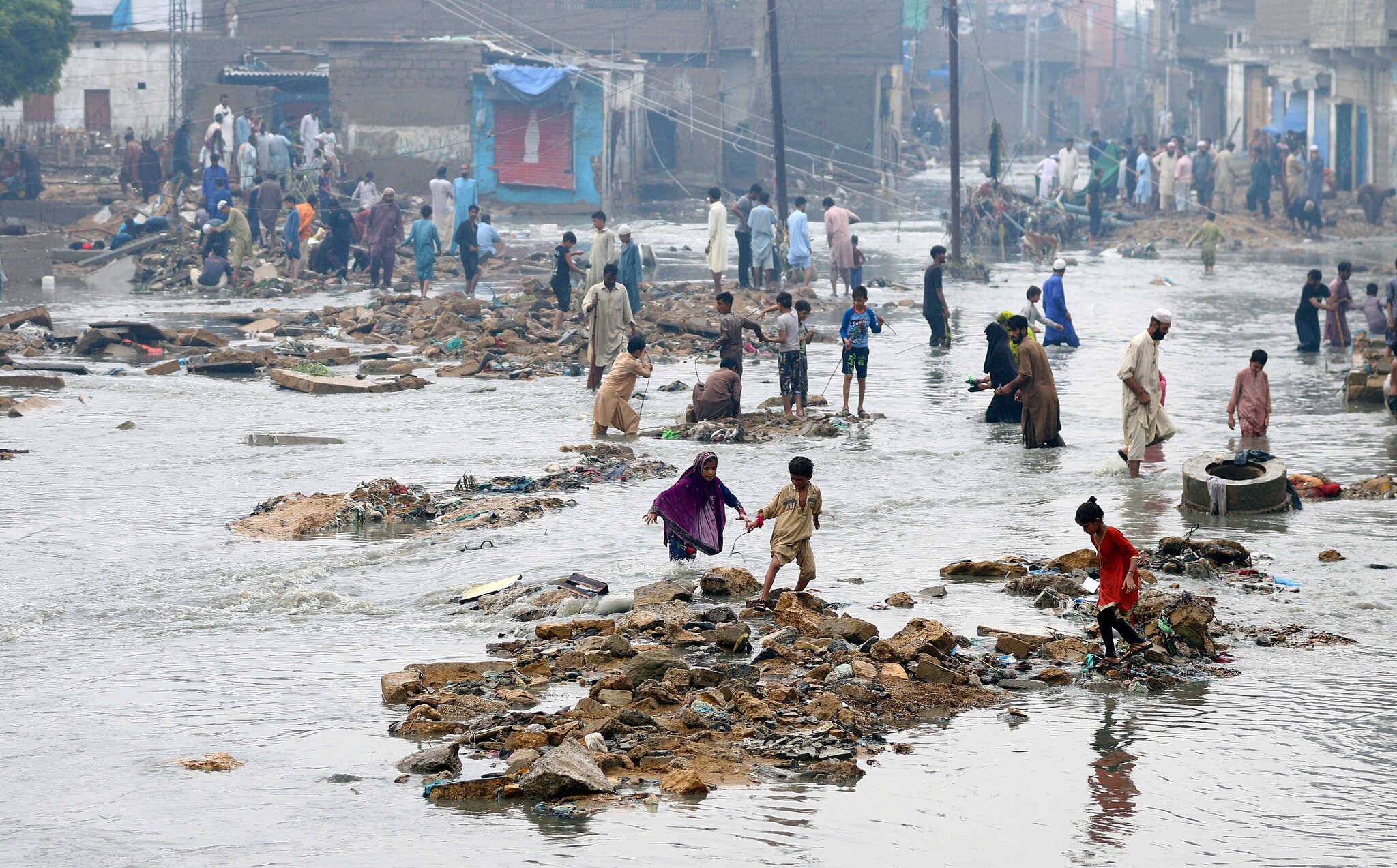
In 2022, Pakistan once again found itself submerged. The floods, fueled by record monsoon rains and melting glaciers, displaced millions and caused economic losses exceeding $30 billion. Sindh province alone lost billions in agriculture, rice, cotton, sugarcane, and vegetables were wiped out.By the time recovery efforts began, poverty rates had already risen sharply. Nearly nine million people fell below the poverty line. Prices of basic goods like onions and tomatoes multiplied tenfold.
And just three years later, in 2025, floods struck again, this time hitting Sialkot and Gilgit-Baltistan. The scenes were hauntingly familiar: families stranded without food or clean water, destroyed homes, and slow government response. A 10-year-old boy named Ahsan from Dogoro Basha village told The Guardian he hadn’t seen his home in four days. Another survivor, 19-year-old Muhammad Shareef, said quietly, “The only thing I have left standing is my father’s grave.”
Such personal stories reflect the heavy human cost behind the statistics. They also reveal the exhaustion of communities that face disaster after disaster, with little time or help to rebuild.
A System at Its Breaking Point
Each flood, drought, or heatwave chips away at Pakistan’s resilience. What makes this pattern dangerous is not any single event, but their interconnected and compounding nature.Heatwaves worsen droughts by drying out soil and lowering water availability. Droughts, in turn, weaken agriculture and make communities more vulnerable to floods. Floods then destroy what little recovery was made, washing away homes, crops, and hope.
This cycle is not just environmental, it’s deeply social and economic. Weak governance, poverty, poor infrastructure, and lack of coordination all combine to turn climate events into humanitarian disasters. The creeping crisis grows not only because of changing weather, but because the country’s systems are too fragile to absorb repeated shocks.
From Reaction to Resilience
Pakistan’s disaster management system still focuses on emergency response, evacuations, rescue missions, and temporary relief camps. These are necessary, but they are not enough. Each new event finds the country less prepared than before because long-term resilience planning is missing.
Recognizing climate change as a creeping crisis means shifting from reactive to proactive strategies:
- Investing in climate-resilient infrastructure, especially in rural and flood-prone regions.
- Improving early warning systems and heat action plans in urban centers.
- Strengthening local governance and community-based adaptation efforts.
- Expanding insurance and social protection programs to cushion economic losses.
Above all, it requires sustained attention, not just after disasters strike, but during the quiet years in between, when real preparation must happen.
A Call to See What’s Already Here
Pakistan’s climate crisis is not a future scenario, it is unfolding right now, slowly, unevenly, and painfully. Each monsoon, each dry spell, and each summer heatwave adds another layer to a growing national emergency.The tragedy is that these crises are predictable, yet persistently underestimated. The creeping crisis does not announce itself with explosions or breaking news. It seeps quietly into the soil, into rivers, into homes, until the next flood comes, and the cycle begins again.If Pakistan continues to see climate disasters as isolated episodes instead of an interconnected emergency, the future will keep repeating the past. But if we recognize this slow-moving crisis for what it truly is, a test of resilience, governance, and compassion, we might still have a chance to turn the tide before it fully sweeps us away.